Twelve questions across ratios, exact values and identities, with full worked proofs, including the tan/cot identity that yields to a single substitution.
Lesson 4 of 4
4 min read
How to use this set
These twelve questions cover the whole chapter: ratios from a triangle, the exact values, and identities. When you prove an identity, work on one side only, and jot the reason for each step in a word or two, such as "Pythagoras", "reciprocal" or "common denominator". If a proof lands on the other side with no reasoning shown, the examiner can give method marks only if your steps are easy to follow. So make them easy to follow.
Section A: Ratios
In right triangle ABC with the right angle at C, AB=26 and BC=10. Find sinA, cosA, tanB.
sinθ=419. Find cosθ and cotθ.
tanA=3512. Evaluate sinA−cosAsinA+cosA.
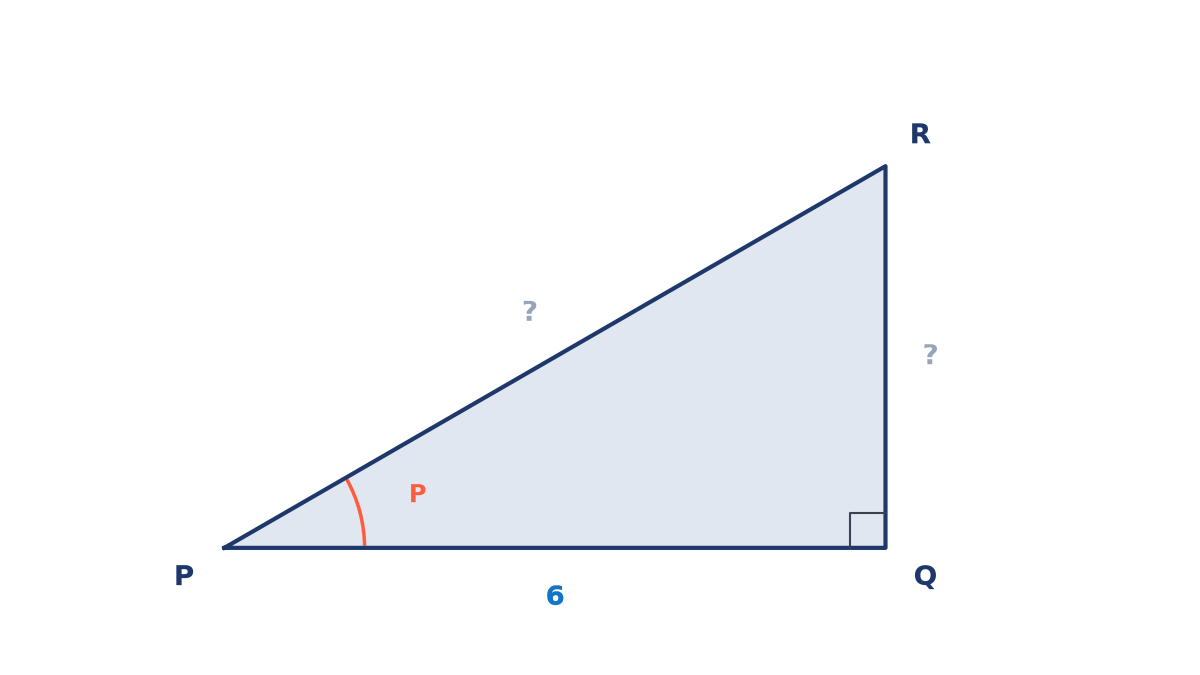
In right triangle PQR with the right angle at Q, tanP=31 and PQ=6. Find QR and PR.
Question 1: triangle ABC with AB = 26 and BC = 10Question 4: triangle PQR with PQ = 6
Find the acute angle θ for which sinθ=cosθ, and the one for which 2sin2θ=23.
If cos(A+B)=0 and sin(A−B)=21, with A>B and both angles acute, find A and B.
Section C: Identities
Prove 1−cotθtanθ+1−tanθcotθ=1+secθcosecθ.
Prove (sinA+cosecA)2+(cosA+secA)2=7+tan2A+cot2A.
Prove 1−sinA1+sinA=secA+tanA, for acute A.
If sinθ+cosθ=2, find tanθ+cotθ.
Answers
Show answers
AC=676−100=24. So sinA=ABBC=2610=135, cosA=2624=1312, and tanB=BCAC=1024=512.
The adjacent side is =1681−81=40. So cosθ=4140 and cotθ=940.
Divide the top and bottom by cosA: tanA−1tanA+1=−35233547=−2347.
tanP=PQQR, so QR=36=23, and PR=36+12=48=43. (Angle P is 30∘, which fits: the hypotenuse is twice the opposite side.)
41+43=1, and 3−4=−1.
The numerator is 4−4+43+0=43 and the denominator is 4, so the value is 163.
sinθ=cosθ means tanθ=1, so θ=45∘. For the second, sin2θ=43, so sinθ=23 and θ=60∘.
A+B=90∘ and A−B=30∘, so A=60∘ and B=30∘.
Let t=tanθ, so that cotθ=t1. Then LHS =1−t1t+1−tt1=t−1t2−t(t−1)1=t(t−1)t3−1=t(t−1)(t−1)(t2+t+1)=tt2+t+1=t+1+t1=tanθ+cotθ+1. And tanθ+cotθ=sinθcosθsin2θ+cos2θ=secθcosecθ. So LHS =1+secθcosecθ.
Expand both brackets: sin2A+2+cosec2A+cos2A+2+sec2A=1+4+(1+cot2A)+(1+tan2A)=7+tan2A+cot2A.
Multiply inside the root by 1+sinA1+sinA: 1−sin2A(1+sinA)2=cos2A(1+sinA)2=cosA1+sinA=secA+tanA (which is positive for acute A).
Square both sides: sin2θ+cos2θ+2sinθcosθ=2, so 2sinθcosθ=1 and sinθcosθ=21. Then tanθ+cotθ=sinθcosθ1=2. (And indeed θ=45∘.)
Test yourself
Trigonometry: Mixed Practice, Quiz
Five questions on the whole Introduction to Trigonometry chapter. Pick one answer for each.