The three identities and their proofs from Pythagoras, the rearranged forms worth knowing by sight, the difference-of-squares trick with sec and tan, and the routine for proving an identity without assuming it.
Lesson 3 of 4
5 min read
6 practice questions
What an identity is
An identity is an equation that holds for every angle at which both sides make sense. Three identities link the six trigonometric ratios, and all three are really just Pythagoras dressed up. In this lesson we prove them and then learn the routine for proving other identities. Pay attention to that routine, because identity proofs carry more marks than anything else in this chapter.
The three identities
sin2A+cos2A=1 1+tan2A=sec2A 1+cot2A=cosec2A
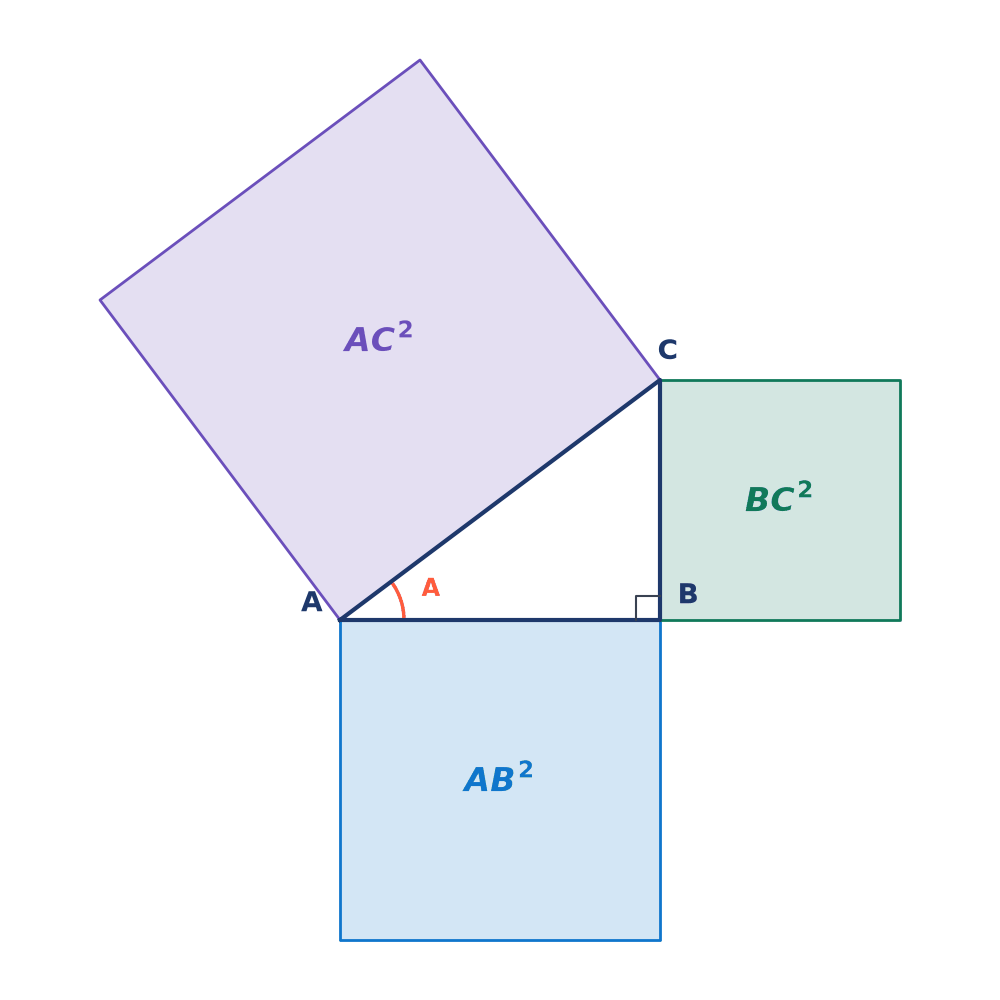
Proof of the first. In right triangle ABC with the right angle at B, Pythagoras says AB2+BC2=AC2. Now divide every term by AC2:
Pythagoras in triangle ABC, the source of all three identities
(ACAB)2+(ACBC)2=1⟹cos2A+sin2A=1
The second comes from dividing AB2+BC2=AC2 by AB2 instead, which gives 1+tan2A=sec2A. The third comes from dividing by BC2, giving cot2A+1=cosec2A.
The second one holds for 0∘≤A<90∘ and the third for 0∘<A≤90∘, because tan90∘ and cot0∘ are not defined.
The last two factorise as a difference of squares: (secA−tanA)(secA+tanA)=1. In other words, secA−tanA and secA+tanA are reciprocals of each other. Keep that in your back pocket; it opens up several standard proofs.
Expressing one ratio in terms of another
Example 1. Write tanA and secA in terms of sinA.
Since cosA=1−sin2A, we get tanA=1−sin2AsinA and secA=1−sin2A1.
Proving identities: the routine
Begin with the side that looks more complicated. If you get stuck, rewrite everything in terms of sin and cos. Keep working on that one side until it turns into the other. And never shift terms across the equals sign: doing that quietly assumes the very thing you're trying to prove.
Example 2. Prove (sinθ+cosθ)2=1+2sinθcosθ.
LHS =sin2θ+2sinθcosθ+cos2θ=1+2sinθcosθ= RHS.
Example 3. Prove 1+cosθ1−cosθ=(cosecθ−cotθ)2.
Here the right side is the busier one, so start there. RHS =(sinθ1−sinθcosθ)2=sin2θ(1−cosθ)2=1−cos2θ(1−cosθ)2=(1−cosθ)(1+cosθ)(1−cosθ)2=1+cosθ1−cosθ= LHS.
That first step, multiplying by the conjugate, is the move to reach for whenever you see a denominator like 1±sin or 1±cos.
An identity used to find a value
Example 6.tanθ+secθ=p. Show that sinθ=p2+1p2−1.
Because (secθ−tanθ)(secθ+tanθ)=1, we know secθ−tanθ=p1. Add this to secθ+tanθ=p and you get 2secθ=p+p1=pp2+1. Subtract instead and you get 2tanθ=p−p1=pp2−1. Finally, sinθ=secθtanθ=p2+1p2−1.
Practice
Prove each identity, or find the value asked for.
The first factor is sinθ1−sin2θ=sinθcos2θ. The second is cosθsin2θ. The third is sinθcosθsin2θ+cos2θ=sinθcosθ1. Multiply them: sinθcosθ⋅sinθcosθcos2θsin2θ=1.
Over a common denominator: (1+cosθ)sinθsin2θ+(1+cosθ)2=(1+cosθ)sinθsin2θ+1+2cosθ+cos2θ=(1+cosθ)sinθ2+2cosθ=sinθ2.
cotA=sinAcosA=sinA1−sin2A.
7sin2θ+3(1−sin2θ)=4 gives 4sin2θ=1, so sinθ=21. Then θ=30∘ and tanθ=31.
LHS =secA1+secA=cosA+1. RHS =1−cosA1−cos2A=1−cosA(1−cosA)(1+cosA)=1+cosA. The two sides match.
Test yourself
Trigonometric Identities, Quiz
Five questions on trigonometric identities. Pick one answer for each.