Exact values derived from an isosceles right triangle and a halved equilateral triangle, the limiting cases at 0° and 90°, the table and a pattern to remember it, evaluating expressions, and finding an angle from a value.
Lesson 2 of 4
4 min read
6 practice questions
Five angles worth knowing by heart
For five special angles, 0∘, 30∘, 45∘, 60∘ and 90∘, the trigonometric ratios can be written down exactly, with no calculator. In this lesson we get all of them from two triangles you can draw in a few seconds, arrange them in the table you'll use for the rest of the chapter, and try the kinds of evaluation and angle-finding questions that depend on it.
45∘ from an isosceles right triangle
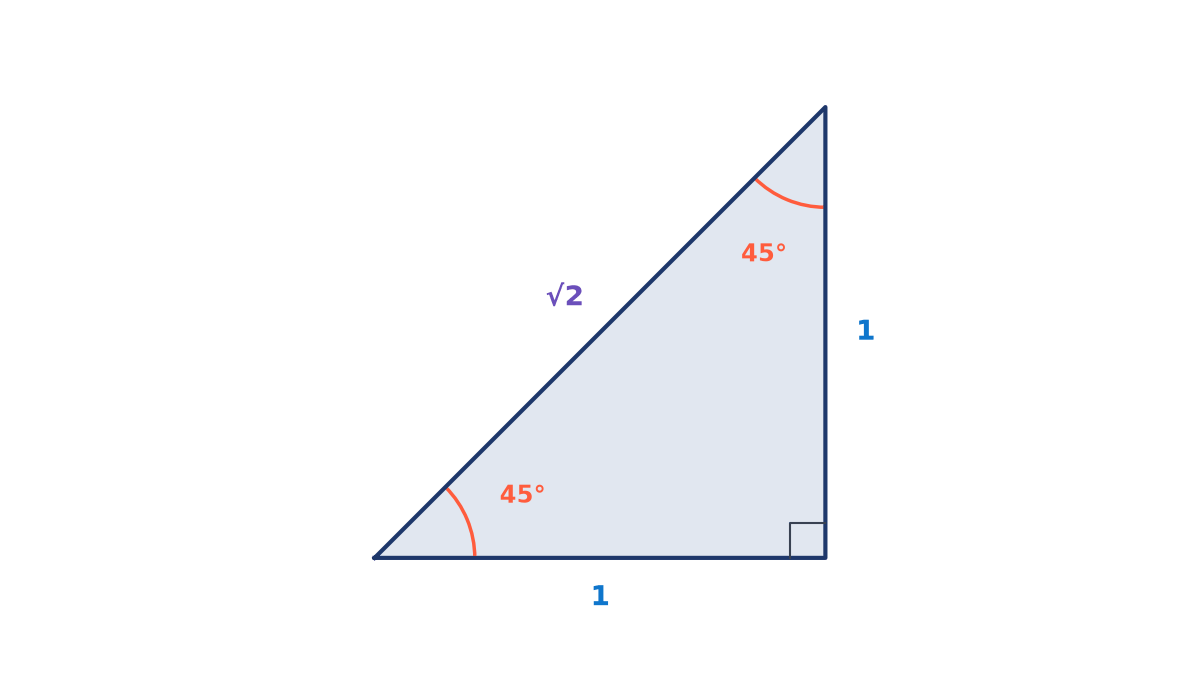
Draw a right triangle with both legs equal to 1. Both its acute angles are 45∘, and its hypotenuse is 2.
sin45∘=21,cos45∘=21,tan45∘=1
The 45° triangle: legs 1, hypotenuse √2
30∘ and 60∘ from an equilateral triangle
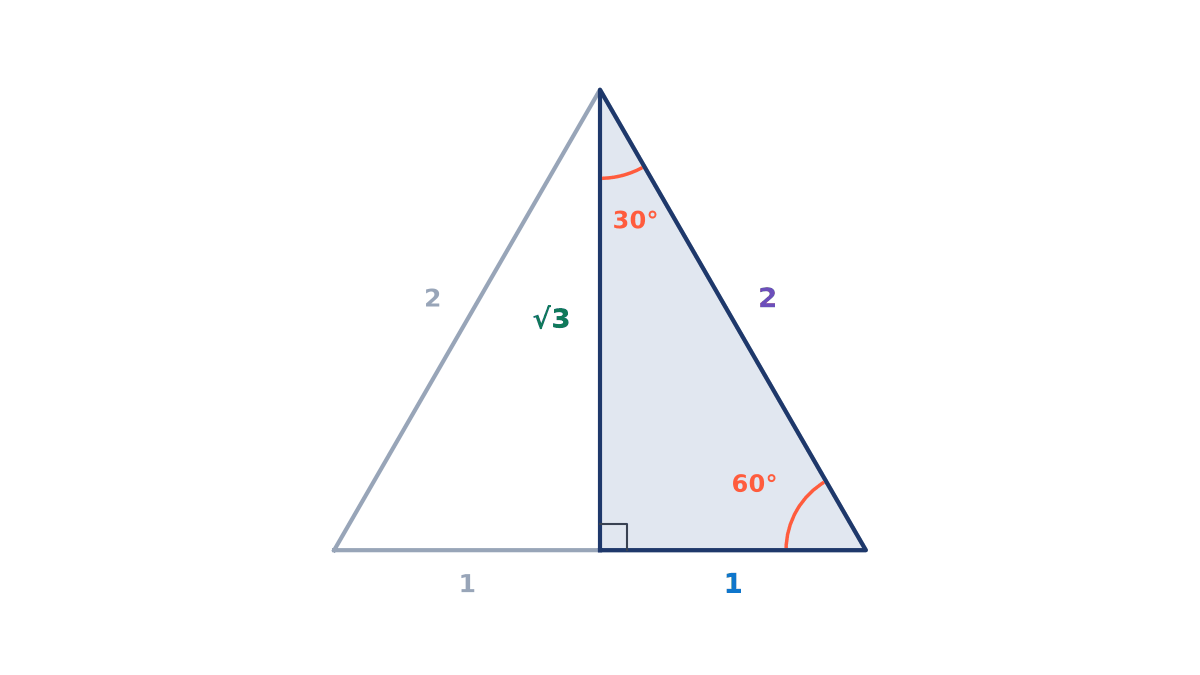
Now draw an equilateral triangle of side 2 and drop a perpendicular from the top vertex to the base. It cuts both the base and the angle in half. What you get is a right triangle with hypotenuse 2, one leg 1, and angles 30∘ and 60∘. Pythagoras gives the other leg as 3.
Half an equilateral triangle: the 30° and 60° triangle
The leg of length 1 sits opposite the 30∘ angle:
sin30∘=21,cos30∘=23,tan30∘=31
And the leg of length 3 sits opposite the 60∘ angle:
sin60∘=23,cos60∘=21,tan60∘=3
0∘ and 90∘ as limits
Imagine the angle A getting smaller and smaller, closing towards 0∘. The opposite side shrinks to nothing, and the adjacent side becomes the hypotenuse. So sin0∘=0, cos0∘=1, tan0∘=0. Now let A open up towards 90∘, and the roles swap: sin90∘=1, cos90∘=0, and tan90∘ is not defined, because you'd be dividing by zero. For the same reason, cot0∘, sec90∘ and cosec0∘ are not defined.
The table
0∘
30∘
45∘
60∘
90∘
sin
0
21
21
23
1
cos
1
23
21
21
0
tan
0
31
1
3
not defined
Here's an easy way to remember the sine row: 0/2,1/2,2/2,3/2,4/2. The cosine row is the same list read backwards. The other three ratios are just reciprocals, for instance cosec30∘=2, sec60∘=2, cot45∘=1.
Evaluating expressions
Example 1.2sin30∘cos30∘=2⋅21⋅23=23. (That happens to equal sin60∘. It isn't luck, but the reason belongs to a later class.)
Example 5. If tanA=31 and A is acute, then straight from the table, A=30∘.
Example 6.sin(A+B)=1 and cos(A−B)=23, with A+B≤90∘ and A>B. Find A and B.
From sin(A+B)=1 we get A+B=90∘, and from cos(A−B)=23 we get A−B=30∘. Adding the two, 2A=120∘, so A=60∘ and B=30∘.
A warning about a tempting mistake
Please don't fall into this trap: sin(A+B) is notsinA+sinB. Try it. sin(30∘+60∘)=sin90∘=1, but sin30∘+sin60∘=21+23≈1.37. In the same way, sin60∘=2sin30∘: the left side is 23≈0.87 and the right side is 1.
(a) False, since 21=3. (b) True: tan=sin/cos always holds, and here both sides are 1. (c) True: the left side is 1, and the right side is 2⋅21⋅21=1.
Test yourself
Ratios of 0°, 30°, 45°, 60° and 90°, Quiz
Five questions on ratios of standard angles. Pick one answer for each.