The six ratios of a right triangle, why each depends only on the angle, the bounds on sine and cosine, and the scale-factor method for finding all six ratios from any one of them.
Lesson 1 of 4
5 min read
6 practice questions
The idea behind trigonometry
Here is a small fact with big consequences. In a right-angled triangle, the ratio of any two sides depends only on the acute angle, not on how big the triangle is. Draw it on a notebook or mark it out on a cricket ground, the ratio is the same. There are six such ratios, and they are the trigonometric ratios. In this lesson we define them, see why they make sense, and learn the standard way to find all six once you know any one.
The six ratios
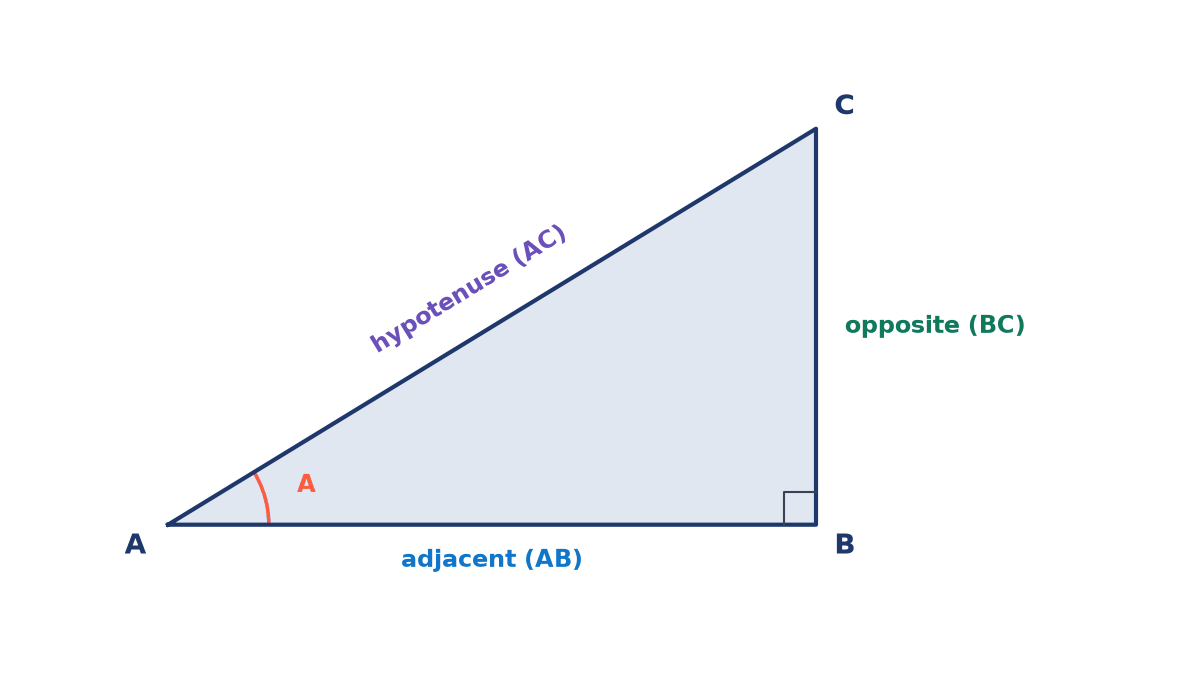
Take right triangle ABC with the right angle at B, and look at the acute angle A. The side oppositeA is BC, the side adjacent to A is AB, and the hypotenuse is AC.
The remaining three are simply their reciprocals:
cosecA=sinA1,secA=cosA1,cotA=tanA1
You also get tanA=cosAsinA and cotA=sinAcosA. That's because dividing opposite by adjacent is the same as dividing hypopp by hypadj.
Keep in mind that "opposite" and "adjacent" always depend on which angle you're looking from. Stand at angle C in the same triangle and AB becomes the opposite side while BC becomes adjacent. That's why sinC=cosA.
Opposite, adjacent and hypotenuse for angle A
Why the ratio depends only on the angle
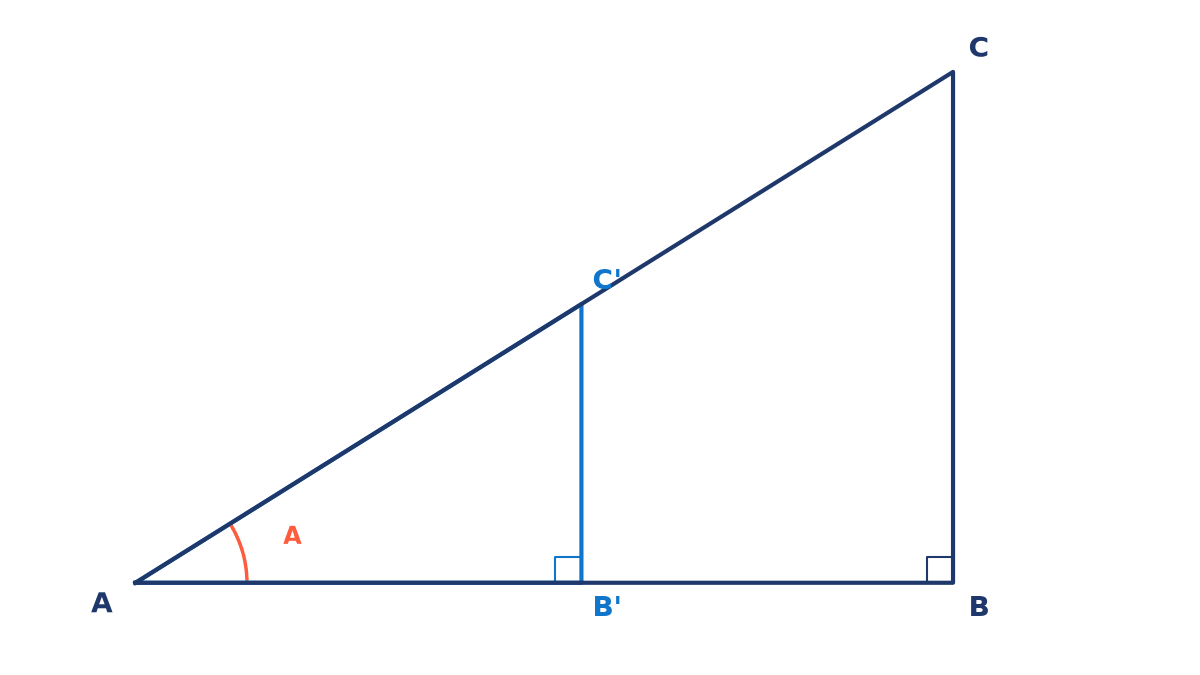
Take two right triangles that share the same acute angle A. They have two equal angles (A and 90∘), so they are similar, and their matching sides are in proportion. So the ratio hypotenuseopposite comes out the same in both. That is exactly why sinA is a number that depends on A and nothing else.
Same angle A, similar triangles, same ratios
Bounds
The hypotenuse is always the longest side, so for any acute angle sinA≤1 and cosA≤1. On the other hand, tanA can be as large as you like. So if your working ever gives you sinA=1.2, stop: there's a mistake somewhere.
From one ratio, find the rest
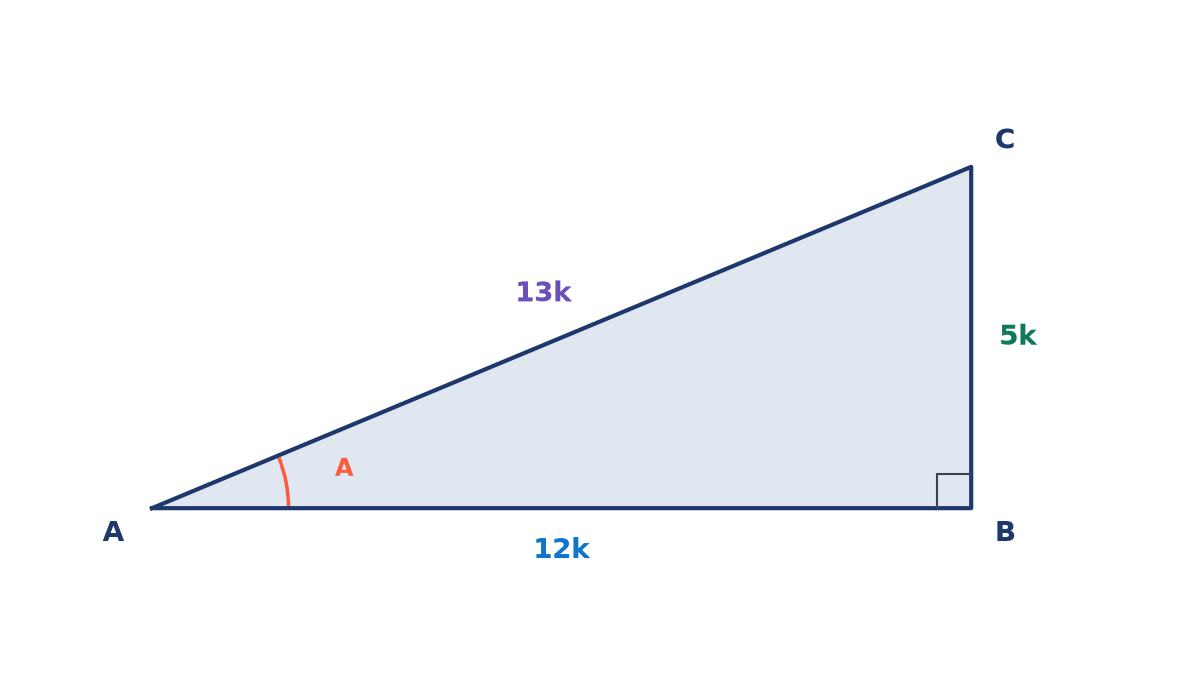
The method is always the same. Write the given ratio as a fraction of two sides, bring in a scale factor k, find the third side with Pythagoras, and then read off everything else.
Example 1.sinA=135. Find the other ratios.
Since sinA=ACBC, let BC=5k and AC=13k. Then AB2=169k2−25k2=144k2, so AB=12k.
cotB=oppositeadjacent, so take adjacent =12k and opposite =5k. Then hypotenuse =144+25k=13k. So sinB=135 and cosB=1312.
Example 3.5tanA=12. Find 4sinA+cosA4sinA−cosA.
tanA=512, so opposite is 12k, adjacent 5k and hypotenuse 13k. That gives sinA=1312 and cosA=135.
4⋅1312+1354⋅1312−135=48+548−5=5343
There's a faster way, and it's worth knowing. Divide the top and bottom by cosA to get 4tanA+14tanA−1=548+1548−1=5343. Same answer, and you never needed the hypotenuse.
Equal ratios mean equal angles
If sinA=sinB for two acute angles, then A=B. The triangles are similar with the same ratio, so they must have the same angle. You'll use this whenever you need to prove two angles equal.
Practice
In right triangle PQR with the right angle at Q, PQ=8 and QR=15. Find sinP, cosP, tanP, and sinR.
cosA=2920. Find sinA and tanA.
tanθ=3. Find sinθ and cosθ.
secA=2425. Find tanA and cosecA.
5tanA=4. Work out 1+tan2A2tanA, and check that it equals 2sinAcosA.
Can cosA=45 be true for any angle A? Why or why not?
Answers
Show answers
PR=64+225=17. For angle P, the opposite side is QR=15 and the adjacent side is PQ=8. So sinP=1715, cosP=178, tanP=815. For R, the opposite side is PQ=8, so sinR=178.
Adjacent is 20k and hypotenuse 29k, so opposite is 841−400k=21k. Then sinA=2921 and tanA=2021.
Opposite is 3k and adjacent k, so hypotenuse is 2k. Then sinθ=23 and cosθ=21.
Hypotenuse 25k and adjacent 24k give opposite 7k. So tanA=247 and cosecA=725.
With tanA=54: 1+251658=254158=4140. Now take opposite 4k, adjacent 5k, hypotenuse 41k: 2sinAcosA=2⋅414⋅415=4140 ✓.
No. cosA is adjacent over hypotenuse, and the hypotenuse is the longest side, so cosA≤1 always.
Test yourself
Trigonometric Ratios, Quiz
Five questions on the six trigonometric ratios. Pick one answer for each.