This set of 16 original questions practises the Class 10 Polynomials chapter: reading the number of zeroes from a graph, finding zeroes and checking them against the coefficients, forming a quadratic from the sum and product of its zeroes, and checking the three relationships for a cubic. The questions start easy and build up to 3-mark and 4-mark exam level. Try each one before reading the solution.
Quick recap#
Zeroes from graphs#
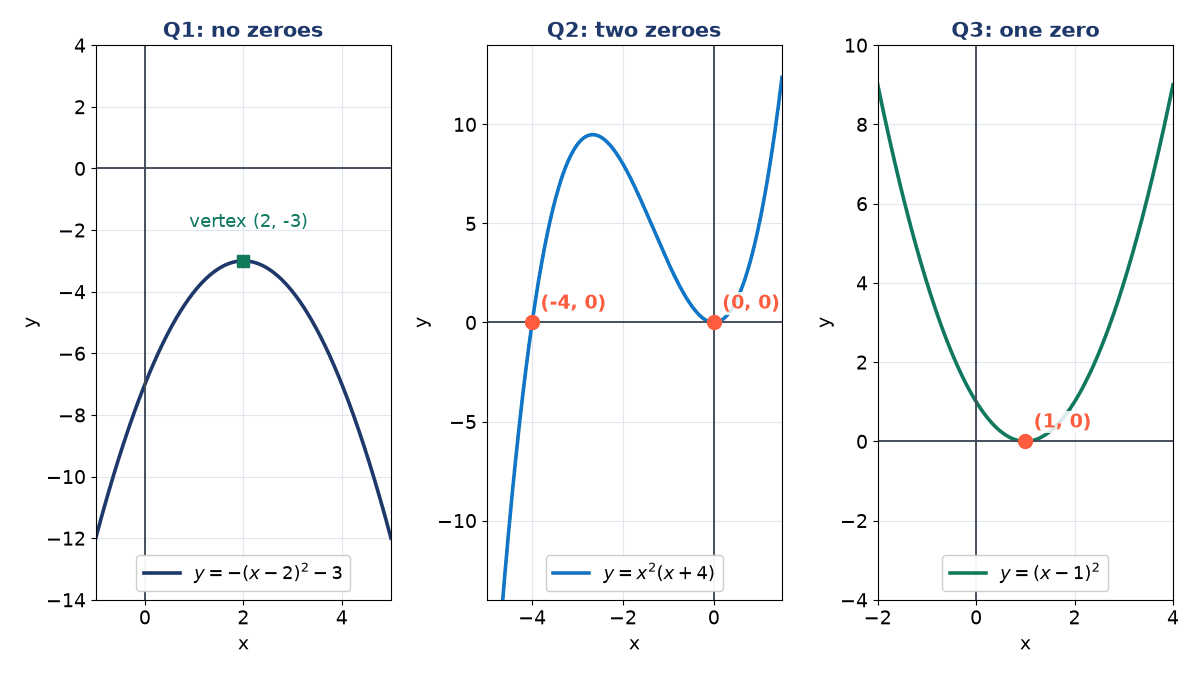
Possible graphs for Questions 1 to 3. Question 1#
The graph of a quadratic polynomial y = p ( x ) y = p(x) y = p ( x ) ( 2 , − 3 ) (2, -3) ( 2 , − 3 ) p ( x ) p(x) p ( x )
A downward parabola has its highest point at the vertex. Here the highest value of p ( x ) p(x) p ( x ) − 3 -3 − 3 − ( x − 2 ) 2 − 3 -(x - 2)^2 - 3 − ( x − 2 ) 2 − 3 − 3 -3 − 3
Answer: p ( x ) p(x) p ( x )
Question 2#
The graph of a cubic polynomial crosses the x-axis at ( − 4 , 0 ) (-4, 0) ( − 4 , 0 ) ( 0 , 0 ) (0, 0) ( 0 , 0 )
Crossing and touching both count as meeting the x-axis. The graph meets it at two points, with x-coordinates − 4 -4 − 4 0 0 0 x 2 ( x + 4 ) x^2(x + 4) x 2 ( x + 4 ) 0 0 0
Answer: two zeroes, − 4 -4 − 4 0 0 0
Question 3#
A parabola opens upwards and its vertex is ( 1 , 0 ) (1, 0) ( 1 , 0 )
The vertex is the lowest point, and it lies on the x-axis. Every other point is above the axis, so the graph touches the axis only at ( 1 , 0 ) (1, 0) ( 1 , 0 ) ( x − 1 ) 2 (x - 1)^2 ( x − 1 ) 2
Answer: one zero, x = 1 x = 1 x = 1
Why this works: for a parabola, the position of the vertex compared with the x-axis, together with the direction of opening, decides the number of zeroes.
Question 4#
Where does the graph of y = 3 x + 6 y = 3x + 6 y = 3 x + 6 3 x + 6 3x + 6 3 x + 6
On the x-axis y = 0 y = 0 y = 0 3 x + 6 = 0 3x + 6 = 0 3 x + 6 = 0 x = − 2 x = -2 x = − 2 3 ( − 2 ) + 6 = 0 3(-2) + 6 = 0 3 ( − 2 ) + 6 = 0
Answer: at ( − 2 , 0 ) (-2, 0) ( − 2 , 0 ) − 2 -2 − 2
Finding zeroes and verifying the relationships#
Question 5#
Find the zeroes of x 2 − 3 x − 10 x^2 - 3x - 10 x 2 − 3 x − 10
Two numbers with product − 10 -10 − 10 − 3 -3 − 3 − 5 -5 − 5 2 2 2
x 2 − 3 x − 10 = x 2 − 5 x + 2 x − 10 = ( x − 5 ) ( x + 2 ) x^2 - 3x - 10 = x^2 - 5x + 2x - 10 = (x - 5)(x + 2) x 2 − 3 x − 10 = x 2 − 5 x + 2 x − 10 = ( x − 5 ) ( x + 2 )
The zeroes are 5 5 5 − 2 -2 − 2 a = 1 a = 1 a = 1 b = − 3 b = -3 b = − 3 c = − 10 c = -10 c = − 10
5 + ( − 2 ) = 3 = − − 3 1 5 × ( − 2 ) = − 10 = − 10 1 \displaystyle \begin{aligned} 5 + (-2) &= 3 = -\frac{-3}{1} \\ 5 \times (-2) &= -10 = \frac{-10}{1} \end{aligned} 5 + ( − 2 ) 5 × ( − 2 ) = 3 = − 1 − 3 = − 10 = 1 − 10
Answer: zeroes 5 5 5 − 2 -2 − 2 3 = − b a \displaystyle 3 = -\frac{b}{a} 3 = − a b − 10 = c a \displaystyle -10 = \frac{c}{a} − 10 = a c
Question 6#
Find the zeroes of 5 v 2 + 15 v 5v^2 + 15v 5 v 2 + 15 v
Take out the common factor: 5 v 2 + 15 v = 5 v ( v + 3 ) 5v^2 + 15v = 5v(v + 3) 5 v 2 + 15 v = 5 v ( v + 3 ) 0 0 0 − 3 -3 − 3 a = 5 a = 5 a = 5 b = 15 b = 15 b = 15 c = 0 c = 0 c = 0
0 + ( − 3 ) = − 3 = − 15 5 0 × ( − 3 ) = 0 = 0 5 \displaystyle \begin{aligned} 0 + (-3) &= -3 = -\frac{15}{5} \\ 0 \times (-3) &= 0 = \frac{0}{5} \end{aligned} 0 + ( − 3 ) 0 × ( − 3 ) = − 3 = − 5 15 = 0 = 5 0
Answer: zeroes 0 0 0 − 3 -3 − 3
Question 7#
Find the zeroes of t 2 − 11 t^2 - 11 t 2 − 11
t 2 − 11 = ( t − 11 ) ( t + 11 ) t^2 - 11 = (t - \sqrt{11})(t + \sqrt{11}) t 2 − 11 = ( t − 11 ) ( t + 11 ) 11 \sqrt{11} 11 − 11 -\sqrt{11} − 11 a = 1 a = 1 a = 1 b = 0 b = 0 b = 0 c = − 11 c = -11 c = − 11
11 + ( − 11 ) = 0 = − 0 1 11 × ( − 11 ) = − 11 = − 11 1 \displaystyle \begin{aligned} \sqrt{11} + (-\sqrt{11}) &= 0 = -\frac{0}{1} \\ \sqrt{11} \times (-\sqrt{11}) &= -11 = \frac{-11}{1} \end{aligned} 11 + ( − 11 ) 11 × ( − 11 ) = 0 = − 1 0 = − 11 = 1 − 11
Answer: zeroes ± 11 \pm\sqrt{11} ± 11 0 0 0 − 11 -11 − 11
Question 8#
Find the zeroes of 12 x 2 − 7 x + 1 12x^2 - 7x + 1 12 x 2 − 7 x + 1
We need two numbers with product 12 × 1 = 12 12 \times 1 = 12 12 × 1 = 12 − 7 -7 − 7 − 3 -3 − 3 − 4 -4 − 4
12 x 2 − 7 x + 1 = 12 x 2 − 3 x − 4 x + 1 = 3 x ( 4 x − 1 ) − 1 ( 4 x − 1 ) = ( 3 x − 1 ) ( 4 x − 1 ) \begin{aligned} 12x^2 - 7x + 1 &= 12x^2 - 3x - 4x + 1 \\ &= 3x(4x - 1) - 1(4x - 1) \\ &= (3x - 1)(4x - 1) \end{aligned} 12 x 2 − 7 x + 1 = 12 x 2 − 3 x − 4 x + 1 = 3 x ( 4 x − 1 ) − 1 ( 4 x − 1 ) = ( 3 x − 1 ) ( 4 x − 1 )
The zeroes are 1 3 \displaystyle \frac{1}{3} 3 1 1 4 \displaystyle \frac{1}{4} 4 1
1 3 + 1 4 = 7 12 = − − 7 12 1 3 × 1 4 = 1 12 = 1 12 \displaystyle \begin{aligned} \frac{1}{3} + \frac{1}{4} &= \frac{7}{12} = -\frac{-7}{12} \\ \frac{1}{3} \times \frac{1}{4} &= \frac{1}{12} = \frac{1}{12} \end{aligned} 3 1 + 4 1 3 1 × 4 1 = 12 7 = − 12 − 7 = 12 1 = 12 1
Answer: zeroes 1 3 \displaystyle \frac{1}{3} 3 1 1 4 \displaystyle \frac{1}{4} 4 1 7 12 \displaystyle \frac{7}{12} 12 7 1 12 \displaystyle \frac{1}{12} 12 1
Question 9#
Find a quadratic polynomial whose zeroes have sum 5 5 5 6 6 6
Using x 2 − S x + P x^2 - Sx + P x 2 − S x + P x 2 − 5 x + 6 x^2 - 5x + 6 x 2 − 5 x + 6 x 2 − 5 x + 6 = ( x − 2 ) ( x − 3 ) x^2 - 5x + 6 = (x - 2)(x - 3) x 2 − 5 x + 6 = ( x − 2 ) ( x − 3 ) 2 2 2 3 3 3 5 5 5 6 6 6
Answer: x 2 − 5 x + 6 x^2 - 5x + 6 x 2 − 5 x + 6
Question 10#
Find a quadratic polynomial whose zeroes have sum 1 3 \displaystyle \frac{1}{3} 3 1 − 2 3 \displaystyle -\frac{2}{3} − 3 2
x 2 − 1 3 x − 2 3 \displaystyle x^2 - \frac{1}{3}x - \frac{2}{3} x 2 − 3 1 x − 3 2
Multiply by k = 3 k = 3 k = 3 3 x 2 − x − 2 3x^2 - x - 2 3 x 2 − x − 2 − 6 -6 − 6 − 1 -1 − 1 − 3 -3 − 3 2 2 2
3 x 2 − x − 2 = 3 x 2 − 3 x + 2 x − 2 = ( 3 x + 2 ) ( x − 1 ) 3x^2 - x - 2 = 3x^2 - 3x + 2x - 2 = (3x + 2)(x - 1) 3 x 2 − x − 2 = 3 x 2 − 3 x + 2 x − 2 = ( 3 x + 2 ) ( x − 1 )
The zeroes are 1 1 1 − 2 3 \displaystyle -\frac{2}{3} − 3 2 = 1 3 \displaystyle = \frac{1}{3} = 3 1 = − 2 3 \displaystyle = -\frac{2}{3} = − 3 2
Answer: 3 x 2 − x − 2 3x^2 - x - 2 3 x 2 − x − 2 1 1 1 − 2 3 \displaystyle -\frac{2}{3} − 3 2
Question 11#
Find a quadratic polynomial with zeroes 2 + 3 2 + \sqrt{3} 2 + 3 2 − 3 2 - \sqrt{3} 2 − 3
S = ( 2 + 3 ) + ( 2 − 3 ) = 4 P = ( 2 + 3 ) ( 2 − 3 ) = 4 − 3 = 1 \begin{aligned} S &= (2 + \sqrt{3}) + (2 - \sqrt{3}) = 4 \\ P &= (2 + \sqrt{3})(2 - \sqrt{3}) = 4 - 3 = 1 \end{aligned} S P = ( 2 + 3 ) + ( 2 − 3 ) = 4 = ( 2 + 3 ) ( 2 − 3 ) = 4 − 3 = 1
So the polynomial is x 2 − 4 x + 1 x^2 - 4x + 1 x 2 − 4 x + 1
Answer: x 2 − 4 x + 1 x^2 - 4x + 1 x 2 − 4 x + 1
Why this works: the irrational parts cancel in both the sum and the product, so the coefficients are integers.
Question 12#
One zero of 2 x 2 − 9 x + k 2x^2 - 9x + k 2 x 2 − 9 x + k k k k
Let the zeroes be α \alpha α 2 α 2\alpha 2 α
α + 2 α = − − 9 2 ⇒ 3 α = 9 2 ⇒ α = 3 2 \displaystyle \alpha + 2\alpha = -\frac{-9}{2} \ \Rightarrow\ 3\alpha = \frac{9}{2} \ \Rightarrow\ \alpha = \frac{3}{2} α + 2 α = − 2 − 9 ⇒ 3 α = 2 9 ⇒ α = 2 3
From the product,
α × 2 α = k 2 ⇒ 2 ( 3 2 ) 2 = k 2 ⇒ 9 2 = k 2 ⇒ k = 9 \displaystyle \alpha \times 2\alpha = \frac{k}{2} \ \Rightarrow\ 2\left(\frac{3}{2}\right)^2 = \frac{k}{2} \ \Rightarrow\ \frac{9}{2} = \frac{k}{2} \ \Rightarrow\ k = 9 α × 2 α = 2 k ⇒ 2 ( 2 3 ) 2 = 2 k ⇒ 2 9 = 2 k ⇒ k = 9
Check: 2 x 2 − 9 x + 9 = ( 2 x − 3 ) ( x − 3 ) 2x^2 - 9x + 9 = (2x - 3)(x - 3) 2 x 2 − 9 x + 9 = ( 2 x − 3 ) ( x − 3 ) 3 2 \displaystyle \frac{3}{2} 2 3 3 3 3 3 3 3 3 2 \displaystyle \frac{3}{2} 2 3
Answer: k = 9 k = 9 k = 9 3 2 \displaystyle \frac{3}{2} 2 3 3 3 3
Question 13#
If α \alpha α β \beta β 2 x 2 − 5 x + 3 2x^2 - 5x + 3 2 x 2 − 5 x + 3 α 2 + β 2 \alpha^2 + \beta^2 α 2 + β 2 1 α + 1 β \displaystyle \frac{1}{\alpha} + \frac{1}{\beta} α 1 + β 1
α + β = 5 2 \displaystyle \alpha + \beta = \frac{5}{2} α + β = 2 5 α β = 3 2 \displaystyle \alpha\beta = \frac{3}{2} α β = 2 3
(a) α 2 + β 2 = ( 5 2 ) 2 − 2 × 3 2 = 25 4 − 3 = 13 4 (b) 1 α + 1 β = α + β α β = 5 / 2 3 / 2 = 5 3 \displaystyle \begin{aligned} \text{(a)}\ \alpha^2 + \beta^2 &= \left(\frac{5}{2}\right)^2 - 2 \times \frac{3}{2} = \frac{25}{4} - 3 = \frac{13}{4} \\ \text{(b)}\ \frac{1}{\alpha} + \frac{1}{\beta} &= \frac{\alpha + \beta}{\alpha\beta} = \frac{5/2}{3/2} = \frac{5}{3} \end{aligned} (a) α 2 + β 2 (b) α 1 + β 1 = ( 2 5 ) 2 − 2 × 2 3 = 4 25 − 3 = 4 13 = α β α + β = 3/2 5/2 = 3 5
Check: 2 x 2 − 5 x + 3 = ( x − 1 ) ( 2 x − 3 ) 2x^2 - 5x + 3 = (x - 1)(2x - 3) 2 x 2 − 5 x + 3 = ( x − 1 ) ( 2 x − 3 ) 1 1 1 3 2 \displaystyle \frac{3}{2} 2 3 1 + 9 4 = 13 4 \displaystyle 1 + \frac{9}{4} = \frac{13}{4} 1 + 4 9 = 4 13 1 + 2 3 = 5 3 \displaystyle 1 + \frac{2}{3} = \frac{5}{3} 1 + 3 2 = 3 5
Answer: (a) 13 4 \displaystyle \frac{13}{4} 4 13 5 3 \displaystyle \frac{5}{3} 3 5
Cubic polynomials#
Question 14#
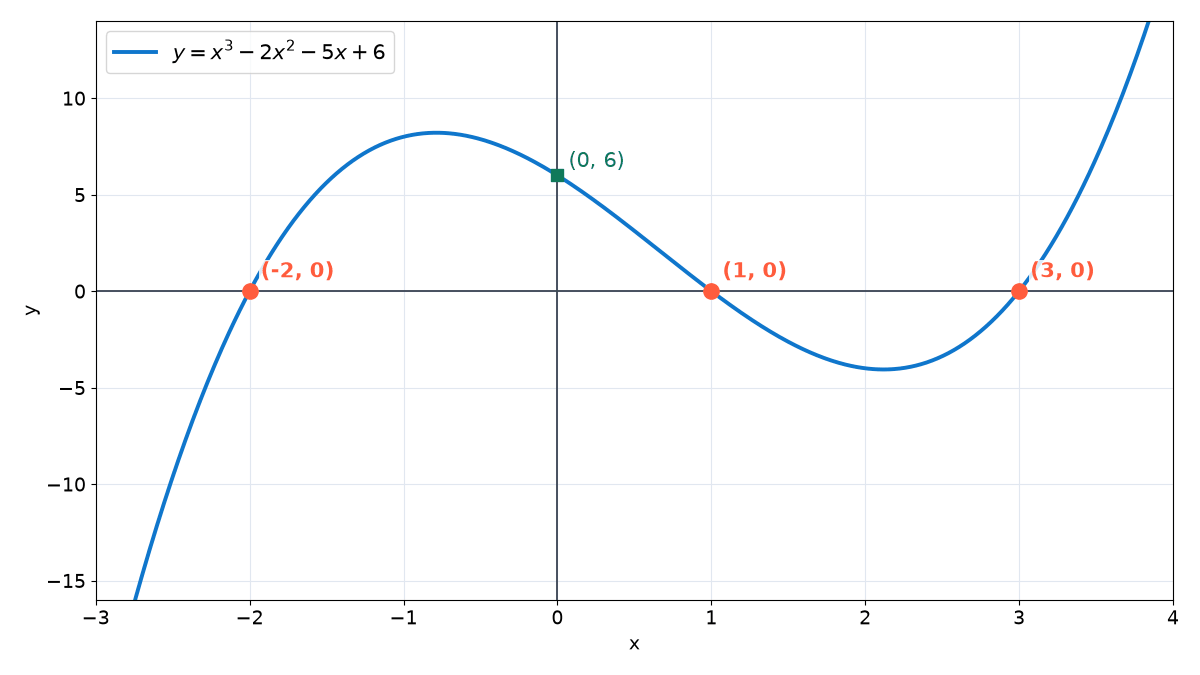
Verify that 1 1 1 − 2 -2 − 2 3 3 3 p ( x ) = x 3 − 2 x 2 − 5 x + 6 p(x) = x^3 - 2x^2 - 5x + 6 p ( x ) = x 3 − 2 x 2 − 5 x + 6
p ( 1 ) = 1 − 2 − 5 + 6 = 0 p ( − 2 ) = − 8 − 8 + 10 + 6 = 0 p ( 3 ) = 27 − 18 − 15 + 6 = 0 \begin{aligned} p(1) &= 1 - 2 - 5 + 6 = 0 \\ p(-2) &= -8 - 8 + 10 + 6 = 0 \\ p(3) &= 27 - 18 - 15 + 6 = 0 \end{aligned} p ( 1 ) p ( − 2 ) p ( 3 ) = 1 − 2 − 5 + 6 = 0 = − 8 − 8 + 10 + 6 = 0 = 27 − 18 − 15 + 6 = 0
So all three are zeroes. With a = 1 a = 1 a = 1 b = − 2 b = -2 b = − 2 c = − 5 c = -5 c = − 5 d = 6 d = 6 d = 6 α = 1 \alpha = 1 α = 1 β = − 2 \beta = -2 β = − 2 γ = 3 \gamma = 3 γ = 3
α + β + γ = 1 − 2 + 3 = 2 = − − 2 1 α β + β γ + γ α = − 2 − 6 + 3 = − 5 = − 5 1 α β γ = 1 × ( − 2 ) × 3 = − 6 = − 6 1 \displaystyle \begin{aligned} \alpha + \beta + \gamma &= 1 - 2 + 3 = 2 = -\frac{-2}{1} \\ \alpha\beta + \beta\gamma + \gamma\alpha &= -2 - 6 + 3 = -5 = \frac{-5}{1} \\ \alpha\beta\gamma &= 1 \times (-2) \times 3 = -6 = -\frac{6}{1} \end{aligned} α + β + γ α β + β γ + γ α α β γ = 1 − 2 + 3 = 2 = − 1 − 2 = − 2 − 6 + 3 = − 5 = 1 − 5 = 1 × ( − 2 ) × 3 = − 6 = − 1 6
Answer: all three values give p = 0 p = 0 p = 0 2 2 2 − 5 -5 − 5 − 6 -6 − 6 − b a \displaystyle -\frac{b}{a} − a b c a \displaystyle \frac{c}{a} a c − d a \displaystyle -\frac{d}{a} − a d
The cubic in Question 14 crosses the x-axis at its three zeroes; the y-intercept 6 6 6 Question 15#
Find a cubic polynomial whose zeroes have sum 3 3 3 − 1 -1 − 1 − 3 -3 − 3 3 3 3 1 1 1 − 1 -1 − 1
Take a = 1 a = 1 a = 1 − b = 3 -b = 3 − b = 3 c = − 1 c = -1 c = − 1 − d = − 3 -d = -3 − d = − 3 b = − 3 b = -3 b = − 3 c = − 1 c = -1 c = − 1 d = 3 d = 3 d = 3
p ( x ) = x 3 − 3 x 2 − x + 3 p(x) = x^3 - 3x^2 - x + 3 p ( x ) = x 3 − 3 x 2 − x + 3
Factorise by grouping:
x 3 − 3 x 2 − x + 3 = x 2 ( x − 3 ) − 1 ( x − 3 ) = ( x − 3 ) ( x − 1 ) ( x + 1 ) x^3 - 3x^2 - x + 3 = x^2(x - 3) - 1(x - 3) = (x - 3)(x - 1)(x + 1) x 3 − 3 x 2 − x + 3 = x 2 ( x − 3 ) − 1 ( x − 3 ) = ( x − 3 ) ( x − 1 ) ( x + 1 )
So the zeroes are 3 3 3 1 1 1 − 1 -1 − 1 3 3 3 3 − 1 − 3 = − 1 3 - 1 - 3 = -1 3 − 1 − 3 = − 1 − 3 -3 − 3
Answer: x 3 − 3 x 2 − x + 3 x^3 - 3x^2 - x + 3 x 3 − 3 x 2 − x + 3 3 3 3 1 1 1 − 1 -1 − 1
Question 16#
The zeroes of x 3 − 6 x 2 + 3 x + 10 x^3 - 6x^2 + 3x + 10 x 3 − 6 x 2 + 3 x + 10 a − b a - b a − b a a a a + b a + b a + b a a a b b b
Sum of zeroes:
( a − b ) + a + ( a + b ) = 3 a = − − 6 1 = 6 ⇒ a = 2 \displaystyle (a - b) + a + (a + b) = 3a = -\frac{-6}{1} = 6 \ \Rightarrow\ a = 2 ( a − b ) + a + ( a + b ) = 3 a = − 1 − 6 = 6 ⇒ a = 2
Product of zeroes:
( a − b ) a ( a + b ) = − 10 1 2 ( 4 − b 2 ) = − 10 4 − b 2 = − 5 b 2 = 9 ⇒ b = ± 3 \displaystyle \begin{aligned} (a - b)\,a\,(a + b) &= -\frac{10}{1} \\ 2(4 - b^2) &= -10 \\ 4 - b^2 &= -5 \\ b^2 &= 9 \ \Rightarrow\ b = \pm 3 \end{aligned} ( a − b ) a ( a + b ) 2 ( 4 − b 2 ) 4 − b 2 b 2 = − 1 10 = − 10 = − 5 = 9 ⇒ b = ± 3
Either sign gives the same three zeroes: − 1 -1 − 1 2 2 2 5 5 5 ( − 1 ) ( 2 ) + ( 2 ) ( 5 ) + ( 5 ) ( − 1 ) = − 2 + 10 − 5 = 3 = 3 1 \displaystyle (-1)(2) + (2)(5) + (5)(-1) = -2 + 10 - 5 = 3 = \frac{3}{1} ( − 1 ) ( 2 ) + ( 2 ) ( 5 ) + ( 5 ) ( − 1 ) = − 2 + 10 − 5 = 3 = 1 3
Answer: a = 2 a = 2 a = 2 b = ± 3 b = \pm 3 b = ± 3 − 1 -1 − 1 2 2 2 5 5 5
Why this works: writing the zeroes as a − b a - b a − b a a a a + b a + b a + b b b b a a a
Key terms#
Zero of a polynomial A number that makes the polynomial equal to 0 0 0
x-intercept A point where a graph meets the x-axis; its x-coordinate is a zero.
Parabola The graph of a quadratic polynomial.
Vertex The turning point of a parabola.
Repeated zero A zero that occurs twice, where the graph touches the x-axis instead of crossing it.
Leading coefficient The coefficient a a a
Sum and product of zeroes − b a \displaystyle -\frac{b}{a} − a b c a \displaystyle \frac{c}{a} a c
Common questions#
How do I check my zeroes quickly in the exam?#
Add and multiply them and compare with − b a \displaystyle -\frac{b}{a} − a b c a \displaystyle \frac{c}{a} a c
Does a touching point count as one zero or two?#
When asked for the number of zeroes from a graph, count the touching point once. The polynomial has a repeated zero there.
What if a coefficient is missing?#
Take it as 0 0 0 5 v 2 + 15 v 5v^2 + 15v 5 v 2 + 15 v c = 0 c = 0 c = 0 0 0 0 0 0 0
Is my quadratic wrong if it differs from the answer key by a constant?#
No. x 2 − 5 x + 6 x^2 - 5x + 6 x 2 − 5 x + 6 2 x 2 − 10 x + 12 2x^2 - 10x + 12 2 x 2 − 10 x + 12
Where does the y-intercept come in?#
The graph meets the y-axis at ( 0 , p ( 0 ) ) (0, p(0)) ( 0 , p ( 0 )) p ( 0 ) p(0) p ( 0 ) 0 0 0
References#
National Council of Educational Research and Training. Mathematics: Textbook for Class X . NCERT, New Delhi.
Sharma, R. D. Mathematics for Class 10 . Dhanpat Rai Publications.
Aggarwal, R. S. Secondary School Mathematics for Class 10 . Bharati Bhawan.