The zeroes of a polynomial and its coefficients are closely linked. For a quadratic, the sum and the product of the zeroes can be read straight from the coefficients, without solving anything. This lets you check zeroes you have found, build a quadratic when you know only the sum and product of its zeroes, and answer questions such as "find α 2 + β 2 \alpha^2 + \beta^2 α 2 + β 2
The results#
Quadratic polynomials#
Let α \alpha α β \beta β p ( x ) = a x 2 + b x + c p(x) = ax^2 + bx + c p ( x ) = a x 2 + b x + c a ≠ 0 a \ne 0 a = 0
α + β = − b a , α β = c a \displaystyle \alpha + \beta = -\frac{b}{a}, \qquad \alpha\beta = \frac{c}{a} α + β = − a b , α β = a c
In words: sum of zeroes = − coefficient of x coefficient of x 2 \displaystyle = -\frac{\text{coefficient of } x}{\text{coefficient of } x^2} = − coefficient of x 2 coefficient of x = constant term coefficient of x 2 \displaystyle = \frac{\text{constant term}}{\text{coefficient of } x^2} = coefficient of x 2 constant term
Cubic polynomials#
Let α \alpha α β \beta β γ \gamma γ p ( x ) = a x 3 + b x 2 + c x + d p(x) = ax^3 + bx^2 + cx + d p ( x ) = a x 3 + b x 2 + c x + d a ≠ 0 a \ne 0 a = 0
α + β + γ = − b a α β + β γ + γ α = c a α β γ = − d a \displaystyle \begin{aligned} \alpha + \beta + \gamma &= -\frac{b}{a} \\ \alpha\beta + \beta\gamma + \gamma\alpha &= \frac{c}{a} \\ \alpha\beta\gamma &= -\frac{d}{a} \end{aligned} α + β + γ α β + β γ + γ α α β γ = − a b = a c = − a d
Notice the signs alternate: minus, plus, minus.
Why the results are true#
Proof for a quadratic#
If α \alpha α β \beta β a x 2 + b x + c ax^2 + bx + c a x 2 + b x + c ( x − α ) (x - \alpha) ( x − α ) ( x − β ) (x - \beta) ( x − β ) a a a
a x 2 + b x + c = a ( x − α ) ( x − β ) ax^2 + bx + c = a(x - \alpha)(x - \beta) a x 2 + b x + c = a ( x − α ) ( x − β )
Expand the right-hand side:
a ( x − α ) ( x − β ) = a x 2 − a ( α + β ) x + a α β a(x - \alpha)(x - \beta) = ax^2 - a(\alpha + \beta)x + a\alpha\beta a ( x − α ) ( x − β ) = a x 2 − a ( α + β ) x + a α β
Two polynomials are equal for all x x x x x x
b = − a ( α + β ) ⇒ α + β = − b a c = a α β ⇒ α β = c a \displaystyle \begin{aligned} b &= -a(\alpha + \beta) &&\Rightarrow\ \alpha + \beta = -\frac{b}{a} \\ c &= a\alpha\beta &&\Rightarrow\ \alpha\beta = \frac{c}{a} \end{aligned} b c = − a ( α + β ) = a α β ⇒ α + β = − a b ⇒ α β = a c
Proof for a cubic#
In the same way, a x 3 + b x 2 + c x + d = a ( x − α ) ( x − β ) ( x − γ ) ax^3 + bx^2 + cx + d = a(x - \alpha)(x - \beta)(x - \gamma) a x 3 + b x 2 + c x + d = a ( x − α ) ( x − β ) ( x − γ )
a ( x − α ) ( x − β ) ( x − γ ) = a x 3 − a ( α + β + γ ) x 2 + a ( α β + β γ + γ α ) x − a α β γ a(x - \alpha)(x - \beta)(x - \gamma) = ax^3 - a(\alpha + \beta + \gamma)x^2 + a(\alpha\beta + \beta\gamma + \gamma\alpha)x - a\alpha\beta\gamma a ( x − α ) ( x − β ) ( x − γ ) = a x 3 − a ( α + β + γ ) x 2 + a ( α β + β γ + γ α ) x − a α β γ
Comparing coefficients gives b = − a ( α + β + γ ) b = -a(\alpha + \beta + \gamma) b = − a ( α + β + γ ) c = a ( α β + β γ + γ α ) c = a(\alpha\beta + \beta\gamma + \gamma\alpha) c = a ( α β + β γ + γ α ) d = − a α β γ d = -a\alpha\beta\gamma d = − a α β γ
If a quadratic has zeroes whose sum is S S S P P P
k [ x 2 − S x + P ] , k ≠ 0 k\left[x^2 - Sx + P\right], \quad k \ne 0 k [ x 2 − S x + P ] , k = 0
This follows from ( x − α ) ( x − β ) = x 2 − ( α + β ) x + α β (x - \alpha)(x - \beta) = x^2 - (\alpha + \beta)x + \alpha\beta ( x − α ) ( x − β ) = x 2 − ( α + β ) x + α β k k k k k k
Method#
Write down (or work out) S = α + β S = \alpha + \beta S = α + β P = α β P = \alpha\beta P = α β
Write x 2 − S x + P x^2 - Sx + P x 2 − S x + P S S S − S x -Sx − S x + ∣ S ∣ x +|S|x + ∣ S ∣ x
Multiply by the LCM of the denominators (this is your k k k
Check: factorise or use − b a \displaystyle -\frac{b}{a} − a b c a \displaystyle \frac{c}{a} a c
Method: verifying the relationship#
Factorise the polynomial (split the middle term for a quadratic).
Set each factor equal to 0 0 0
Work out the sum and the product of the zeroes you found.
Work out − b a \displaystyle -\frac{b}{a} − a b c a \displaystyle \frac{c}{a} a c b b b c c c
Show the two pairs of values are equal.
Worked examples#
Example 1: find and verify#
Find the zeroes of 6 x 2 − 5 x − 6 6x^2 - 5x - 6 6 x 2 − 5 x − 6
We need two numbers with product 6 × ( − 6 ) = − 36 6 \times (-6) = -36 6 × ( − 6 ) = − 36 − 5 -5 − 5 − 9 -9 − 9 4 4 4
6 x 2 − 5 x − 6 = 6 x 2 − 9 x + 4 x − 6 = 3 x ( 2 x − 3 ) + 2 ( 2 x − 3 ) = ( 2 x − 3 ) ( 3 x + 2 ) \begin{aligned} 6x^2 - 5x - 6 &= 6x^2 - 9x + 4x - 6 \\ &= 3x(2x - 3) + 2(2x - 3) \\ &= (2x - 3)(3x + 2) \end{aligned} 6 x 2 − 5 x − 6 = 6 x 2 − 9 x + 4 x − 6 = 3 x ( 2 x − 3 ) + 2 ( 2 x − 3 ) = ( 2 x − 3 ) ( 3 x + 2 )
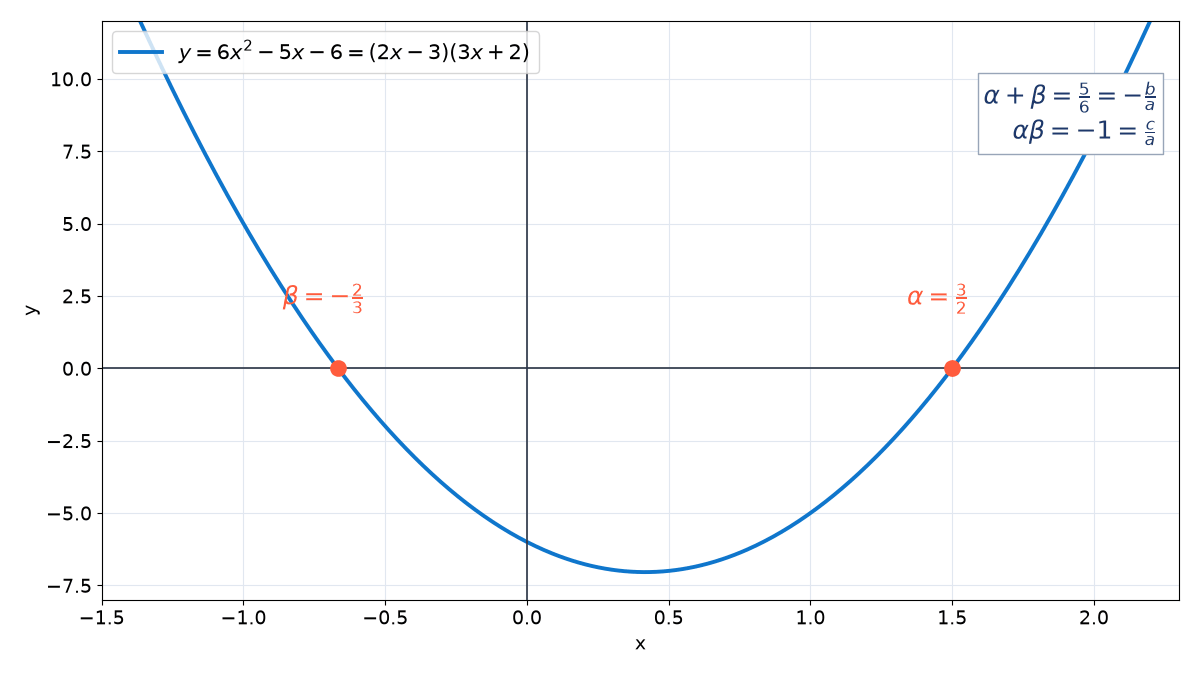
So the zeroes are α = 3 2 \displaystyle \alpha = \frac{3}{2} α = 2 3 β = − 2 3 \displaystyle \beta = -\frac{2}{3} β = − 3 2 a = 6 a = 6 a = 6 b = − 5 b = -5 b = − 5 c = − 6 c = -6 c = − 6
α + β = 3 2 − 2 3 = 9 − 4 6 = 5 6 , − b a = − − 5 6 = 5 6 α β = 3 2 × ( − 2 3 ) = − 1 , c a = − 6 6 = − 1 \displaystyle \begin{aligned} \alpha + \beta &= \frac{3}{2} - \frac{2}{3} = \frac{9 - 4}{6} = \frac{5}{6}, &\quad -\frac{b}{a} &= -\frac{-5}{6} = \frac{5}{6} \\ \alpha\beta &= \frac{3}{2} \times \left(-\frac{2}{3}\right) = -1, &\quad \frac{c}{a} &= \frac{-6}{6} = -1 \end{aligned} α + β α β = 2 3 − 3 2 = 6 9 − 4 = 6 5 , = 2 3 × ( − 3 2 ) = − 1 , − a b a c = − 6 − 5 = 6 5 = 6 − 6 = − 1
Both relationships hold.
The parabola y = 6 x 2 − 5 x − 6 y = 6x^2 - 5x - 6 y = 6 x 2 − 5 x − 6 − 2 3 \displaystyle -\frac{2}{3} − 3 2 3 2 \displaystyle \frac{3}{2} 2 3 Example 2: a quadratic with no x x x #
Find the zeroes of 4 x 2 − 9 4x^2 - 9 4 x 2 − 9
4 x 2 − 9 = ( 2 x − 3 ) ( 2 x + 3 ) 4x^2 - 9 = (2x - 3)(2x + 3) 4 x 2 − 9 = ( 2 x − 3 ) ( 2 x + 3 ) 3 2 \displaystyle \frac{3}{2} 2 3 − 3 2 \displaystyle -\frac{3}{2} − 2 3 a = 4 a = 4 a = 4 b = 0 b = 0 b = 0 c = − 9 c = -9 c = − 9
Sum = 3 2 + ( − 3 2 ) = 0 = − 0 4 Product = 3 2 × ( − 3 2 ) = − 9 4 = c a \displaystyle \begin{aligned} \text{Sum} &= \frac{3}{2} + \left(-\frac{3}{2}\right) = 0 = -\frac{0}{4} \\ \text{Product} &= \frac{3}{2} \times \left(-\frac{3}{2}\right) = -\frac{9}{4} = \frac{c}{a} \end{aligned} Sum Product = 2 3 + ( − 2 3 ) = 0 = − 4 0 = 2 3 × ( − 2 3 ) = − 4 9 = a c
A missing term simply has coefficient 0 0 0
Find a quadratic polynomial whose zeroes have (a) sum − 4 -4 − 4 3 3 3 1 4 \displaystyle \frac{1}{4} 4 1 − 1 8 \displaystyle -\frac{1}{8} − 8 1
(a) x 2 − ( − 4 ) x + 3 = x 2 + 4 x + 3 x^2 - (-4)x + 3 = x^2 + 4x + 3 x 2 − ( − 4 ) x + 3 = x 2 + 4 x + 3 x 2 + 4 x + 3 = ( x + 1 ) ( x + 3 ) x^2 + 4x + 3 = (x + 1)(x + 3) x 2 + 4 x + 3 = ( x + 1 ) ( x + 3 ) − 1 -1 − 1 − 3 -3 − 3 − 4 -4 − 4 3 3 3
(b) x 2 − 1 4 x − 1 8 \displaystyle x^2 - \frac{1}{4}x - \frac{1}{8} x 2 − 4 1 x − 8 1 4 4 4 8 8 8 8 8 8 k = 8 k = 8 k = 8
8 [ x 2 − 1 4 x − 1 8 ] = 8 x 2 − 2 x − 1 \displaystyle 8\left[x^2 - \frac{1}{4}x - \frac{1}{8}\right] = 8x^2 - 2x - 1 8 [ x 2 − 4 1 x − 8 1 ] = 8 x 2 − 2 x − 1
Check: 8 x 2 − 2 x − 1 = ( 4 x + 1 ) ( 2 x − 1 ) 8x^2 - 2x - 1 = (4x + 1)(2x - 1) 8 x 2 − 2 x − 1 = ( 4 x + 1 ) ( 2 x − 1 ) − 1 4 \displaystyle -\frac{1}{4} − 4 1 1 2 \displaystyle \frac{1}{2} 2 1 = 1 4 \displaystyle = \frac{1}{4} = 4 1 = − 1 8 \displaystyle = -\frac{1}{8} = − 8 1
Example 4: irrational sum#
Find a quadratic polynomial whose zeroes have sum 2 \sqrt{2} 2 − 4 -4 − 4
The polynomial is x 2 − 2 x − 4 x^2 - \sqrt{2}x - 4 x 2 − 2 x − 4 − 2 -\sqrt{2} − 2 − 4 -4 − 4 − 2 2 -2\sqrt{2} − 2 2 2 \sqrt{2} 2
x 2 − 2 x − 4 = x 2 − 2 2 x + 2 x − 4 = x ( x − 2 2 ) + 2 ( x − 2 2 ) = ( x − 2 2 ) ( x + 2 ) \begin{aligned} x^2 - \sqrt{2}x - 4 &= x^2 - 2\sqrt{2}x + \sqrt{2}x - 4 \\ &= x(x - 2\sqrt{2}) + \sqrt{2}(x - 2\sqrt{2}) \\ &= (x - 2\sqrt{2})(x + \sqrt{2}) \end{aligned} x 2 − 2 x − 4 = x 2 − 2 2 x + 2 x − 4 = x ( x − 2 2 ) + 2 ( x − 2 2 ) = ( x − 2 2 ) ( x + 2 )
The zeroes are 2 2 2\sqrt{2} 2 2 − 2 -\sqrt{2} − 2 = 2 = \sqrt{2} = 2 = 2 2 × ( − 2 ) = − 4 = 2\sqrt{2} \times (-\sqrt{2}) = -4 = 2 2 × ( − 2 ) = − 4
Example 5: expressions in the zeroes#
If α \alpha α β \beta β x 2 − 5 x + 4 x^2 - 5x + 4 x 2 − 5 x + 4 1 α + 1 β \displaystyle \frac{1}{\alpha} + \frac{1}{\beta} α 1 + β 1 α 2 + β 2 \alpha^2 + \beta^2 α 2 + β 2 ( α − β ) 2 (\alpha - \beta)^2 ( α − β ) 2
Here α + β = − − 5 1 = 5 \displaystyle \alpha + \beta = -\frac{-5}{1} = 5 α + β = − 1 − 5 = 5 α β = 4 1 = 4 \displaystyle \alpha\beta = \frac{4}{1} = 4 α β = 1 4 = 4
(a) 1 α + 1 β = α + β α β = 5 4 (b) α 2 + β 2 = ( α + β ) 2 − 2 α β = 25 − 8 = 17 (c) ( α − β ) 2 = ( α + β ) 2 − 4 α β = 25 − 16 = 9 \displaystyle \begin{aligned} \text{(a)}\ \frac{1}{\alpha} + \frac{1}{\beta} &= \frac{\alpha + \beta}{\alpha\beta} = \frac{5}{4} \\ \text{(b)}\ \alpha^2 + \beta^2 &= (\alpha + \beta)^2 - 2\alpha\beta = 25 - 8 = 17 \\ \text{(c)}\ (\alpha - \beta)^2 &= (\alpha + \beta)^2 - 4\alpha\beta = 25 - 16 = 9 \end{aligned} (a) α 1 + β 1 (b) α 2 + β 2 (c) ( α − β ) 2 = α β α + β = 4 5 = ( α + β ) 2 − 2 α β = 25 − 8 = 17 = ( α + β ) 2 − 4 α β = 25 − 16 = 9
Check: x 2 − 5 x + 4 = ( x − 1 ) ( x − 4 ) x^2 - 5x + 4 = (x - 1)(x - 4) x 2 − 5 x + 4 = ( x − 1 ) ( x − 4 ) 1 1 1 4 4 4 1 + 1 4 = 5 4 \displaystyle 1 + \frac{1}{4} = \frac{5}{4} 1 + 4 1 = 4 5 1 + 16 = 17 1 + 16 = 17 1 + 16 = 17 ( 1 − 4 ) 2 = 9 (1 - 4)^2 = 9 ( 1 − 4 ) 2 = 9
Example 6: a cubic, verified#
Show that 3 3 3 1 2 \displaystyle \frac{1}{2} 2 1 − 1 -1 − 1 p ( x ) = 2 x 3 − 5 x 2 − 4 x + 3 p(x) = 2x^3 - 5x^2 - 4x + 3 p ( x ) = 2 x 3 − 5 x 2 − 4 x + 3
First, substitute:
p ( 3 ) = 2 ( 27 ) − 5 ( 9 ) − 4 ( 3 ) + 3 = 54 − 45 − 12 + 3 = 0 p ( 1 2 ) = 2 ( 1 8 ) − 5 ( 1 4 ) − 2 + 3 = 1 4 − 5 4 + 1 = 0 p ( − 1 ) = 2 ( − 1 ) − 5 ( 1 ) + 4 + 3 = − 2 − 5 + 4 + 3 = 0 \displaystyle \begin{aligned} p(3) &= 2(27) - 5(9) - 4(3) + 3 = 54 - 45 - 12 + 3 = 0 \\ p\left(\tfrac{1}{2}\right) &= 2\left(\tfrac{1}{8}\right) - 5\left(\tfrac{1}{4}\right) - 2 + 3 = \tfrac{1}{4} - \tfrac{5}{4} + 1 = 0 \\ p(-1) &= 2(-1) - 5(1) + 4 + 3 = -2 - 5 + 4 + 3 = 0 \end{aligned} p ( 3 ) p ( 2 1 ) p ( − 1 ) = 2 ( 27 ) − 5 ( 9 ) − 4 ( 3 ) + 3 = 54 − 45 − 12 + 3 = 0 = 2 ( 8 1 ) − 5 ( 4 1 ) − 2 + 3 = 4 1 − 4 5 + 1 = 0 = 2 ( − 1 ) − 5 ( 1 ) + 4 + 3 = − 2 − 5 + 4 + 3 = 0
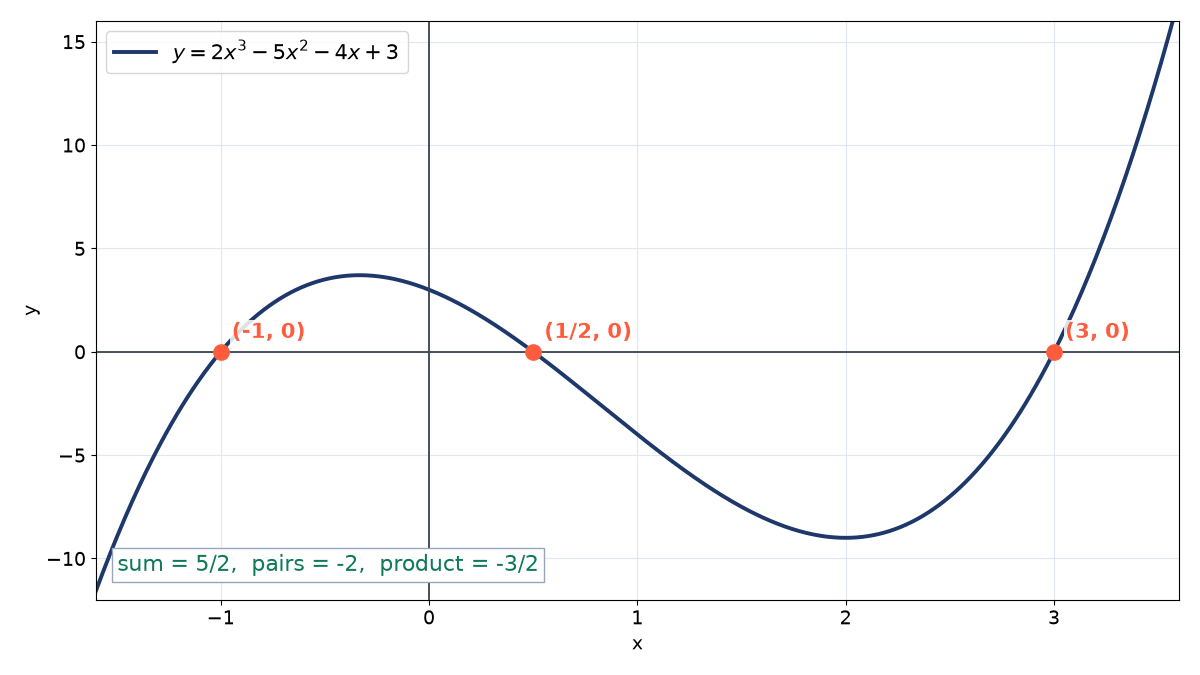
So all three are zeroes; in fact p ( x ) = ( x − 3 ) ( 2 x − 1 ) ( x + 1 ) p(x) = (x - 3)(2x - 1)(x + 1) p ( x ) = ( x − 3 ) ( 2 x − 1 ) ( x + 1 ) a = 2 a = 2 a = 2 b = − 5 b = -5 b = − 5 c = − 4 c = -4 c = − 4 d = 3 d = 3 d = 3 α = 3 \alpha = 3 α = 3 β = 1 2 \displaystyle \beta = \frac{1}{2} β = 2 1 γ = − 1 \gamma = -1 γ = − 1
α + β + γ = 3 + 1 2 − 1 = 5 2 = − − 5 2 = − b a α β + β γ + γ α = 3 2 + ( − 1 2 ) + ( − 3 ) = − 2 = − 4 2 = c a α β γ = 3 × 1 2 × ( − 1 ) = − 3 2 = − 3 2 = − d a \displaystyle \begin{aligned} \alpha + \beta + \gamma &= 3 + \tfrac{1}{2} - 1 = \tfrac{5}{2} = -\frac{-5}{2} = -\frac{b}{a} \\ \alpha\beta + \beta\gamma + \gamma\alpha &= \tfrac{3}{2} + \left(-\tfrac{1}{2}\right) + (-3) = -2 = \frac{-4}{2} = \frac{c}{a} \\ \alpha\beta\gamma &= 3 \times \tfrac{1}{2} \times (-1) = -\tfrac{3}{2} = -\frac{3}{2} = -\frac{d}{a} \end{aligned} α + β + γ α β + β γ + γ α α β γ = 3 + 2 1 − 1 = 2 5 = − 2 − 5 = − a b = 2 3 + ( − 2 1 ) + ( − 3 ) = − 2 = 2 − 4 = a c = 3 × 2 1 × ( − 1 ) = − 2 3 = − 2 3 = − a d
All three relationships hold.
The cubic in Example 6 crosses the x-axis at its three zeroes. Common mistakes#
Writing the sum as b a \displaystyle \frac{b}{a} a b − b a \displaystyle -\frac{b}{a} − a b
Ignoring the sign of b b b c c c 6 x 2 − 5 x − 6 6x^2 - 5x - 6 6 x 2 − 5 x − 6 b = − 5 b = -5 b = − 5 c = − 6 c = -6 c = − 6 5 5 5 6 6 6
Forming the quadratic as x 2 + S x + P x^2 + Sx + P x 2 + S x + P x 2 − S x + P x^2 - Sx + P x 2 − S x + P
Using the cubic product rule without the minus sign: α β γ = − d a \displaystyle \alpha\beta\gamma = -\frac{d}{a} α β γ = − a d
Writing α 2 + β 2 = ( α + β ) 2 \alpha^2 + \beta^2 = (\alpha + \beta)^2 α 2 + β 2 = ( α + β ) 2 − 2 α β -2\alpha\beta − 2 α β
Forgetting that a missing term has coefficient 0 0 0
Saying "the" quadratic when the answer is only fixed up to a non-zero constant k k k
Try these#
Find the sum and product of the zeroes of 3 x 2 + 7 x − 6 3x^2 + 7x - 6 3 x 2 + 7 x − 6 Answer: sum − 7 3 \displaystyle -\frac{7}{3} − 3 7 − 2 -2 − 2 2 3 \displaystyle \frac{2}{3} 3 2 − 3 -3 − 3
Find a quadratic polynomial whose zeroes have sum − 1 2 \displaystyle -\frac{1}{2} − 2 1 − 3 -3 − 3 Answer: 2 x 2 + x − 6 2x^2 + x - 6 2 x 2 + x − 6
One zero of x 2 + k x − 15 x^2 + kx - 15 x 2 + k x − 15 3 3 3 k k k Answer: k = 2 k = 2 k = 2 − 5 -5 − 5
If α \alpha α β \beta β x 2 − 7 x + 10 x^2 - 7x + 10 x 2 − 7 x + 10 α 2 + β 2 \alpha^2 + \beta^2 α 2 + β 2 Answer: 29 29 29
The zeroes of x 3 − 6 x 2 + 11 x − 6 x^3 - 6x^2 + 11x - 6 x 3 − 6 x 2 + 11 x − 6 1 1 1 2 2 2 3 3 3 Answer: 6 6 6 11 11 11 6 6 6
Key terms#
Zero A value of x x x 0 0 0
Coefficient The number multiplying a power of x x x
Leading coefficient The coefficient of the highest power, written a a a 0 0 0
Constant term The term without x x x c c c d d d
Sum of zeroes − b a \displaystyle -\frac{b}{a} − a b Product of zeroes c a \displaystyle \frac{c}{a} a c − d a \displaystyle -\frac{d}{a} − a d Sum of products two at a time α β + β γ + γ α = c a \displaystyle \alpha\beta + \beta\gamma + \gamma\alpha = \frac{c}{a} α β + β γ + γ α = a c Factor If α \alpha α ( x − α ) (x - \alpha) ( x − α )
Common questions#
Multiplying a polynomial by any non-zero number does not change where it equals 0 0 0 k k k
Do the relationships hold if the zeroes are equal?#
Yes. For ( x − 3 ) 2 = x 2 − 6 x + 9 (x - 3)^2 = x^2 - 6x + 9 ( x − 3 ) 2 = x 2 − 6 x + 9 3 3 3 3 3 3 6 = − − 6 1 \displaystyle 6 = -\frac{-6}{1} 6 = − 1 − 6 9 = 9 1 \displaystyle 9 = \frac{9}{1} 9 = 1 9
Can I use the relationships instead of factorising?#
For sums, products and expressions such as α 2 + β 2 \alpha^2 + \beta^2 α 2 + β 2
How do I remember the cubic signs?#
Divide the coefficients by a a a − b a \displaystyle -\frac{b}{a} − a b + c a \displaystyle +\frac{c}{a} + a c − d a \displaystyle -\frac{d}{a} − a d
Is the order of α \alpha α β \beta β #
No. Sums and products do not depend on the order, so either zero can be called α \alpha α
References#
National Council of Educational Research and Training. Mathematics: Textbook for Class X . NCERT, New Delhi.
Aggarwal, R. S. Secondary School Mathematics for Class 10 . Bharati Bhawan.
Hall, H. S. and Knight, S. R. Higher Algebra . Macmillan.