Expresswala Academy Mathematics Tuition

Polynomials

Zeroes of a Polynomial and Their Graphs: Class 10 Maths

Learn what the zeroes of a polynomial mean on a graph: degree, linear, quadratic and cubic polynomials, and how to count zeroes from where the graph meets the x-axis.

By 10 min read

A poly­no­mial is an expres­sion such as 3x−63x - 6, x2−2x−15x^2 - 2x - 15 or x3−4xx^3 - 4x. A zero of a poly­no­mial is a value of xx that makes the poly­no­mial equal to 00. This les­son shows what zeroes look like on a graph: they are exactly the points where the graph meets the x-axis. Once you see this, you can tell how many zeroes a poly­no­mial has just by look­ing at its graph, which is a com­mon short-answer ques­tion in Class 10 board papers. The same idea is used later when you solve qua­dratic equa­tions and when you study graphs in higher classes.

Poly­no­mi­als and their degree

What a poly­no­mial is

A poly­no­mial in xx is a sum of terms of the form axna x^n, where aa is a real num­ber and nn is a whole num­ber (0,1,2,3,…0, 1, 2, 3, \dots). So 4x2−7x+14x^2 - 7x + 1 is a poly­no­mial, but x+2\sqrt{x} + 2 and 1x+3\displaystyle \frac{1}{x} + 3 are not, because the pow­ers 12\displaystyle \frac{1}{2} and −1-1 are not whole num­bers.

Degree

The degree of a poly­no­mial is the high­est power of xx that appears with a non-zero coef­fi­cient. For exam­ple, 2x3−3x2+x−52x^3 - 3x^2 + x - 5 has degree 33, and 7−2x7 - 2x has degree 11.

Types by degree

DegreeNameGen­eral formExam­ple
1Lin­ear poly­no­mialax+b, a≠0ax + b,\ a \ne 03x−63x - 6
2Qua­dratic poly­no­mialax2+bx+c, a≠0ax^2 + bx + c,\ a \ne 0x2−2x−15x^2 - 2x - 15
3Cubic poly­no­mialax3+bx2+cx+d, a≠0ax^3 + bx^2 + cx + d,\ a \ne 0x3−4xx^3 - 4x

The con­di­tion a≠0a \ne 0 mat­ters: if the lead­ing coef­fi­cient were 00, the degree would drop.

Value of a poly­no­mial

If p(x)p(x) is a poly­no­mial and kk is a real num­ber, then p(k)p(k) is the num­ber you get by replac­ing xx with kk. This is called the value of p(x)p(x) at x=kx = k.

Zero of a poly­no­mial

A real num­ber kk is a zero of p(x)p(x) if p(k)=0p(k) = 0. For a lin­ear poly­no­mial ax+bax + b, solv­ing ax+b=0ax + b = 0 gives exactly one zero:

x=−ba\displaystyle x = -\frac{b}{a}

The key result: zeroes are x-inter­cepts

State­ment

The zeroes of a poly­no­mial p(x)p(x) are pre­cisely the x-coor­di­nates of the points where the graph of y=p(x)y = p(x) meets the x-axis. So the num­ber of zeroes equals the num­ber of points where the graph meets the x-axis.

Why it is true

Every point on the x-axis has y-coor­di­nate 00. A point (k,y)(k, y) lies on the graph of y=p(x)y = p(x) exactly when y=p(k)y = p(k). So the graph meets the x-axis at (k,0)(k, 0) exactly when p(k)=0p(k) = 0, that is, exactly when kk is a zero of p(x)p(x). Both state­ments describe the same set of num­bers, so they must match one for one.

Graph of a lin­ear poly­no­mial

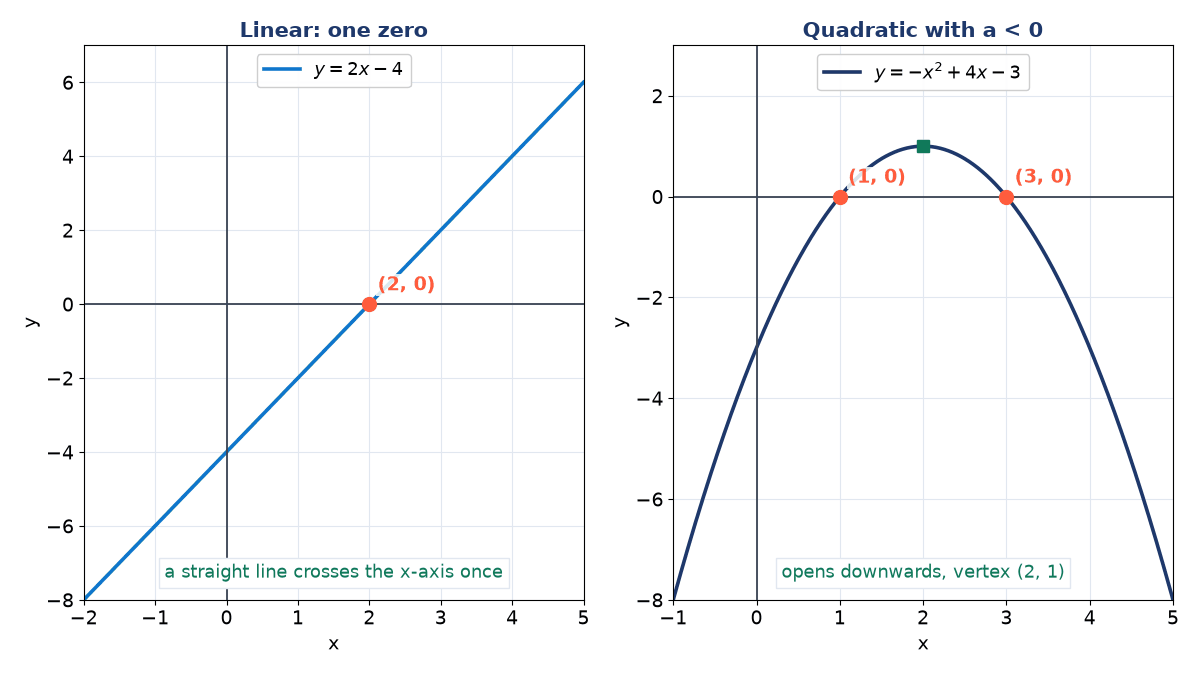
The graph of y=ax+by = ax + b with a≠0a \ne 0 is a straight line that is not par­al­lel to the x-axis, so it crosses the x-axis at exactly one point, (−ba,0)\displaystyle \left(-\frac{b}{a}, 0\right). A lin­ear poly­no­mial there­fore has exactly one zero.

Two graphs: the line y = 2x - 4 crossing the x-axis at (2, 0), and the downward parabola y = -x^2 + 4x - 3 crossing at (1, 0) and (3, 0) with vertex (2, 1)
The line y=2x−4y = 2x - 4 meets the x-axis once; the parabola y=−x2+4x−3y = -x^2 + 4x - 3 opens down­wards and meets it twice.

Graph of a qua­dratic poly­no­mial

The graph of y=ax2+bx+cy = ax^2 + bx + c is a curve called a parabola.

  • If a>0a \gt 0, the parabola opens upwards (like a cup) and has a low­est point.
  • If a<0a \lt 0, it opens down­wards (like a cap) and has a high­est point.

The low­est or high­est point is called the ver­tex. A parabola can relate to the x-axis in only three ways:

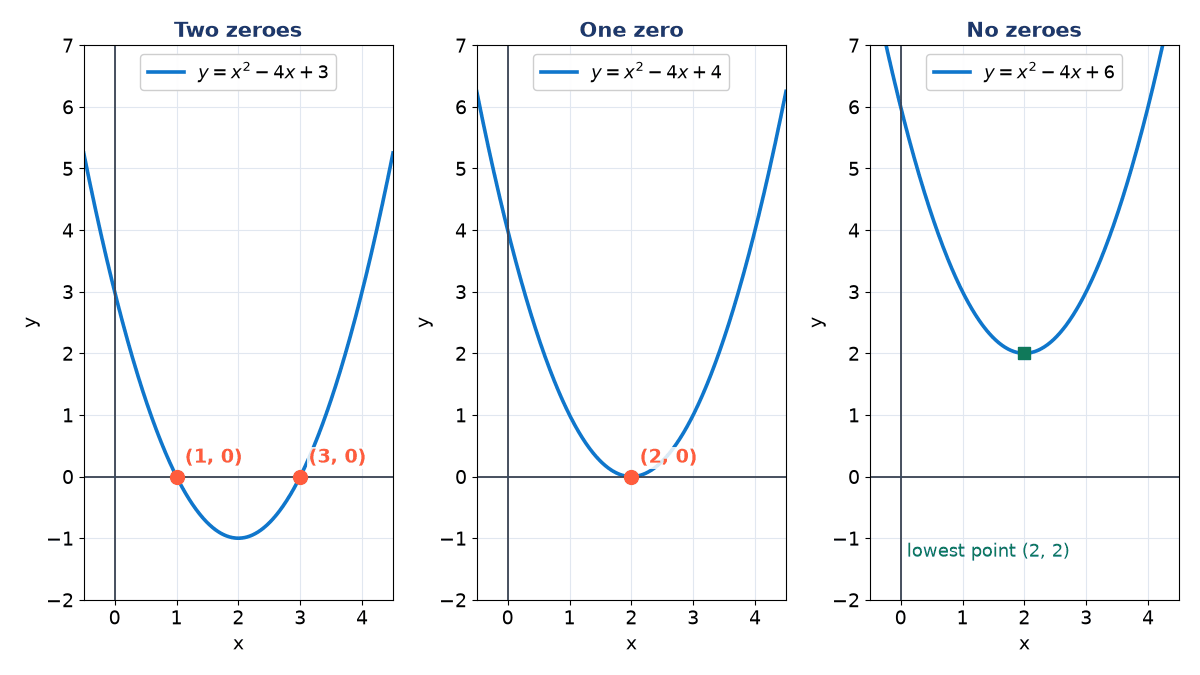
  1. It cuts the x-axis at two dis­tinct points: two zeroes.
  2. It just touches the x-axis at one point (the ver­tex lies on the axis): one zero, which is counted twice as two equal zeroes.
  3. It lies com­pletely above or com­pletely below the x-axis: no real zeroes.

So a qua­dratic poly­no­mial has at most two zeroes.

Three upward parabolas: y = x^2 - 4x + 3 cuts the x-axis at (1, 0) and (3, 0); y = x^2 - 4x + 4 touches at (2, 0); y = x^2 - 4x + 6 stays above, lowest point (2, 2)
Three qua­drat­ics with the same shape: two zeroes, one zero, and no zeroes.

Graph of a cubic poly­no­mial

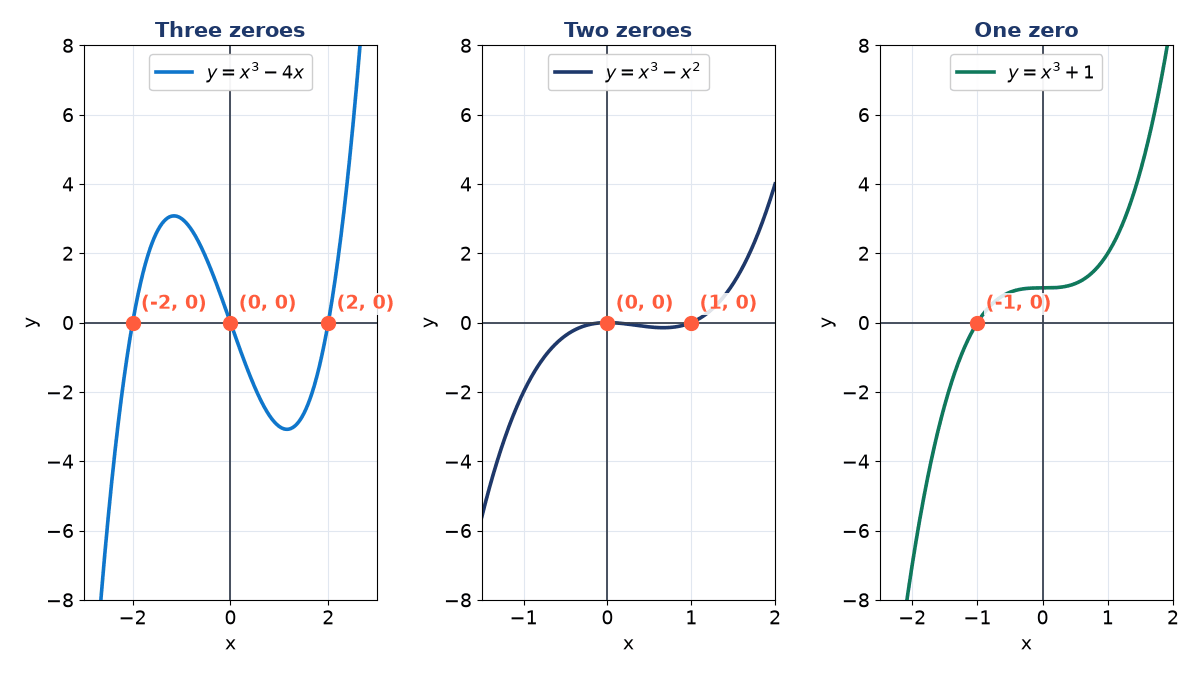
The graph of a cubic y=ax3+bx2+cx+dy = ax^3 + bx^2 + cx + d always goes off in oppo­site ver­ti­cal direc­tions at the two ends (one end up, the other down), so it must meet the x-axis at least once. It can meet the x-axis at one, two or three points. A cubic poly­no­mial there­fore has at most three zeroes.

Three cubic graphs: y = x^3 - 4x meets the x-axis at -2, 0 and 2; y = x^3 - x^2 touches at 0 and crosses at 1; y = x^3 + 1 crosses only at (-1, 0)
Cubic graphs meet­ing the x-axis at three, two and one points.

The gen­eral rule

A poly­no­mial of degree nn has at most nn zeroes, so its graph meets the x-axis at most nn times.

Method: read­ing zeroes from a graph

  1. Look only at the points where the curve meets the x-axis (cross­ing or touch­ing both count).
  2. Count these points. That count is the num­ber of zeroes.
  3. Read the x-coor­di­nate of each point. These are the zeroes.
  4. Check your answer against the degree: a qua­dratic can­not have more than 22 zeroes, a cubic not more than 33.
  5. If the equa­tion is given, con­firm each zero by sub­sti­tut­ing it and get­ting 00.

Ignore where the graph meets the y-axis. That point gives p(0)p(0), the con­stant term, not a zero.

Worked exam­ples

Exam­ple 1: find­ing a value

Find the value of p(x)=2x3−3x2+x−5p(x) = 2x^3 - 3x^2 + x - 5 at x=2x = 2 and at x=−1x = -1. State its degree.

p(2)=2(8)−3(4)+2−5=16−12+2−5=1p(−1)=2(−1)−3(1)+(−1)−5=−2−3−1−5=−11\begin{aligned} p(2) &= 2(8) - 3(4) + 2 - 5 = 16 - 12 + 2 - 5 = 1 \\ p(-1) &= 2(-1) - 3(1) + (-1) - 5 = -2 - 3 - 1 - 5 = -11 \end{aligned}

The high­est power is x3x^3, so the degree is 33 (a cubic). Since nei­ther value is 00, nei­ther 22 nor −1-1 is a zero.

Exam­ple 2: zero of a lin­ear poly­no­mial

Find the zero of p(x)=3x−6p(x) = 3x - 6 and say where its graph meets the x-axis.

Set 3x−6=03x - 6 = 0, so 3x=63x = 6 and x=2x = 2. Check: p(2)=6−6=0p(2) = 6 - 6 = 0. The graph is a straight line that meets the x-axis at (2,0)(2, 0). The line y=2x−4y = 2x - 4 in the first fig­ure has the same zero, since 2(2)−4=02(2) - 4 = 0.

Exam­ple 3: zeroes of a qua­dratic and its graph

Find the zeroes of p(x)=x2−2x−15p(x) = x^2 - 2x - 15 and describe its graph.

Split the mid­dle term: two num­bers with prod­uct −15-15 and sum −2-2 are −5-5 and 33.

x2−2x−15=x2−5x+3x−15=x(x−5)+3(x−5)=(x−5)(x+3)\begin{aligned} x^2 - 2x - 15 &= x^2 - 5x + 3x - 15 \\ &= x(x - 5) + 3(x - 5) \\ &= (x - 5)(x + 3) \end{aligned}

So p(x)=0p(x) = 0 when x=5x = 5 or x=−3x = -3. Here a=1>0a = 1 \gt 0, so the parabola opens upwards and cuts the x-axis at (−3,0)(-3, 0) and (5,0)(5, 0). Its ver­tex lies mid­way between the zeroes, at x=1x = 1, where p(1)=1−2−15=−16p(1) = 1 - 2 - 15 = -16, so the ver­tex is (1,−16)(1, -16). The graph meets the y-axis at (0,−15)(0, -15), which is not a zero.

Exam­ple 4: count­ing zeroes with­out full fac­toris­ing

With­out draw­ing, decide how many zeroes each has: (a) x2−6x+9x^2 - 6x + 9, (b) x2+2x+5x^2 + 2x + 5.

(a) x2−6x+9=(x−3)2x^2 - 6x + 9 = (x - 3)^2. This is 00 only at x=3x = 3 and pos­i­tive every­where else, so the parabola touches the x-axis at (3,0)(3, 0). It has one zero (33, repeated).

(b) Com­plete the square:

x2+2x+5=(x+1)2+4x^2 + 2x + 5 = (x + 1)^2 + 4

A square is never neg­a­tive, so the value is always at least 44. The low­est point is (−1,4)(-1, 4), above the x-axis, so the graph never meets the axis. There are no real zeroes.

Exam­ple 5: a parabola that opens down­wards

For p(x)=−x2+4x−3p(x) = -x^2 + 4x - 3, find the zeroes, the ver­tex and the direc­tion in which the graph opens.

Take out −1-1 and fac­torise:

−x2+4x−3=−(x2−4x+3)=−(x−1)(x−3)-x^2 + 4x - 3 = -(x^2 - 4x + 3) = -(x - 1)(x - 3)

The zeroes are 11 and 33. Since a=−1<0a = -1 \lt 0, the parabola opens down­wards. The ver­tex is at x=1+32=2\displaystyle x = \frac{1 + 3}{2} = 2, and p(2)=−4+8−3=1p(2) = -4 + 8 - 3 = 1, so the ver­tex is (2,1)(2, 1), above the x-axis, which is why the curve crosses the axis twice. It meets the y-axis at (0,−3)(0, -3). Com­pare with the sec­ond panel of the first fig­ure.

Exam­ple 6: zeroes of cubics from their graphs

Find the zeroes of (a) x3−4xx^3 - 4x, (b) x3−x2x^3 - x^2 and match them with the cubic fig­ure.

(a) x3−4x=x(x2−4)=x(x−2)(x+2)x^3 - 4x = x(x^2 - 4) = x(x - 2)(x + 2). The zeroes are −2-2, 00 and 22: three cross­ing points. As a check on the shape, p(−1)=−1+4=3p(-1) = -1 + 4 = 3 and p(1)=1−4=−3p(1) = 1 - 4 = -3, so the curve is above the axis between −2-2 and 00 and below it between 00 and 22.

(b) x3−x2=x2(x−1)x^3 - x^2 = x^2(x - 1). The zeroes are 00 (repeated) and 11. The graph touches the x-axis at the ori­gin and crosses at (1,0)(1, 0): two points, so two dis­tinct zeroes.

For com­par­i­son, x3+1x^3 + 1 is 00 only at x=−1x = -1 among real num­bers, so its graph meets the x-axis only once.

Com­mon mis­takes

  • Count­ing the point where the graph meets the y-axis as a zero. Only points on the x-axis count.
  • Say­ing a parabola that only touches the x-axis has no zero. Touch­ing counts: it has one zero.
  • Claim­ing a qua­dratic graph meets the x-axis three times. A parabola can meet it at most twice; recheck your sketch.
  • For­get­ting that a cubic graph must meet the x-axis at least once.
  • Think­ing a down­ward parabola always has zeroes. If its high­est point is below the x-axis, it has none.
  • Writ­ing the zero as the point (2,0)(2, 0) when the ques­tion asks for the zero. The zero is the num­ber 22.
  • Drop­ping the minus sign when sub­sti­tut­ing a neg­a­tive value, for exam­ple writ­ing (−1)3=1(-1)^3 = 1.

Try these

  1. Find p(−1)p(-1) for p(x)=x3−2x2+3p(x) = x^3 - 2x^2 + 3. What does your answer tell you? Answer: p(−1)=0p(-1) = 0, so −1-1 is a zero.
  2. Find the zeroes of x2−x−12x^2 - x - 12. Answer: 44 and −3-3.
  3. How many zeroes does x2+x+1x^2 + x + 1 have? Answer: none (its graph stays above the x-axis).
  4. The graph of a cubic poly­no­mial cuts the x-axis at x=−3x = -3, x=1x = 1 and x=4x = 4. How many zeroes does it have? Answer: 33.
  5. Find the zero of 5x+25x + 2. Answer: −25\displaystyle -\frac{2}{5}.
  6. Describe the graph of y=−x2+6x−9y = -x^2 + 6x - 9 and give its num­ber of zeroes. Answer: a down­ward parabola touch­ing the x-axis at (3,0)(3, 0); one zero, 33.

Key terms

Poly­no­mial
A sum of terms axnax^n where each nn is a whole num­ber and each aa is real.
Degree
The high­est power of the vari­able with a non-zero coef­fi­cient.
Lin­ear poly­no­mial
A poly­no­mial of degree 1; its graph is a straight line.
Qua­dratic poly­no­mial
A poly­no­mial of degree 2; its graph is a parabola.
Cubic poly­no­mial
A poly­no­mial of degree 3.
Value of a poly­no­mial
The num­ber p(k)p(k) obtained by sub­sti­tut­ing x=kx = k.
Zero
A num­ber kk with p(k)=0p(k) = 0; the x-coor­di­nate of a point where the graph meets the x-axis.
Parabola
The U-shaped (or inverted U-shaped) graph of a qua­dratic poly­no­mial.
Ver­tex
The low­est point of an upward parabola or the high­est point of a down­ward one.

Com­mon ques­tions

Can a qua­dratic poly­no­mial have exactly one zero?

Yes. When the parabola just touches the x-axis, as x2−4x+4=(x−2)2x^2 - 4x + 4 = (x - 2)^2 does at x=2x = 2, there is one zero. It is often described as two equal zeroes.

Can a cubic poly­no­mial have no zeroes?

No. One end of a cubic graph goes up and the other goes down, so the curve must cross the x-axis at least once.

Does the sign of aa change the num­ber of zeroes?

Not by itself. The sign of aa only decides whether the parabola opens up or down. The num­ber of zeroes depends on where the ver­tex is com­pared with the x-axis.

What does the point where the graph meets the y-axis tell me?

It is (0,p(0))(0, p(0)), and p(0)p(0) is the con­stant term. It is a zero only if the con­stant term is itself 00.

How many zeroes can a poly­no­mial of degree nn have?

At most nn. A lin­ear poly­no­mial has exactly one, a qua­dratic at most two and a cubic at most three.
Ref­er­ences

  1. National Coun­cil of Edu­ca­tional Research and Train­ing. Math­e­mat­ics: Text­book for Class X. NCERT, New Delhi.
  2. Sharma, R. D. Math­e­mat­ics for Class 10. Dhan­pat Rai Pub­li­ca­tions.
  3. Stew­art, J., Redlin, L. and Wat­son, S. Pre­cal­cu­lus: Math­e­mat­ics for Cal­cu­lus. Cen­gage Learn­ing.