Volume of a Combination of Solids: Class 10 Examples
Find the volume of combined solids by adding and subtracting simple volumes. Covers hemispherical and conical ends, hollowed-out solids, rise in water level and capacity in litres, with worked examples.
Volume tells you how much space a solid takes up, or how much a container can hold. For objects built from simple solids, such as a storage tank with a rounded bottom, a toy that is a cone on a hemisphere, or a pencil stand with a hole drilled in it, the volume comes from adding and subtracting the volumes of the pieces. Volume questions are used to find how much material an object needs, how heavy it is, and how much water a tank holds.
This lesson shows why volumes simply add, how to handle hollowed-out solids, how to find a rise in water level, and how to convert cubic units to litres.
Volume measures the space filled by material. When two solids are joined, they do not overlap: each keeps all its own material, and none of it disappears into the join. So the space filled by the whole is the space filled by one part plus the space filled by the other. There is no "hidden face" correction, because a face has area but no thickness, so it has no volume.
When a piece is cut out, exactly that piece's material is lost, so its volume is subtracted.
For displacement: water cannot occupy the space taken by the sunken solid, so the water level goes up until the extra space above the old level equals the solid's volume. If the container is a cylinder of radius R and the level rises by x, the extra space is a cylinder of volume πR2x. So
πR2x=Vsolid⇒x=πR2Vsolid.
Surface area thinking versus volume thinking#
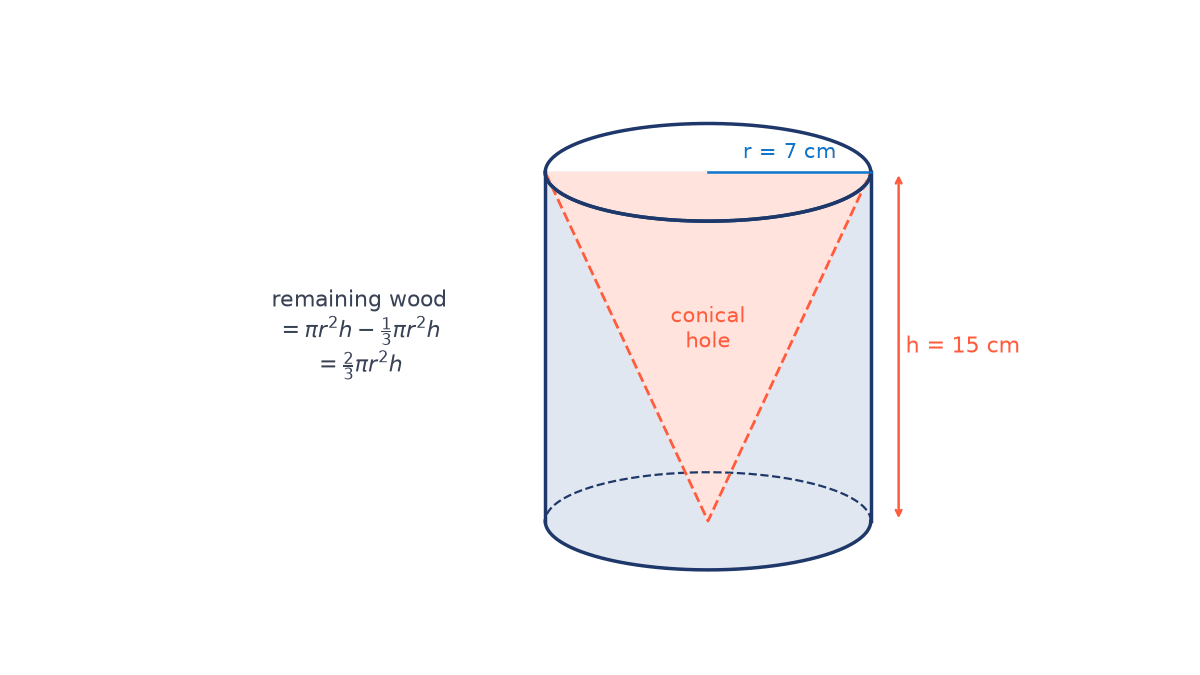
From a solid wooden cylinder of radius 7 cm and height 15 cm, a cone of the same radius and the same height is carved out. Find the volume of wood left.
A cone takes one third of the cylinder with the same base and height, so two thirds is left.
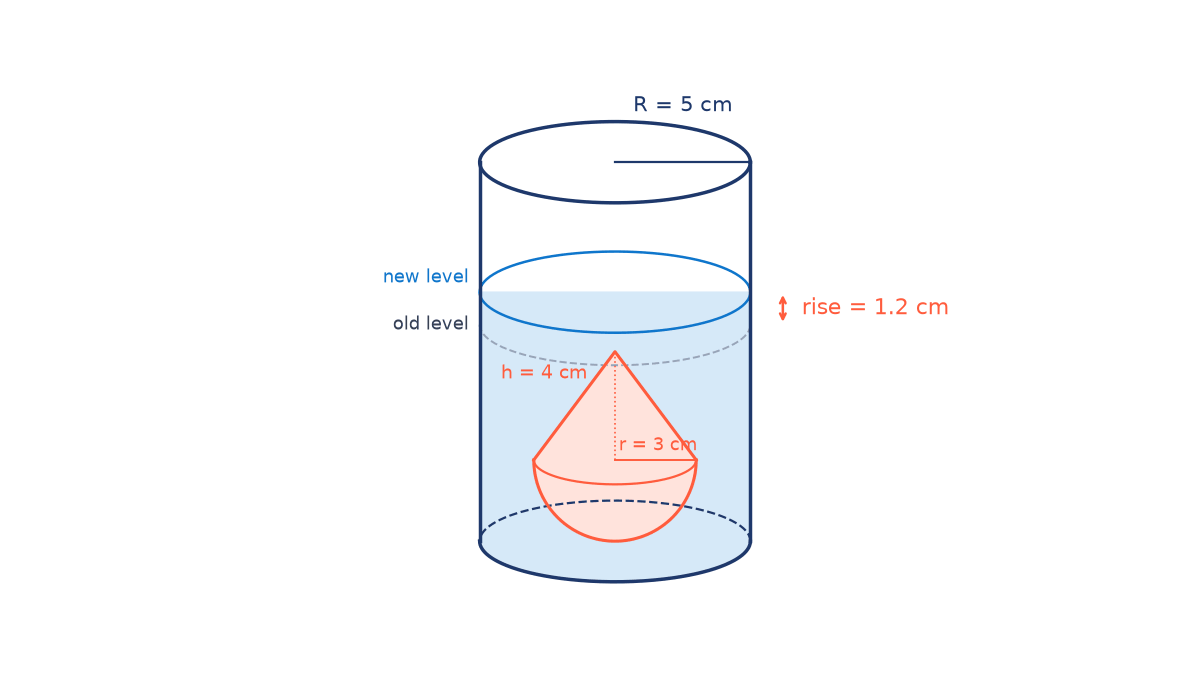
A cylindrical vessel of radius 5 cm contains water. A solid toy, made of a cone of radius 3 cm and height 4 cm on a hemisphere of radius 3 cm, is dropped in and is fully under water. By how much does the water level rise?
The extra water column above the old level has the same volume as the toy.
A water tank is a cylinder of radius 0.6 m and height 1.2 m with a hemispherical bottom of the same radius. Find how many litres of water it can hold. Use π=3.14.
A toy is a cone of radius 7 cm and height 7 cm on a hemisphere of radius 7 cm. Find its volume. Answer: 1078 cm3.
From a cube of edge 7 cm, the largest possible hemisphere is scooped out of one face. Find the volume left, correct to two decimal places, using π=722. Answer: 253.17 cm3.
A solid made of a cylinder (radius 2 cm, height 10 cm) with a cone (radius 2 cm, height 6 cm) on top is sunk in a cuboidal tank with a base of 20 cm by 10 cm. Find the rise in water level, using π=3.14. Answer: 0.7536 cm.
Find the capacity in litres of a cylindrical container of radius 7 cm and height 20 cm. Answer: 3.08 litres.