Learn to find the surface area of solids made by joining cubes, cylinders, cones and hemispheres: which faces are hidden, a step-by-step method, and worked toy, capsule, tent and cost examples.
Many everyday objects are made by joining simple solids. A spinning top can be a cone sitting on a hemisphere. A medicine capsule is a cylinder with a hemisphere at each end. A circus tent is a cylinder with a cone on top. To find how much paint, cloth or metal sheet such an object needs, you find its surface area. The key skill is not a new formula. It is deciding which faces can still be seen once the solids are joined, and which are now hidden inside.
This lesson recaps the standard formulas, explains the "hidden face" idea, and works through toys, capsules, tents, a cube with a dome and a hollowed-out cylinder, ending with a cost problem in rupees.
In the table, a is the edge of a cube; l, b, h are the length, breadth and height of a cuboid; r is a radius, h a height and l the slant height of a cone.
Solid
Curved or lateral surface area
Total surface area
Volume
Cube
4a2
6a2
a3
Cuboid
2h(l+b)
2(lb+bh+hl)
lbh
Cylinder
2πrh
2πr(r+h)
πr2h
Cone
πrl
πr(l+r)
31πr2h
Sphere
4πr2
4πr2
34πr3
Hemisphere
2πr2
3πr2
32πr3
For a cone the slant height comes from Pythagoras' theorem, because the height, the radius and the slant height form a right-angled triangle:
l=h2+r2
Unless a question says otherwise, take π=722. When the radius is a multiple of 7 (or of 3.5), this value makes the arithmetic come out neatly.
The total surface area of a hemisphere, 3πr2, is its curved dome 2πr2 plus its flat circular face πr2. When solids are joined, the flat faces are usually the ones that disappear. That is why combined-solid problems almost always use the curved surface areas, plus only those flat faces that are still exposed.
Surface area of a combined solid = sum of the areas of all the faces that are still on the outside after joining.
It is not the sum of the total surface areas of the separate pieces. When two solids are stuck together along a flat face, that face is now inside the object: nobody can paint it or touch it.
Surface area measures the outer skin of an object. Picture wrapping the finished object in paper. The paper touches only the exposed faces. The circle where a cone meets a hemisphere is sealed on both sides, so no paper reaches it. So we add the exposed parts and leave out every face that lies along a join. If a joined face is only partly covered, as when a small hemisphere sits on a large cube face, the uncovered part of that face is still exposed and must be counted.
Example 1: A toy made of a cone on a hemisphere#
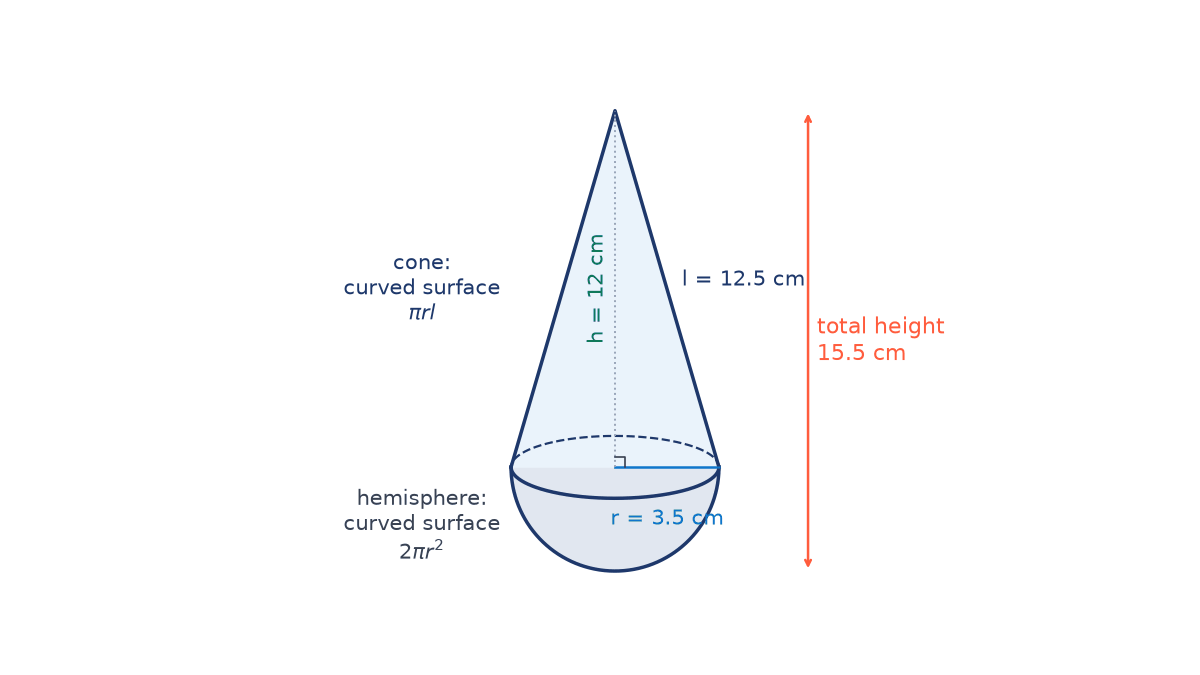
A wooden toy is a cone of radius 3.5 cm mounted on a hemisphere of the same radius. The total height of the toy is 15.5 cm. Find its total surface area. If painting costs ₹2 per cm2, find the cost of painting it.
The flat circle where the cone meets the hemisphere is hidden, so only the two curved surfaces count.
Dimensions. The hemisphere's height equals its radius, so the height of the cone is 15.5−3.5=12 cm. Then
l=122+3.52=144+12.25=156.25=12.5 cm.
Exposed faces. The curved surface of the cone and the curved surface of the hemisphere. The shared circle is hidden.
CSA of hemisphereCSA of coneTotal surface area=2πr2=2×722×3.5×3.5=77 cm2=πrl=722×3.5×12.5=137.5 cm2=77+137.5=214.5 cm2
Notice that h+2r is just the total length, 20 mm. So the surface of a capsule equals 2πr×(total length), the same as an open cylinder of that full length.
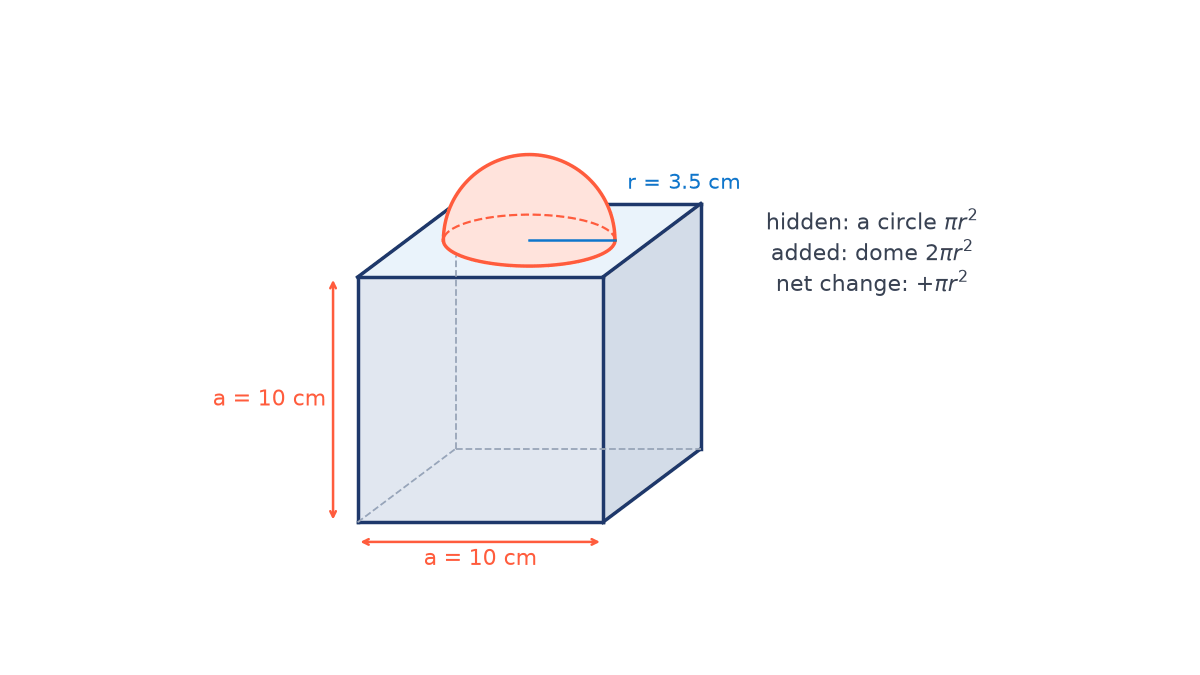
A decorative block is a cube of edge 10 cm. A hemisphere of diameter 7 cm is fixed on the centre of its top face. Find the total surface area of the block.
The hemisphere covers a circle of the top face but adds a dome twice that area.
Exposed faces. All six faces of the cube except the circle of radius 3.5 cm under the hemisphere, plus the dome of the hemisphere.
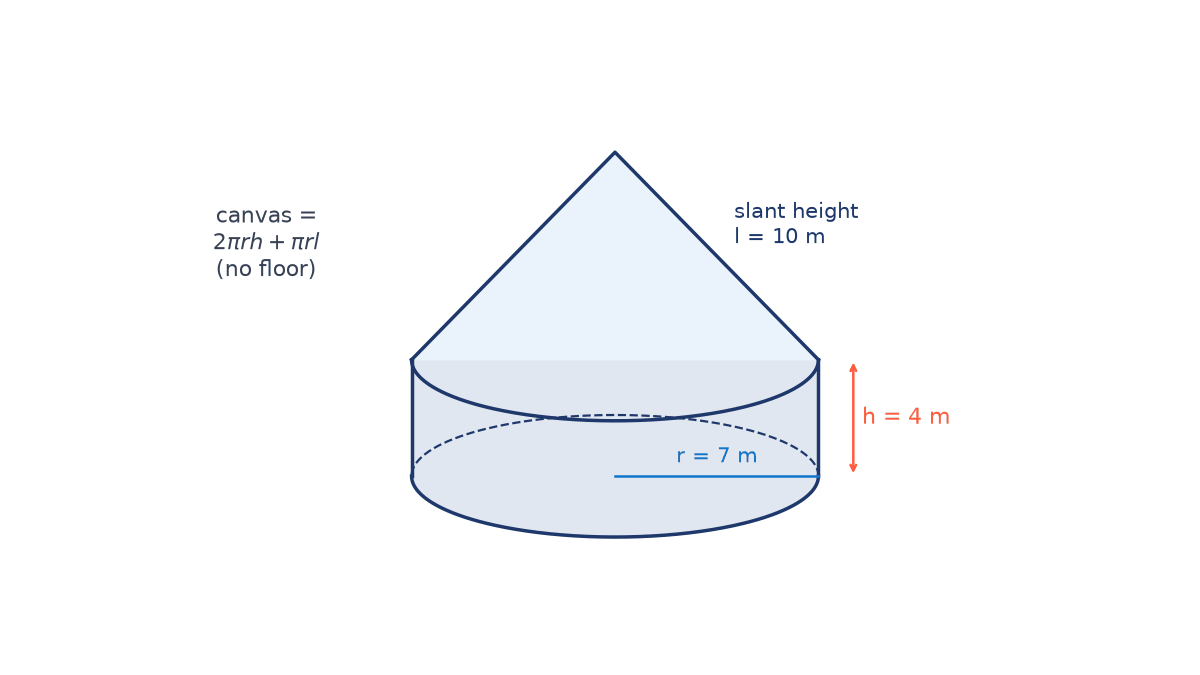
A tent has a cylindrical lower part of radius 7 m and height 4 m, with a conical top of the same radius and slant height 10 m. Find the area of canvas needed (there is no canvas floor). Find the cost of the canvas at ₹120 per m2.
Canvas covers the curved wall and the conical roof; the floor and the joining circle are not covered.
Exposed faces. The curved wall of the cylinder and the curved surface of the cone. The circle where they meet is hidden, and the floor has no canvas.
A solid cylinder of radius 3 cm and height 10 cm has a cone of the same radius and height 4 cm hollowed out from its top face. Find the total surface area of the remaining solid, first in terms of π and then using π=722.
Dimensions. Slant height of the hollow: l=42+32=5 cm.
Exposed faces. The curved surface of the cylinder and its bottom circle are unchanged. The top circle has been removed completely (the hollow has the same radius). In its place is the inner curved surface of the cone, which is now on the outside.
A solid is a cylinder of radius 7 cm and height 10 cm with a hemisphere of the same radius on top. Its flat base is exposed. Find its total surface area. Answer: 902 cm2.
Two cubes of edge 5 cm are joined face to face. Find the surface area of the cuboid formed. Answer: 250 cm2.
A cone of radius 6 cm and height 8 cm stands on top of a cylinder of radius 6 cm and height 10 cm. Find the total surface area in terms of π. Answer:216πcm2.
A hemisphere of diameter 14 cm is fixed on one face of a cube of edge 14 cm. Find the total surface area. Answer: 1330 cm2.
For the toy in Example 1, what would painting cost at ₹2 per cm2 if only the cone were painted? Answer: ₹275.
Is the surface area of a combined solid the sum of the separate surface areas?#
No. Faces that are joined together are hidden, so you add only the parts that remain on the outside. Summing total surface areas counts the joined faces twice.
When do I use 2πr2 and when 3πr2 for a hemisphere?#
Use 2πr2 when the flat face is joined to another solid or is open. Use 3πr2 only for a solid hemisphere standing alone with its flat face exposed.
Can hollowing out a solid increase its surface area?#
Yes. A flat face is removed, but a new inner curved surface appears. In Example 5 the solid cylinder had 78πcm2 of surface before and 84πcm2 after.
Use whatever the question states. If it says nothing, 722 is usual when the radius is a multiple of 7 or 3.5; otherwise an answer in terms of π is also acceptable unless a number is asked for.