Irrational Numbers and Real Numbers Solutions: The World of Numbers, Class 9
Step-by-step solutions to all 16 end-of-chapter questions of The World of Numbers: decimals, the proof that root 5 is irrational, recurring decimals as fractions, numbers in between and the root spiral.
These are complete solutions to all 16 End-of-Chapter Exercises of "The World of Numbers". The questions practise long division into decimals, proving a square root irrational, turning repeating decimals into fractions, marking numbers on the number line, finding rational numbers between two given ones, and reasoning with signs and algebra. Each answer is worked in full so you can follow every step.
Key facts used:
A rational number is qp with p,q integers and q=0.
In lowest terms, qp has a terminating decimal exactly when q has no prime factor other than 2 and 5; if q=2a×5b, it has as many decimal places as the larger of a and b.
Pure repeating decimal with n repeating digits: multiply by 10n and subtract. General repeating decimal with m non-repeating and n repeating digits: compare 10mx and 10m+nx.
The average 2a+b of two rational numbers lies between them.
If n2 is a multiple of a prime r, then n is a multiple of r.
Baudhāyana–Pythagoras theorem: in a right triangle, (hypotenuse)2 = sum of squares of the legs.
Decimals and irrationality
Question 1
By long division, write each rational number as a terminating decimal or as a non-terminating repeating decimal: (i) 503 (ii) 92.
(i) Divide 3 by 50. 50 does not go into 3 or 30, so the first decimal digit is 0. Then 300÷50=6 with remainder 0, so the division stops.
503=0.06
Check: 50=2×52 has only the primes 2 and 5, so a terminating decimal was expected, with 2 places.
(ii) Divide 2 by 9. 20÷9=2 remainder 2. The remainder 2 is the same as the starting number, so every later step repeats: digit 2, remainder 2, for ever.
92=0.222…=0.2
Answer: (i) 0.06, terminating; (ii) 0.2, non-terminating repeating.
Question 2
Prove that 5 is an irrational number.
A fact we need. If n2 is a multiple of 5, then n is a multiple of 5. Any integer n not divisible by 5 is 5m+1, 5m+2, 5m+3 or 5m+4. Squaring:
None of these is a multiple of 5. So a square that is a multiple of 5 must come from a multiple of 5.
Proof by contradiction. Suppose 5 is rational, so 5=qp with integers p,q, q=0, and p,q co-prime.
Squaring, 5=q2p2, so p2=5q2. Then p2 is a multiple of 5, so p is a multiple of 5. Write p=5k for an integer k:
25k2=5q2⇒q2=5k2
So q2 is a multiple of 5, and therefore q is a multiple of 5. Now 5 divides both p and q, which contradicts the assumption that they are co-prime. The assumption was false.
Answer:5 cannot be written as qp, so it is irrational.
Question 3
Write each decimal in the form qp: (i) 12.6 (ii) 0.0120 (iii) 3.052 (iv) 1.235 (v) 0.23 (vi) 2.05 (vii) 2.125 (viii) 3.125 (ix) 2.1625.
(i) Terminating: 12.6=10126=563.
(ii) Terminating: 0.0120=0.012=100012=2503.
(iii) x=3.0525252…: one digit (0) does not repeat, two digits (52) repeat.
Here 9999=32×11×101, and 21623 is not divisible by 3, 11 or 101, so the fraction is in lowest terms. In (vii), (viii) and (ix) the numerators also share no factor with the denominators.
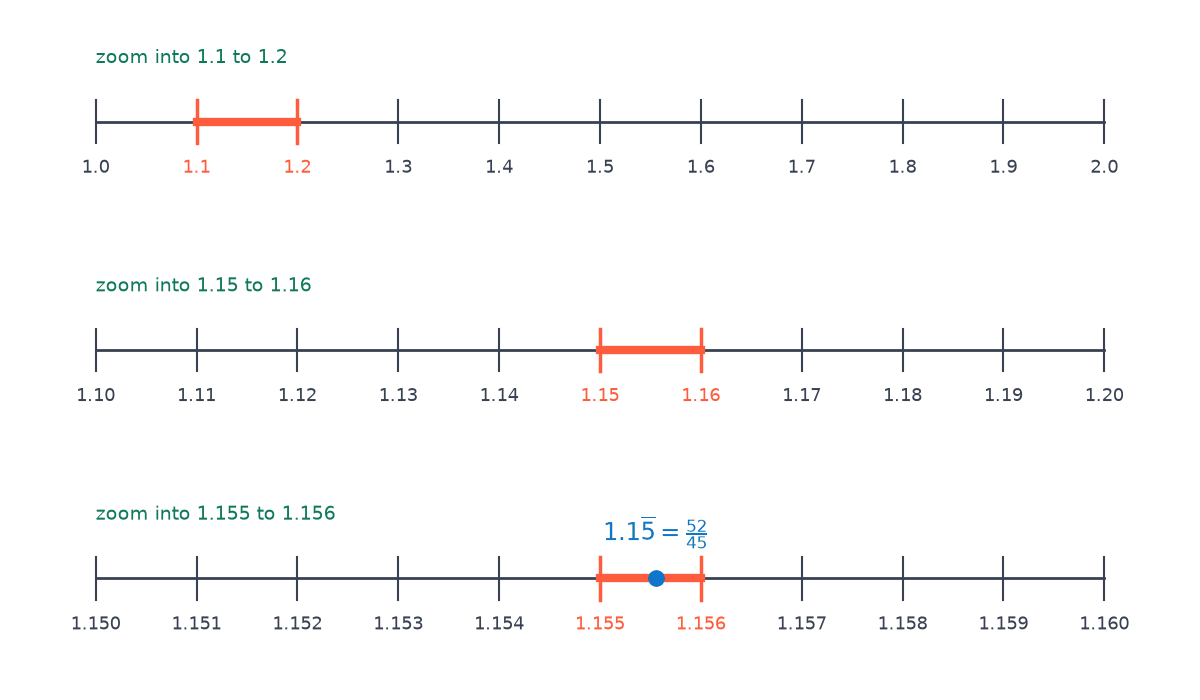
We use successive magnification: zoom into smaller and smaller intervals, each split into 10 equal parts.
(i) 0.532 lies between 0 and 1. Split 0 to 1 into tenths; it lies between 0.5 and 0.6. Split that piece into ten; it lies between 0.53 and 0.54. Split that into ten; it is the 2nd mark after 0.53, which is 0.532.
(ii) 1.15=1.1555… First find it as a fraction: with x=1.1555…, 100x−10x=115.5…−11.5…=104, so 90x=104 and x=4552. To locate it: it lies between 1 and 2; then between 1.1 and 1.2; then between 1.15 and 1.16; then between 1.155 and 1.156, a little past the middle (1.1555…). Each further zoom only narrows the interval, so we can mark it as closely as we like. Alternatively, mark 4552=1457 by splitting the unit from 1 to 2 into 45 equal parts and moving 7 parts.
Successive magnification locates 1.15=4552 between 1.155 and 1.156.
Answer: (i) 0.532 is the 2nd of ten equal marks between 0.53 and 0.54; (ii) 1.15=4552 lies between 1.155 and 1.156, found by zooming in as shown.
Question 5
Find 6 rational numbers between 3 and 4.
Write 3=1030 and 4=1040. Any numerator from 31 to 39 gives a number strictly between them. Take six of them:
1031,1032,1033,1034,1035,1036
These are 3.1,3.2,3.3,3.4,3.5,3.6. Many other answers are possible.
Answer: For example 3.1,3.2,3.3,3.4,3.5,3.6.
Question 6
Find 5 rational numbers between 52 and 53.
The numerators 2 and 3 have no whole number between them, so enlarge the denominator. We need at least 5 integers between the new numerators, so multiply top and bottom by 6:
52=3012,53=3018
The numerators 13, 14, 15, 16, 17 lie between 12 and 18:
3013,3014=157,3015=21,3016=158,3017
Answer:3013,157,21,158,3017 (other answers are possible).
Question 7
Find 5 rational numbers between 61 and 52.
The LCM of 6 and 5 is 30:
61=305,52=3012
The integers 6 to 11 lie between 5 and 12. Choose five of them, 6, 7, 8, 9, 10:
306=51,307,308=154,309=103,3010=31
Answer:51,307,154,103,31 (other answers are possible, for example 3011).
Reasoning with rational numbers
Question 8
If 3x+5x=1516, find the rational number x.
The LCM of 3 and 5 is 15:
155x+153x158x8xx=1516=1516=16=2
Check: 32+52=1510+156=1516.
Answer:x=2
Question 9
a and b are non-zero rational numbers with a+b1=0. Without choosing values, decide whether ab is positive or negative, and justify.
From a+b1=0 we get a=−b1. Multiply both sides by b (allowed, since b=0):
ab=−b1×b=−1
So ab=−1, which is negative. Another way to see it: a is the negative of b1, and b1 has the same sign as b, so a and b have opposite signs; a positive times a negative is negative.
Answer:ab is negative; in fact ab=−1.
Question 10
A rational number has a terminating decimal whose last non-zero digit is in the 4th decimal place. Show it can be written as 104p with p an integer not divisible by 10. Must its denominator in lowest form be divisible by 24 or by 54? Give reasons.
First part. Suppose the number is x=±N.d1d2d3d4, where N is the whole-number part and d4=0 is the last non-zero digit. Multiplying by 104 moves the point four places, so p=104x is an integer, and x=104p. The last digit of p is d4, which is not 0, so p is not divisible by 10.
Second part. Since 104=24×54, reducing 24×54p can only cancel 2s and 5s that divide p. Because p is not divisible by 10, p cannot be divisible by both 2 and 5. So:
if 2 does not divide p, no 2 cancels and the reduced denominator still contains 24;
if 5 does not divide p, no 5 cancels and the reduced denominator still contains 54.
At least one of these cases always happens, so the reduced denominator is always divisible by 24 or by 54 (at least one of them), though not necessarily by both. Examples:
The first is divisible by 24 but not 54; the second by 54 but not 24; the third by both.
Answer:x=104p where p=104x ends in the non-zero digit d4. Yes, the reduced denominator is always divisible by at least one of 24 and 54, because p cannot contain both factors 2 and 5; it need not be divisible by both (for example 20001).
Question 11
Without dividing, decide whether 12518 has a terminating or non-terminating decimal. If it terminates, give the number of decimal places.
18 and 125 share no factor, so the fraction is in lowest terms. 125=53 has only the prime 5, so the decimal terminates. Multiply top and bottom by 23=8:
12518=53×2318×8=1000144=0.144
Answer: Terminating, with 3 decimal places (0.144).
Question 12
A rational number in lowest form has denominator 23×5. How many decimal places does its decimal have? Explain.
Write it as 23×5p with p sharing no factor with 40, so p is odd and not a multiple of 5. To make the denominator a power of 10, we need equal numbers of 2s and 5s, so multiply top and bottom by 52:
23×5p=23×5325p=100025p
So there are at most 3 decimal places. The last digit of 25p is not 0: since p is odd, 25p is odd, so it is not a multiple of 10. Therefore the third decimal digit is non-zero, and there are exactly 3 places. For example, 401=0.025 and 407=0.175.
Answer: Exactly 3 decimal places, because the larger power in 23×51 is 3, so 103 is the smallest power of 10 the denominator can be turned into.
Question 13
Let a=127 and b=65. Write them as mk1 and mk2 with integers k1,k2,m and k2−k1>6. Using this denominator m, write exactly five different rational numbers between a and b with integer numerators. Explain why the condition k2−k1>n+1 is needed to find n such numbers this way.
With m=12: a=127, b=1210, and k2−k1=3, too small. Multiply by 3 to get m=36:
a=3621,b=3630,k2−k1=30−21=9>6
The integers strictly between 21 and 30 are 22,23,…,29. Taking the first five:
3622=1811,3623,3624=32,3625,3626=1813
Why the condition. The method uses fractions mk with k an integer strictly between k1 and k2. The integers strictly between k1 and k2 are k1+1,…,k2−1, and there are k2−k1−1 of them. To pick n different numbers we need k2−k1−1≥n, that is k2−k1≥n+1. The condition k2−k1>n+1 in the question guarantees this with room to spare: it gives at least n+1 choices. (Strictly, k2−k1=n+1 is just enough: with m=24, a=2414 and b=2420 have exactly the five numerators 15 to 19 between them.) If the gap is too small, there are not enough integer numerators, and we must enlarge m first.
Answer:a=3621, b=3630 (so k2−k1=9); five numbers: 3622,3623,3624,3625,3626 (other choices of m and numerators are possible). There are k2−k1−1 integers between k1 and k2, so the gap must exceed n (the stated condition k2−k1>n+1 ensures this) to supply n numerators.
Question 14
Rational numbers x,y,z satisfy x+y+z=0 and xy+yz+zx=0. Show that x=y=z=0.
Expand the square of the sum:
(x+y+z)2=x2+y2+z2+2(xy+yz+zx)
Substitute the two given facts: the left side is 02=0 and the bracket is 0. So
x2+y2+z2=0
Each square is at least 0, since a positive times a positive and a negative times a negative are both positive. Three numbers that are each ≥0 can add to 0 only if every one is 0. So x2=y2=z2=0, which gives x=y=z=0.
Answer: From (x+y+z)2=x2+y2+z2+2(xy+yz+zx) we get x2+y2+z2=0, so x=y=z=0.
Question 15
Show that the rational number 2a+b lies between the rational numbers a and b.
If a=b there is nothing between them, so take a=b and name them so that a<b. The number 2a+b is rational, because sums and quotients (by 2) of rational numbers are rational. Now compare:
Both are positive because b−a>0. So a<2a+b<b. In fact it is exactly halfway, since both gaps equal 2b−a. For example, with a=31 and b=21, the average is 125, and 124<125<126.
Answer: For a<b, both 2a+b−a and b−2a+b equal 2b−a>0, so a<2a+b<b.
The square root spiral
Question 16
Find the lengths of the hypotenuses of all the right triangles in the square root spiral (Fig. 3.14 of the book).
In the book's figure there are 10 right triangles around a common point. The first has both legs equal to 1. Each later triangle uses the previous hypotenuse as one leg and a new side of length 1 as the other leg, with the right angle between them.
Apply the Baudhāyana–Pythagoras theorem step by step:
h1h2h3=12+12=2=(2)2+12=3=(3)2+12=4=2
In general, if one hypotenuse is k, the next is k+1. So the ten hypotenuses are
2,3,2,5,6,7,8,3,10,11
Note that 4=2 and 9=3 are rational, and 8=22.
A square root spiral drawn to scale: ten right triangles with hypotenuses 2 to 11.
Answer:2,3,2,5,6,7,8(=22),3,10,11 units.
Key terms
Terminating decimal
A decimal that ends, such as 0.06; in lowest terms its denominator has only the primes 2 and 5.
Non-terminating repeating decimal
A decimal whose digits go on for ever with a repeating block, such as 0.2.
Lowest form
A fraction whose numerator and denominator have no common factor except 1.
Proof by contradiction
Assuming the opposite of a claim and showing that this leads to something impossible.
Successive magnification
Locating a decimal on the number line by repeatedly zooming into one tenth of the previous interval.
Average
For two numbers a and b, the number 2a+b, which lies exactly halfway between them.
Square root spiral
A chain of right triangles, each with a leg of 1 on the previous hypotenuse, whose hypotenuses are 2,3,4,…
Common questions
Is 0.0120 different from 0.012?
No. A zero at the end of a decimal does not change its value, so both equal 2503.
Why do some answers in Questions 5 to 7 differ from my friend's?
There are infinitely many rational numbers between any two different rational numbers, so many correct answers exist. Check that each of yours is strictly between the two given numbers.
How do I know how many times to multiply by 10?
First multiply by 10 once for each digit that does not repeat. Then multiply by 10 once more for each digit in the repeating block. Subtract the two equations.
Why can we assume p and q are co-prime in Question 2?
Every fraction can be reduced to lowest form by cancelling common factors, so if 5 were a fraction it would have a lowest-form version.
Are all the spiral's hypotenuses irrational?
No. 4=2 and 9=3 are whole numbers. The others, 2,3,5,6,7,8,10,11, are irrational.
References
National Council of Educational Research and Training. Ganita Manjari: Textbook of Mathematics, Grade 9 (Part I). NCERT, New Delhi.
Sharma, R. D. Mathematics for Class 9. Dhanpat Rai Publications.
Hardy, G. H. and Wright, E. M. An Introduction to the Theory of Numbers. Oxford University Press.