Class 10 Surface Areas and Volumes Practice Questions
Fourteen original Class 10 questions on combined solids, covering surface area, volume, cost of painting, canvas, rise in water level and capacity in litres, each with a full step-by-step solution.
This set practises surface area and volume of solids made by joining cubes, cuboids, cylinders, cones and hemispheres. It has 14 original questions, from quick two-mark questions to full exam-length problems with costs, water levels and litres. Every solution is worked step by step, with the unit given in the answer.
A solid is a cone of radius 5 cm and height 12 cm with a hemisphere of radius 5 cm joined to its base. Find, in terms of π, its total surface area and its volume.
A capsule is a cylinder with two hemispherical ends. Its total length is 12 mm and its diameter is 4 mm. Find its volume, correct to two decimal places, using π=722.
r=2 mm, and the cylinder is 12−4=8 mm long. The two ends form one sphere.
A tent is a cylinder of radius 10.5 m and height 3 m surmounted by a cone of the same radius and height 14 m. Find the area of canvas used (no floor) and its cost at ₹80 per m2.
Slant height: l=142+10.52=196+110.25=306.25=17.5 m.
A toy is a cone mounted on a hemisphere, both of radius 6 cm. The total height of the toy is 14 cm. Using π=3.14, find (a) its total surface area and (b) its volume.
From a solid cylinder of height 12 cm and radius 3.5 cm, a hemisphere of radius 3.5 cm is scooped out of each end. Find (a) the total surface area and (b) the volume of the remaining solid.
(a) The curved surface of the cylinder remains. Each flat end is replaced by a hemispherical hollow.
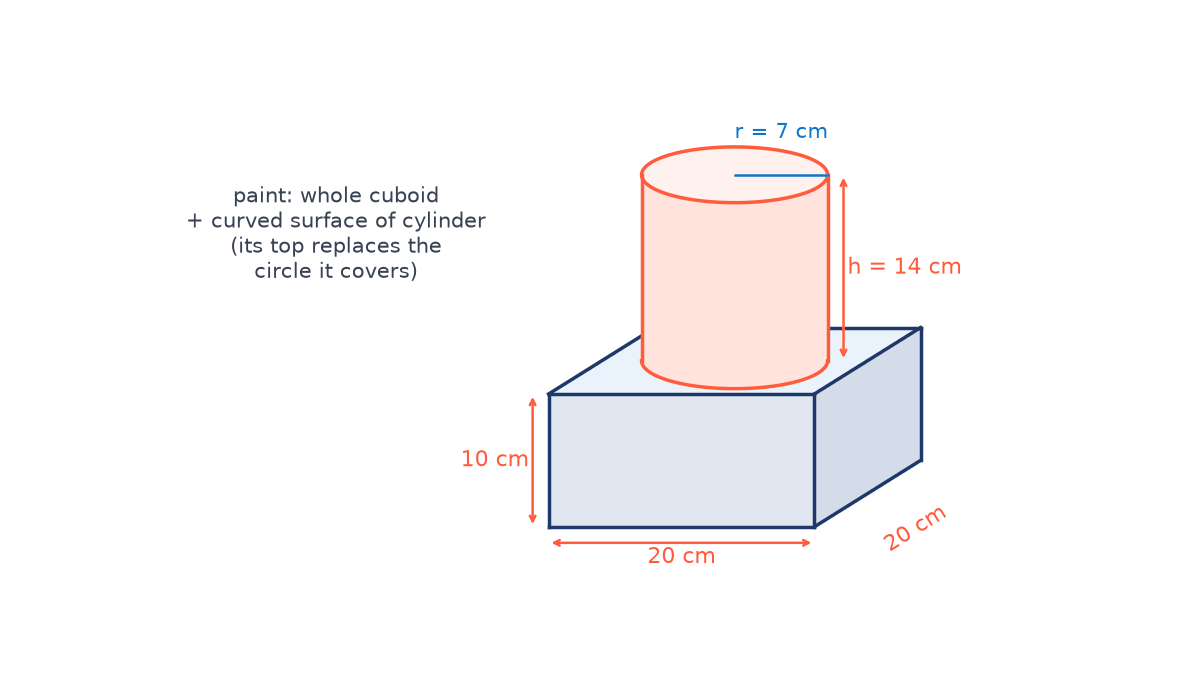
A pedestal is a cuboid 20 cm long, 20 cm wide and 10 cm high, with a solid cylinder of radius 7 cm and height 14 cm fixed at the centre of its top. Find (a) the surface area to be painted (including the base), (b) the cost of painting at 50 paise per cm2, and (c) the volume of the pedestal.
The cylinder hides a circle on the cuboid's top, but its own top circle has exactly the same area.
(a) The circle hidden under the cylinder is replaced by the equal circle on top of the cylinder, so
S=TSA of cuboid−πr2+2πrh+πr2=TSA of cuboid+2πrh=2(400+200+200)+2×722×7×14=1600+616=2216 cm2
(b) 50 paise is ₹0.50, so the cost is 2216×0.5= ₹1108.
A cylindrical jar of radius 10 cm contains water. A solid made of a cylinder (radius 3 cm, height 5 cm) with a hemisphere of radius 3 cm on one end is dropped in and is completely under water. Find the rise in the water level.
V=π(9)(5)+32π(27)=45π+18π=63π cm3
If the level rises by x cm, then π(102)x=63π, so x=10063=0.63 cm.
Why this works: the extra water column is a cylinder with the jar's base, and its volume equals the solid's volume.
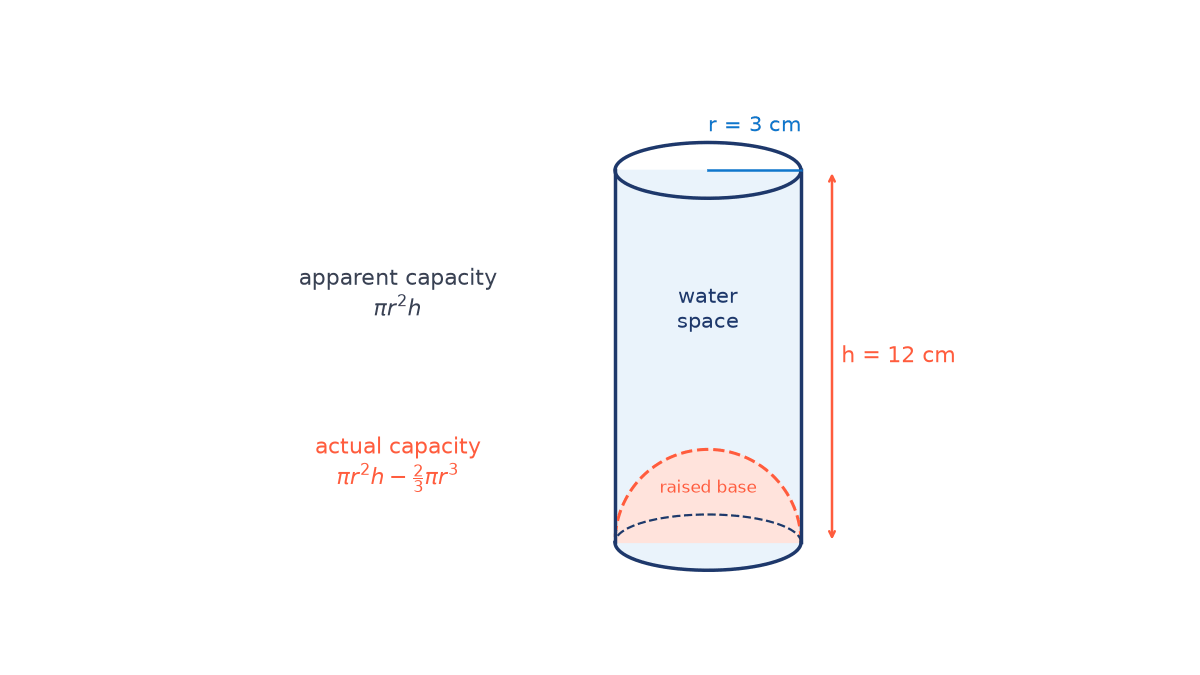
A glass is a cylinder of inner radius 3 cm and height 12 cm, but its bottom is a raised hemisphere of radius 3 cm. Using π=3.14, find the apparent capacity and the actual capacity of the glass.
The raised dome takes up space that looks as if it holds water.
From a solid cylinder of radius 6 cm and height 8 cm, a cone of the same radius and height is hollowed out from the top. Find, in terms of π, the total surface area and the volume of the remaining solid. Are the two answers the same quantity?
The numbers match, but one is an area in cm2 and the other a volume in cm3, so they are different quantities. (With π=3.14, each number is 602.88.)
Answer:192πcm2 and 192πcm3; no, they are different quantities.
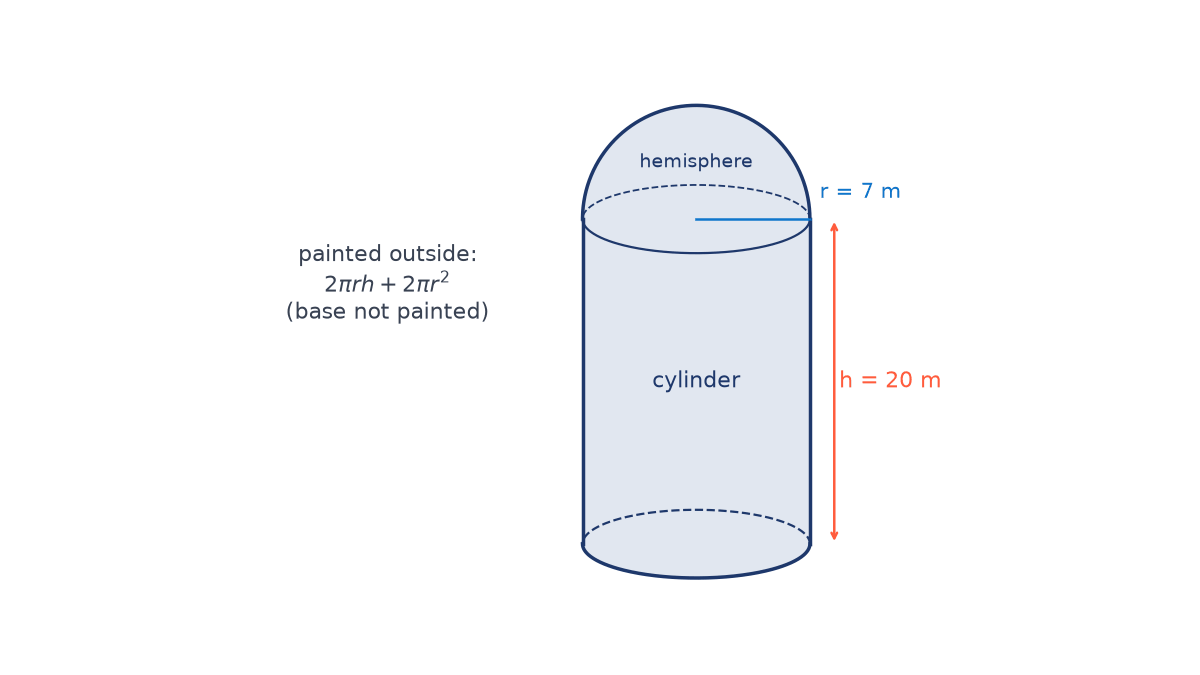
A grain silo is a cylinder of radius 7 m and height 20 m with a hemispherical roof of the same radius. (a) Find the cost of painting its outside (not the base) at ₹15 per m2. (b) Find its volume, correct to two decimal places.
An overhead tank is a cylinder of radius 0.7 m and height 1.5 m, with a cone of the same radius and height 0.6 m forming its bottom. How many litres of water can it hold?
How do I know whether a question wants surface area or volume?#
Painting, covering, canvas, sheet metal and polishing need surface area. Material used, melting, holding water, capacity and weight need volume.
Why is the painted area of the pedestal the cuboid's full area plus only the cylinder's curved surface?#
The cylinder hides a circle on the cuboid, but the cylinder's own top is an exposed circle of the same size, so the two cancel.
Use the value given in the question. If none is given and the radius is a multiple of 7 or 3.5, 722 usually gives a clean answer.
Do I need to show the formula before substituting?#
Yes. Writing the combined formula first, such as πrl+2πr2, shows the examiner which faces you counted, and earns method marks even if the arithmetic slips.
How do I change paise to rupees in cost questions?#
Divide by 100: 50 paise is ₹0.50. Then multiply the area by this rate.