There are three main types of elasticity of demand: price, income and cross elasticity. We take them one at a time.
Price elasticity of demand (PED)
Price elasticity is the most important and most widely used measure. It shows how much the quantity demanded changes when the price of the product changes.
The price elasticity of demand formula is as follows:
Price elasticity = % change in the quantity demanded / % change in the price
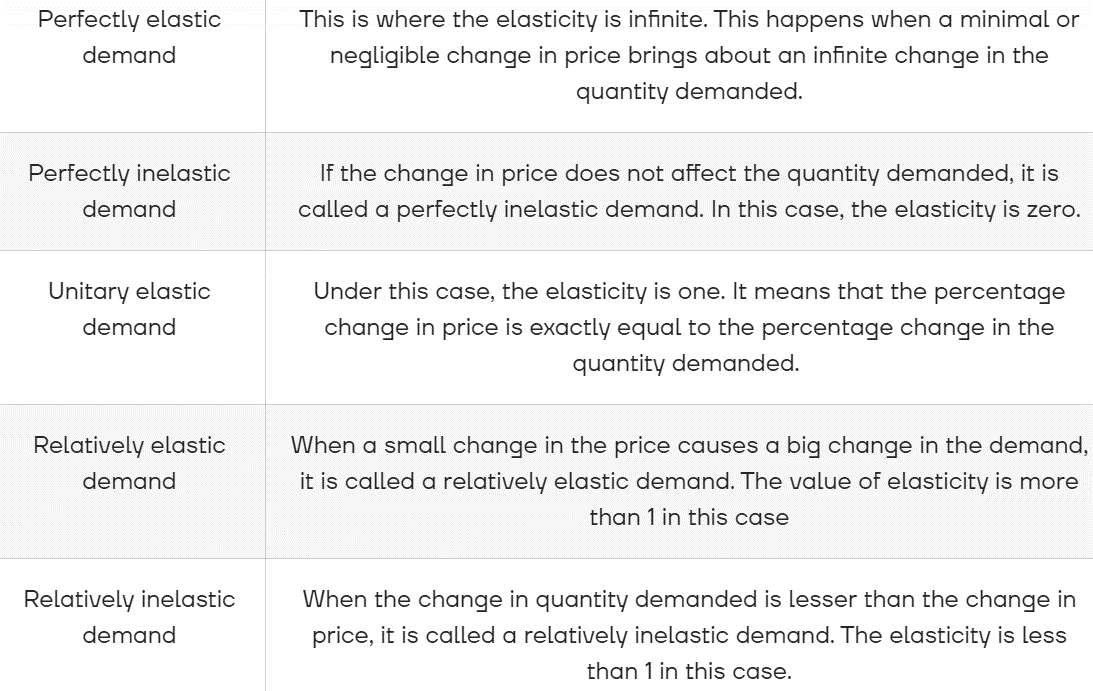
Types of Price Elasticity of Demand
There are five types of price elasticity of demand:
Factors Affecting Price Elasticity of Demand
The factors that affect the price elasticity of demand and determine which type of elasticity the product would have, include:
- The need of the product
- Substitutes available
- Increase or decrease in the consumer’s income
- The time period over which the elasticity is being measured
- The perishability of the product
- Addiction of consumers
Income Elasticity of Demand
Income elasticity of demand (YED) measures the change in demand when the customer's income changes. The price of the product and every other factor are held constant; only income changes.
The income elasticity of demand formula is as follows:
Income elasticity of demand = % change in quantity demanded / % change in income.
For most goods, demand rises when income rises, because customers can afford more.
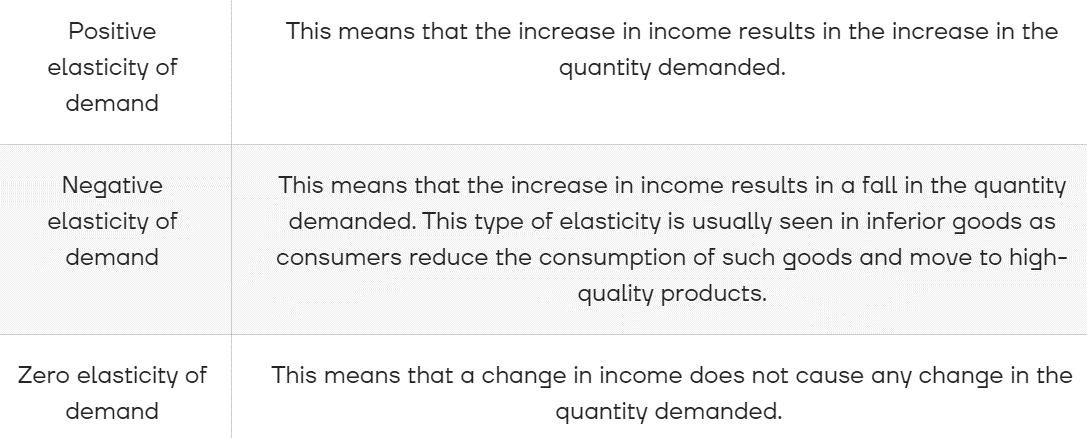
Types of Income Elasticity of Demand
There are three types of income elasticity of demand:
Factors Affecting Income Elasticity of Demand
The income elasticity of demand is affected by three factors:
- the overall income of consumers in the country
- the type of product, for example whether it is an inferior good or a luxury
- the consumption habits of the customer
Cross Elasticity of Demand
Cross elasticity of demand (XED) involves two related goods. The percentage change in the quantity demanded of the first good is measured against the percentage change in the price of the second good. For instance, when measuring the cross elasticity between good A and B, the change in the quantity demanded of good A would be measured against the change in the price of Good B.
The cross price elasticity of demand is measured using the formula:
Cross price elasticity = % change in quantity demanded of good A / % change in price of good B
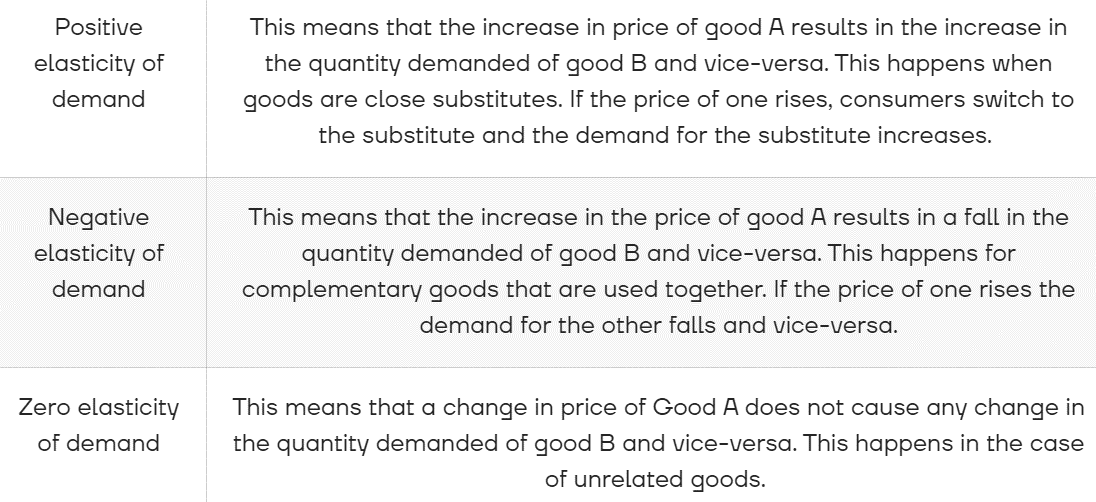
Types of Cross Elasticity of Demand
The cross elasticity of demand can also be categorized under the following three types:
Factors Affecting Cross Elasticity of Demand
The cross elasticity of demand is affected by the nature of the two goods, i.e., whether they are close substitutes, complements or unrelated to one another.
Other types of Elasticity of Demand
The effect of change in economic variables is not always the same on the quantity demanded for a product.
The demand for a product can be elastic, inelastic, or unitary, depending on the rate of change in the demand with respect to the change in the price of a product.
On the basis of the amount of fluctuation shown in the quantity demanded of a good, it is termed as ‘elastic’, ‘inelastic’, and ‘unitary’.
An elastic demand is one that shows a larger fluctuation in the quantity demanded of a product, in response to even a little change in another economic variable. For example, if a particular café raises the price of its coffee a little while others nearby do not, it may lose many of its customers.
An inelastic demand is one that shows a very little fluctuation in the quantity demanded with respect to a change in another economic variable. An example of this can be petrol or diesel.
Unitary elasticity is one in which the fluctuation in one variable and quantity demanded is equal.
We can further classify these elastic and inelastic types of demand into five categories.
Perfectly Elastic Demand
Demand is perfectly elastic when the slightest change in price causes an unlimited change in the quantity demanded.
In perfectly elastic demand, even a small rise in price can result in a fall in demand of the good to zero, whereas a small decline in the price can increase the demand to infinity.
However, perfectly elastic demand is a total theoretical concept and doesn’t find a real application, unless the market is perfectly competitive and the product is homogenous.
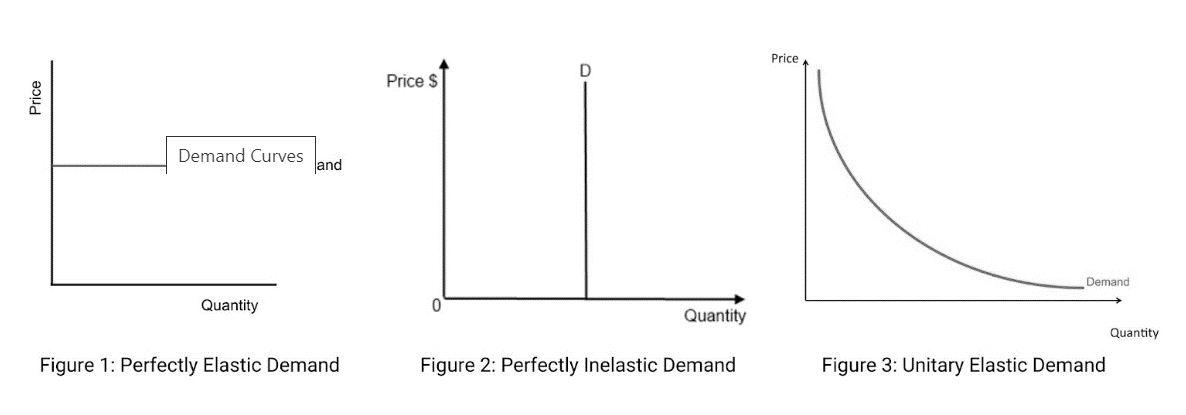
The degree of elasticity of demand helps to define the slope and shape of the demand curve. Therefore, we can determine the elasticity of demand by looking at the slope of the demand curve.
A flatter curve shows more elastic demand. So the demand curve for perfectly elastic demand is a horizontal line.
Perfectly Inelastic Demand
A perfectly inelastic demand is the one in which there is no change measured against a price change.
Like perfectly elastic demand, the concept of perfectly inelastic is also a theoretical concept and doesn’t find a practical application. However, the demand for necessity goods can be the closest example of perfectly inelastic demand.
The numerical value obtained from the PED formula comes out as zero for a perfectly inelastic demand.
The demand curve for perfectly inelastic demand is a vertical line parallel to the price axis.
Relatively Elastic Demand
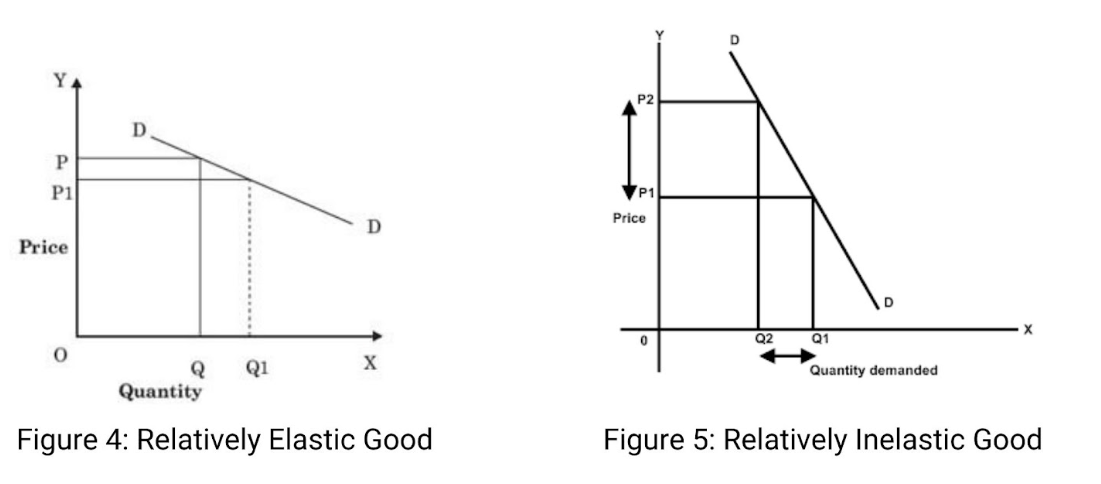
Relatively elastic demand refers to the demand when the proportionate change in the demand is greater than the proportionate change in the price of the good. Its numerical value lies between one and infinity.
In relatively elastic demand, if the price of a good increases by 25% then the demand for the product will necessarily fall by more than 25%.
Unlike the aforementioned types of demand, relatively elastic demand has a practical application as many goods respond in the same manner when there is a price change.
The demand curve of relatively elastic demand is gradually sloping.
Relatively Inelastic Demand
In a relatively inelastic demand, the proportionate change in the quantity demanded for a product is always less than the proportionate change in the price.
For example, if the price of a good falls by 10%, the quantity demanded rises by less than 10%. If it rose by exactly 10%, demand would be unitary elastic.
The numerical value of relatively inelastic demand always comes out as less than 1 and the demand curve is steep.
Unitary Elastic Demand
When the proportionate change in the quantity demanded for a product is equal to the proportionate change in the price of the commodity, it is said to be unitary elastic demand.
The numerical value for unitary elastic demand is equal to 1. The demand curve for unitary elastic demand is represented as a rectangular hyperbola.