A firm's pricing policy depends largely on the market structure it operates in. Each structure is taken in turn below.
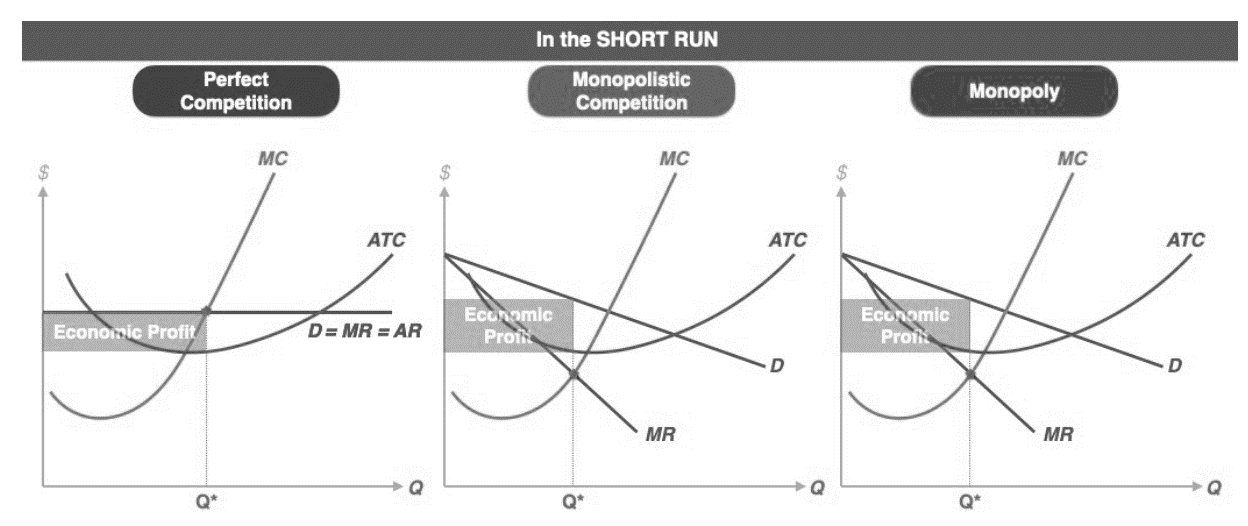
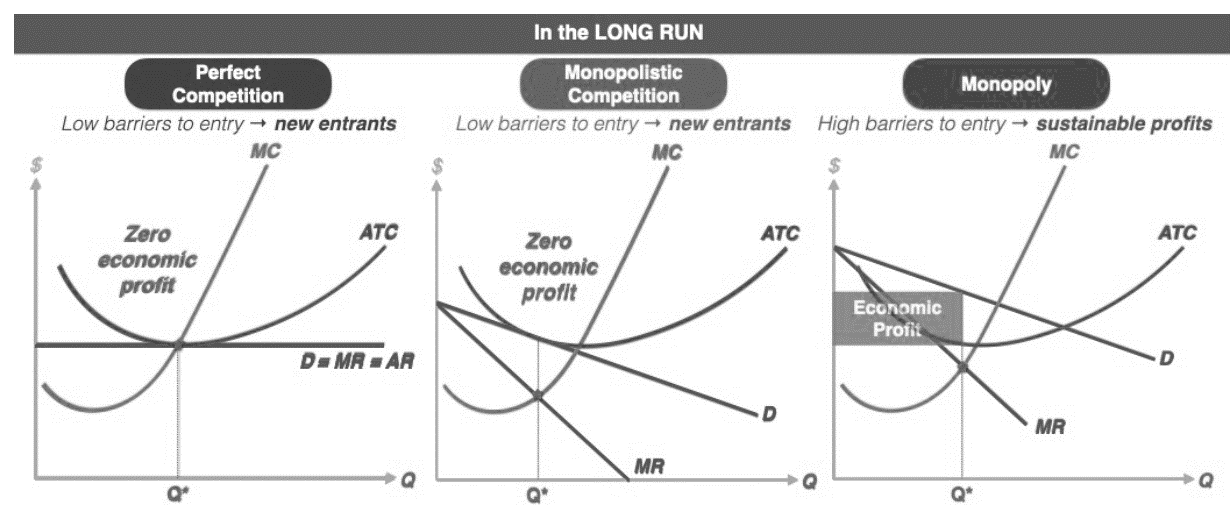
Perfect competition: firms in perfectly competitive markets are price takers, meaning their demand curve is horizontal. In this case, the market price is the marginal revenue and also the average revenue. Firms will produce at the profit-maximizing output where MR = MC.
Monopolistic competition: in this market structure, firms differentiate their products, resulting in a downward-sloping demand curve for each firm. The marginal revenue curve is also downward-sloping but with a steeper gradient. Firms will produce at the profit-maximizing output where MR = MC, earning economic profit in the short run. However, in the long run, new entrants attracted by economic profit will increase competition, lowering the firm’s demand curve, reducing output, and eliminating economic profit.
Monopoly: a monopolist’s demand curve is the same as the market’s demand curve, which is downward-sloping. Monopolists also produce at the profit-maximizing output where MR = MC. Due to high entry barriers, monopolists can maintain economic profit in the long run.
Oligopoly: oligopoly markets are unique due to the interdependence of firms’ pricing and output decisions. The best pricing strategy depends on what we assume about how the firms behave:
Perfect collusion: if firms perfectly collude, the entire market acts like one big monopoly. Firms collude to produce at the level where market MR = market MC and charge a high price to maximize and sustain long-run profit.
Perfect competition among the firms: if firms act as perfect competitors, market behavior is like a perfectly competitive market. In the long run, price converges to the level of the minimum average cost of production, and no economic profit can be made.
However, these are extreme theoretical models. In practice, firms tend to cheat on collusive agreements, making the long-run outcome indeterminate. Prices will likely fall between monopoly and perfect competition prices.
Other oligopoly models include the kinked demand model and the dominant firm model:
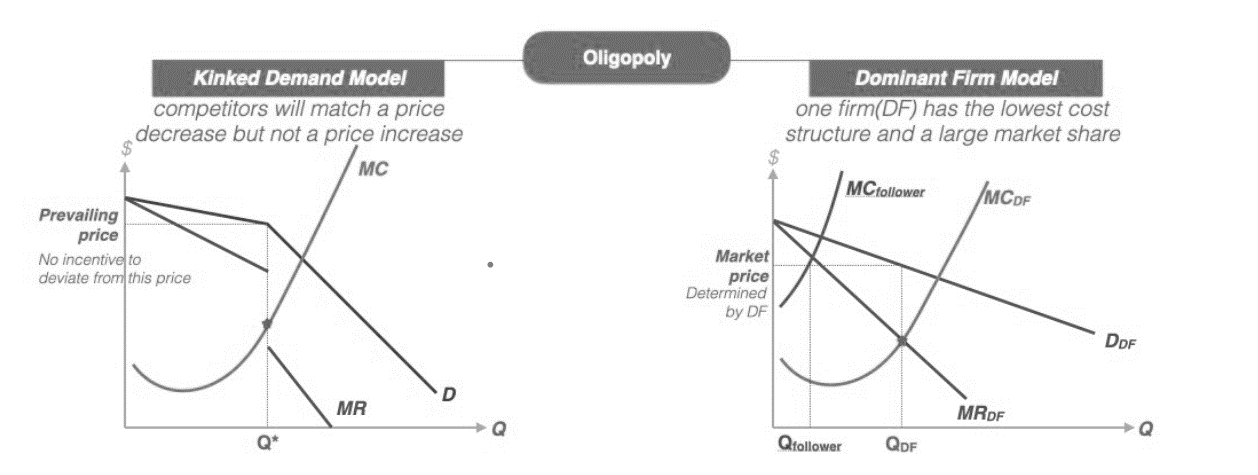
Kinked Demand Model: Assumes competitors will match a price decrease but not a price increase. Firms maximize profit where MR = MC, but there is a gap in the marginal revenue curve, resulting in the same optimal quantity for many cost structures. Firms have little incentive to deviate from the prevailing price.
Dominant Firm Model: Assumes one firm has the lowest cost structure and a large market share. The dominant firm maximizes profits by producing the quantity for which its marginal cost equals its marginal revenue and charges the price on its firm demand curve for that quantity. Other firms in the market essentially take that price as given and produce the quantity for which their marginal cost equals that price.