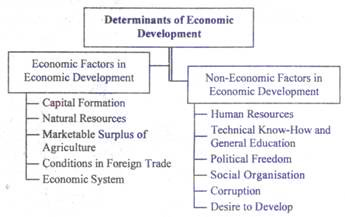
The economic and non-economic factors that decide how fast a country develops: capital formation, natural resources, farm surplus, trade, human resources, technology and more.
In a country’s economic development the role of economic factors is decisive. The stock of capital and the rate of capital accumulation in most cases settle the question whether, at a given point of time, a country will grow or not. There are a few other economic factors which also have some bearing on development but their importance is hardly comparable to that of capital formation. The surplus of foodgrains output available to support urban population, foreign trade conditions and the nature of economic system are some such factors whose role in economic development has to be analyzed:
The strategic role of capital in raising the level of production has traditionally been acknowledged in economics. It is now universally admitted that a country which wants to accelerate the pace of growth, has no choice but to save a high proportion of its income, with the objective of raising the level of investment. Great reliance on foreign aid is highly risky, and thus has to be avoided. Economists rightly assert that lack of capital is the principal obstacle to growth and no developmental plan will succeed unless adequate supply of capital is forthcoming.
Whatever be the economic system, a country cannot hope to achieve economic progress unless a certain minimum rate of capital accumulation is realized. However, if some country wishes to make spectacular strides, it will have to raise its rate of capital formation still higher.
Natural resources are another major factor in a country's development. Among the natural resources, the land area and the quality of the soil, forest wealth, good river system, minerals and oil-resources, good and bracing climate, etc., are included. For economic growth, the existence of natural resources in abundance is essential. A country deficient in natural resources may not be in a position to develop rapidly. In fact, natural resources are a necessary condition for economic growth but not a sufficient one. Japan and India are the two contradictory examples.
According to Lewis, “Other things being equal man can make better use of rich resources than they can of poor”. In less developed countries, natural resources are unutilized, under-utilized or mis- utilized. This is one of the reasons of their backwardness. This is due to economic backwardness and lack of technological factors.
According to Professor Lewis, “A country which is considered to be poor in resources may be considered very rich in resources some later time, not merely because unknown resources are discovered, but equally because new methods are discovered for the known resources”. Japan is one such country which is deficient in natural resources but it is one of the advanced countries of the world because it has been able to discover new use for limited resources.
Increase in agricultural production accompanied by a rise in productivity is important from the point of view of the development of a country. But what is more important is that the marketable surplus of agriculture increases. The term ‘marketable surplus’ refers to the excess of output in the agricultural sector over and above what is required to allow the rural population to subsist.
The importance of the marketable surplus in a developing economy emanates from the fact that the urban industrial population subsists on it. With the development of an economy, the ratio of the urban population increases and increasing demands are made on agriculture for foodgrains. These demands must be met adequately; otherwise the consequent scarcity of food in urban areas will arrest growth.
In case a country fails to produce a sufficient marketable surplus, it will be left with no choice except to import foodgrains which may cause a balance of payments problem. Until 1976-77, India was faced with this problem precisely. In most of the years during the earlier planning period, market arrivals of foodgrains were not adequate to support the urban population.
If some country wants to step-up the tempo of industrialization, it must not allow its agriculture to lag behind. The supply of the farm products particularly foodgrains, must increase, as the setting-up of industries in cities attracts a steady flow of population from the countryside.
The classical theory of trade has been used by economists for a long time to argue that trade between nations is always beneficial to them. In the existing context, the theory suggests that the presently less developed countries should specialize in production of primary products as they have comparative cost advantage in their production. The developed countries, on the contrary, have a comparative cost advantage in manufactures including machines and equipment and should accordingly specialize in them.
In the recent years, a powerful school has emerged under the leadership of Raul Prebisch which questions the merits of unrestricted trade between developed and under-developed countries on both theoretical and empirical grounds.
Foreign trade has proved to be beneficial to countries which have been able to set-up industries in a relatively short period. These countries sooner or later captured international markets for their industrial products. Therefore, a developing country should not only try to become self-reliant in capital equipment as well as other industrial products as early as possible, but it should also attempt to push the development of its industries to such a high level that in course of time manufactured goods replace the primary products as the country’s principal exports.
In countries like India the macro-economic interconnections are crucial and the solutions of the problems of these economies cannot be found merely through the foreign trade sector or simple recipes associated with it.
The economic system and the historical setting of a country also decide the development prospects to a great extent. There was a time when a country could have a laissez faire economy and yet face no difficulty in making economic progress. In today’s entirely different world situation, a country would find it difficult to grow along the England’s path of development.
The Least Developed Countries(LDC) of the present times will have to find their own path of development. They cannot hope to make much progress by adopting a laissez faire economy. Further, these countries cannot raise necessary resources required for development either through colonial exploitation or by foreign trade.
They now have only two choices before them:
i) They can follow a capitalist path of development which will require an efficient market system supported by a rational interventionist role of the State.
ii) The other course open to them is that of economic planning.
The latest experiments in economic planning in China have shown impressive results. Therefore, from the failure of economic planning in the former Soviet Union and the erstwhile East European socialist countries it would be wrong to conclude that a planned economy has built-in inefficiencies which are bound to arrest economic growth.
B) Non-Economic Factors in Economic Development From the available historical evidence, it is now obvious that non-economic factors are as important in development as economic factors. Here we attempt to explain how they exercise influence on the process of economic development:
Human resources are an important factor in economic development. Man provides labour power for production and if in a country labour is efficient and skilled, its capacity to contribute to growth will decidedly be high. The productivity of illiterate, unskilled, disease ridden and superstitious people is generally low and they do not provide any hope to developmental work in a country. But in case human resources remain either unutilized or the manpower management remains defective, the same people who could have made a positive contribution to growth activity prove to be a burden on the economy.
It has never been doubted that the level of technical know-how has a direct bearing on the pace of development. As the scientific and technological knowledge advances, man discovers more and more sophisticated techniques of production which steadily raise the productivity levels.
Schumpeter was deeply impressed by the innovations done by the entrepreneurs, and he attributed much of the capitalist development to this role of the entrepreneurial class. Since technology has now become highly sophisticated, still greater attention has to be given to Research and Development(R&D) for further advancement. Under assumptions of a linear homogeneous production function and a neutral technical change which does not affect the rate of substitution between capital and labour, Robert M. Solow found that most of the increase in output per man-hour in the United States between 1909 and 1949 came not from more capital per worker but from technical progress, which includes the effects of better education and knowledge.
Looking to the world history of modern times one learns that the processes of development and underdevelopment are interlinked and it is wrong to view them in isolation. We all know that the under-development of India, Pakistan, Bangladesh, Sri Lanka, Malaysia, Kenya and a few other countries, which were in the past British colonies, was linked with the development of England. England recklessly exploited them and appropriated a large portion of their economic surplus.
Dadabhai Naoroji has also candidly explained in his classic work ‘Poverty and Un-British Rule in India’ that the drain of wealth from India under the British was the major cause of the increase in poverty in India during that period, which in turn arrested the economic development of the country.
Mass participation in development programs is a pre-condition for accelerating the growth process. However, people show interest in the development activity only when they feel that the fruits of growth will be fairly distributed. Experiences from a number of countries suggest that whenever the defective social organisation allows some elite groups to appropriate the benefits of growth, the general mass of people develop apathy towards State’s development programs. Under the circumstances, it is futile to hope that masses will participate in the development projects undertaken by the State.
India’s experience during the whole period of development planning is a case in point. Growth of monopolies in industries and concentration of economic power in the modern sector is now an undisputed fact. Furthermore, the new agricultural strategy has given rise to a class of rich peasantry creating widespread disparities in the countryside.
Corruption is rampant in developing countries at various levels and it operates as a negative factor in their growth process. Until and unless these countries root-out corruption in their administrative system, it is most natural that the capitalists, traders and other powerful economic classes will continue to exploit national resources in their personal interests.
The regulatory system is also often misused, and the licenses are not always granted on merit. The art of tax evasion has been perfected in the less developed countries by certain sections of the society and often taxes are evaded with the participation of the government officials.
Development activity is not a mechanical process. The pace of economic growth in any country depends to a great extent on people’s desire to develop. If in some country level of consciousness is low and the general mass of people has accepted poverty as its fate, then there will be little hope for development. According to Richard T. Gill, “The point is that economic development is not a mechanical process; it is not a simple adding-up of assorted factors. Ultimately, it is a human enterprise. And like all human enterprises, its outcome will depend finally on the skill, quality and attitudes of the men who undertake”.
What are the factors influencing the economic growth?#
Human resources – this is a major factor that is responsible for boosting the economic growth of a country. The rate of increase in the skills and capabilities of a workforce ultimately increases the economic growth of a country.
Infrastructure development- Improvements and increased investment in physical capital such as roadways, machinery, and factories will increase the efficiency of economic output by reducing the cost.
Planned utilization of natural resources – Proper use of available natural resources like mineral deposits helps boost the productivity of the economy.
Population growth – An increase in the growth of the population will result in the availability of more human resources which in turn will increase the output in terms of quantity. This is also an important factor that influences economic growth.
Advancement in technology – Improvement in technology will affect the economic growth of a country positively. The application of advanced technology will result in increased productivity of labor and economic growth will advance at a lower cost.