Which angle do we mean?#
sin x = 1 2 \displaystyle \sin x = \tfrac{1}{2} sin x = 2 1 1 2 \displaystyle \tfrac{1}{2} 2 1
The principal branches#
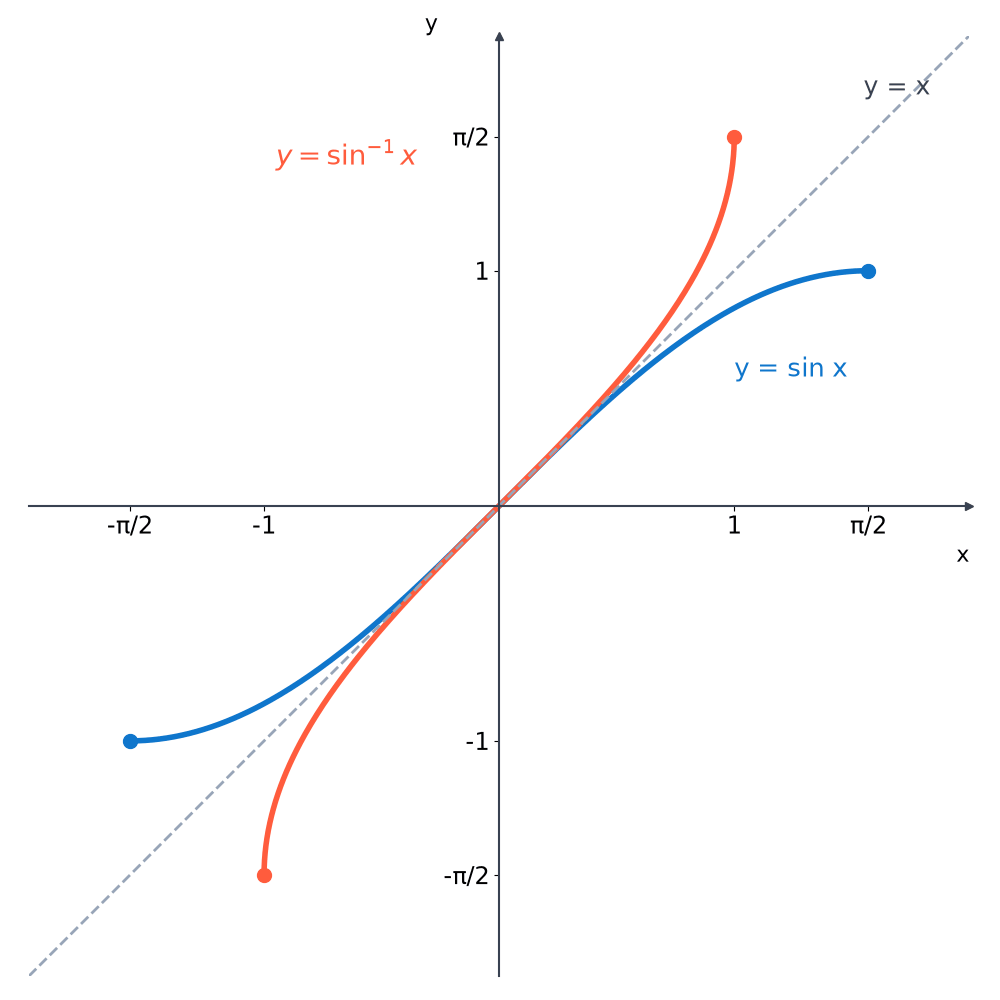
A common slip to avoid: sin − 1 x \sin^{-1}x sin − 1 x 1 sin x \displaystyle \tfrac{1}{\sin x} s i n x 1 sin − 1 \sin^{-1} sin − 1 sin \sin sin [ − π 2 , π 2 ] \displaystyle \left[-\tfrac{\pi}{2}, \tfrac{\pi}{2}\right] [ − 2 π , 2 π ] y = x y = x y = x
The graph of inverse sine is the restricted sine graph reflected in y = x. Principal values#
Example 1. sin − 1 ( − 3 2 ) = − π 3 \displaystyle \sin^{-1}\left(-\tfrac{\sqrt{3}}{2}\right) = -\tfrac{\pi}{3} sin − 1 ( − 2 3 ) = − 3 π sin ( − π 3 ) = − 3 2 \displaystyle \sin(-\tfrac{\pi}{3}) = -\tfrac{\sqrt{3}}{2} sin ( − 3 π ) = − 2 3
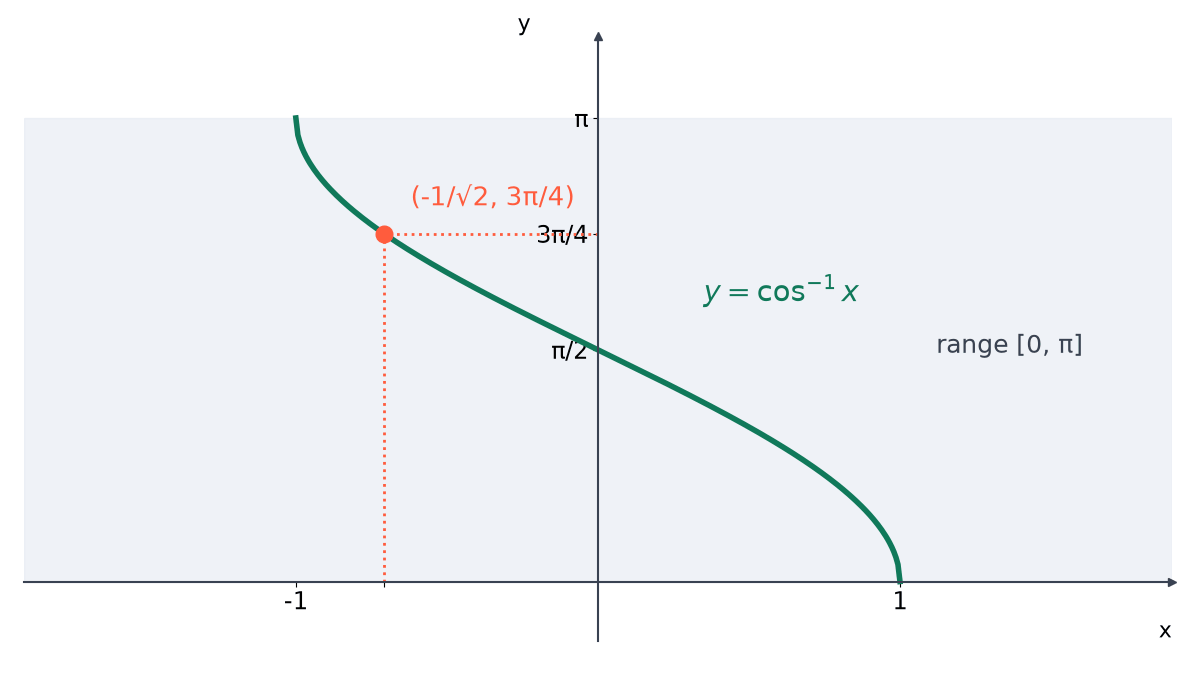
Example 2. cos − 1 ( − 1 2 ) = 3 π 4 \displaystyle \cos^{-1}\left(-\tfrac{1}{\sqrt{2}}\right) = \tfrac{3\pi}{4} cos − 1 ( − 2 1 ) = 4 3 π − π 4 \displaystyle -\tfrac{\pi}{4} − 4 π [ 0 , π ] [0, \pi] [ 0 , π ]
Inverse cosine takes values only in [0, pi], so the value at -1/root 2 is 3pi/4. Example 3. tan − 1 ( − 3 ) = − π 3 \displaystyle \tan^{-1}(-\sqrt{3}) = -\tfrac{\pi}{3} tan − 1 ( − 3 ) = − 3 π cot − 1 ( − 1 ) = 3 π 4 \displaystyle \cot^{-1}(-1) = \tfrac{3\pi}{4} cot − 1 ( − 1 ) = 4 3 π sec − 1 ( − 2 ) = 2 π 3 \displaystyle \sec^{-1}(-2) = \tfrac{2\pi}{3} sec − 1 ( − 2 ) = 3 2 π csc − 1 ( 2 ) = π 4 \displaystyle \csc^{-1}(\sqrt{2}) = \tfrac{\pi}{4} csc − 1 ( 2 ) = 4 π
Example 4. tan − 1 ( 1 ) + cos − 1 ( − 1 2 ) + sin − 1 ( − 1 2 ) = π 4 + 2 π 3 − π 6 = 3 π 4 \displaystyle \tan^{-1}(1) + \cos^{-1}\left(-\tfrac{1}{2}\right) + \sin^{-1}\left(-\tfrac{1}{2}\right) = \tfrac{\pi}{4} + \tfrac{2\pi}{3} - \tfrac{\pi}{6} = \tfrac{3\pi}{4} tan − 1 ( 1 ) + cos − 1 ( − 2 1 ) + sin − 1 ( − 2 1 ) = 4 π + 3 2 π − 6 π = 4 3 π
Watch the range. This is where most marks are lost. sin − 1 ( sin 5 π 6 ) = π 6 \displaystyle \sin^{-1}\left(\sin \tfrac{5\pi}{6}\right) = \tfrac{\pi}{6} sin − 1 ( sin 6 5 π ) = 6 π 5 π 6 \displaystyle \tfrac{5\pi}{6} 6 5 π sin 5 π 6 = 1 2 \displaystyle \sin\tfrac{5\pi}{6} = \tfrac{1}{2} sin 6 5 π = 2 1 π 6 \displaystyle \tfrac{\pi}{6} 6 π cos − 1 ( cos 7 π 4 ) = π 4 \displaystyle \cos^{-1}\left(\cos\tfrac{7\pi}{4}\right) = \tfrac{\pi}{4} cos − 1 ( cos 4 7 π ) = 4 π tan − 1 ( tan 4 π 5 ) = − π 5 \displaystyle \tan^{-1}\left(\tan\tfrac{4\pi}{5}\right) = -\tfrac{\pi}{5} tan − 1 ( tan 5 4 π ) = − 5 π
Try these yourself#
Find the principal values: sin − 1 1 2 \displaystyle \sin^{-1}\tfrac{1}{\sqrt{2}} sin − 1 2 1 cos − 1 3 2 \displaystyle \cos^{-1}\tfrac{\sqrt{3}}{2} cos − 1 2 3 tan − 1 1 3 \displaystyle \tan^{-1}\tfrac{1}{\sqrt{3}} tan − 1 3 1 csc − 1 ( − 2 ) \csc^{-1}(-2) csc − 1 ( − 2 ) sec − 1 2 3 \displaystyle \sec^{-1}\tfrac{2}{\sqrt{3}} sec − 1 3 2 cot − 1 ( − 3 ) \cot^{-1}(-\sqrt{3}) cot − 1 ( − 3 )
Find cos − 1 ( − 3 2 ) + sin − 1 ( − 1 ) \displaystyle \cos^{-1}\left(-\tfrac{\sqrt{3}}{2}\right) + \sin^{-1}(-1) cos − 1 ( − 2 3 ) + sin − 1 ( − 1 )
Find tan − 1 3 − sec − 1 ( − 2 ) \tan^{-1}\sqrt{3} - \sec^{-1}(-\sqrt{2}) tan − 1 3 − sec − 1 ( − 2 )
Find sin − 1 ( sin 3 π 4 ) \displaystyle \sin^{-1}\left(\sin\tfrac{3\pi}{4}\right) sin − 1 ( sin 4 3 π ) cos − 1 ( cos 5 π 3 ) \displaystyle \cos^{-1}\left(\cos\tfrac{5\pi}{3}\right) cos − 1 ( cos 3 5 π ) tan − 1 ( tan 7 π 6 ) \displaystyle \tan^{-1}\left(\tan\tfrac{7\pi}{6}\right) tan − 1 ( tan 6 7 π )
State the domain and range of cos − 1 x \cos^{-1}x cos − 1 x
Find the domain of sin − 1 ( 2 x − 3 ) \sin^{-1}(2x - 3) sin − 1 ( 2 x − 3 )
Is sin − 1 ( sin x ) = x \sin^{-1}(\sin x) = x sin − 1 ( sin x ) = x x x x x x x
Evaluate sin ( π 3 − sin − 1 ( − 1 2 ) ) \displaystyle \sin\left(\tfrac{\pi}{3} - \sin^{-1}\left(-\tfrac{1}{2}\right)\right) sin ( 3 π − sin − 1 ( − 2 1 ) )
Answers to check against#
Show answers
π 4 \displaystyle \tfrac{\pi}{4} 4 π π 6 \displaystyle \tfrac{\pi}{6} 6 π π 6 \displaystyle \tfrac{\pi}{6} 6 π − π 6 \displaystyle -\tfrac{\pi}{6} − 6 π π 6 \displaystyle \tfrac{\pi}{6} 6 π 5 π 6 \displaystyle \tfrac{5\pi}{6} 6 5 π 5 π 6 − π 2 = π 3 \displaystyle \tfrac{5\pi}{6} - \tfrac{\pi}{2} = \tfrac{\pi}{3} 6 5 π − 2 π = 3 π π 3 − 3 π 4 = − 5 π 12 \displaystyle \tfrac{\pi}{3} - \tfrac{3\pi}{4} = -\tfrac{5\pi}{12} 3 π − 4 3 π = − 12 5 π π 4 \displaystyle \tfrac{\pi}{4} 4 π π 3 \displaystyle \tfrac{\pi}{3} 3 π π 6 \displaystyle \tfrac{\pi}{6} 6 π [ − 1 , 1 ] [-1, 1] [ − 1 , 1 ] [ 0 , π ] [0, \pi] [ 0 , π ] ( − 1 , π ) (-1, \pi) ( − 1 , π ) ( 1 , 0 ) (1, 0) ( 1 , 0 ) − 1 ≤ 2 x − 3 ≤ 1 -1 \le 2x - 3 \le 1 − 1 ≤ 2 x − 3 ≤ 1 [ 1 , 2 ] [1, 2] [ 1 , 2 ] No. It holds only for x ∈ [ − π 2 , π 2 ] \displaystyle x \in \left[-\tfrac{\pi}{2}, \tfrac{\pi}{2}\right] x ∈ [ − 2 π , 2 π ]
sin ( π 3 + π 6 ) = 1 \displaystyle \sin\left(\tfrac{\pi}{3} + \tfrac{\pi}{6}\right) = 1 sin ( 3 π + 6 π ) = 1