How fast is it chang­ing?

You already know that a deriv­a­tive tells you how fast one quan­tity changes with another. Now we put that to work. First on real rates of change, like a rip­ple spread­ing on a pond or a tank fill­ing with water, and then on a sim­pler but very use­ful ques­tion: where does a func­tion go up, and where does it come down?

Rate of change

dydx\displaystyle \frac{dy}{dx} is the rate of change of yy with respect to xx. When both of them are chang­ing with time, the chain rule links the rates: dydt=dydx⋅dxdt\displaystyle \frac{dy}{dt} = \frac{dy}{dx}\cdot\frac{dx}{dt}.

Exam­ple 1. The radius of a cir­cu­lar rip­ple grows at 44 cm/s. How fast is the area grow­ing when the radius is 1010 cm? It grows at dAdt=2πrdrdt=80π\displaystyle \tfrac{dA}{dt} = 2\pi r\tfrac{dr}{dt} = 80\pi cm²/s.

Exam­ple 2. A cube's edge grows at 0.20.2 cm/s. At the moment the edge is 55 cm, the vol­ume grows at 3a2⋅0.2=153a^2 \cdot 0.2 = 15 cm³/s and the sur­face area at 12a⋅0.2=1212a \cdot 0.2 = 12 cm²/s.

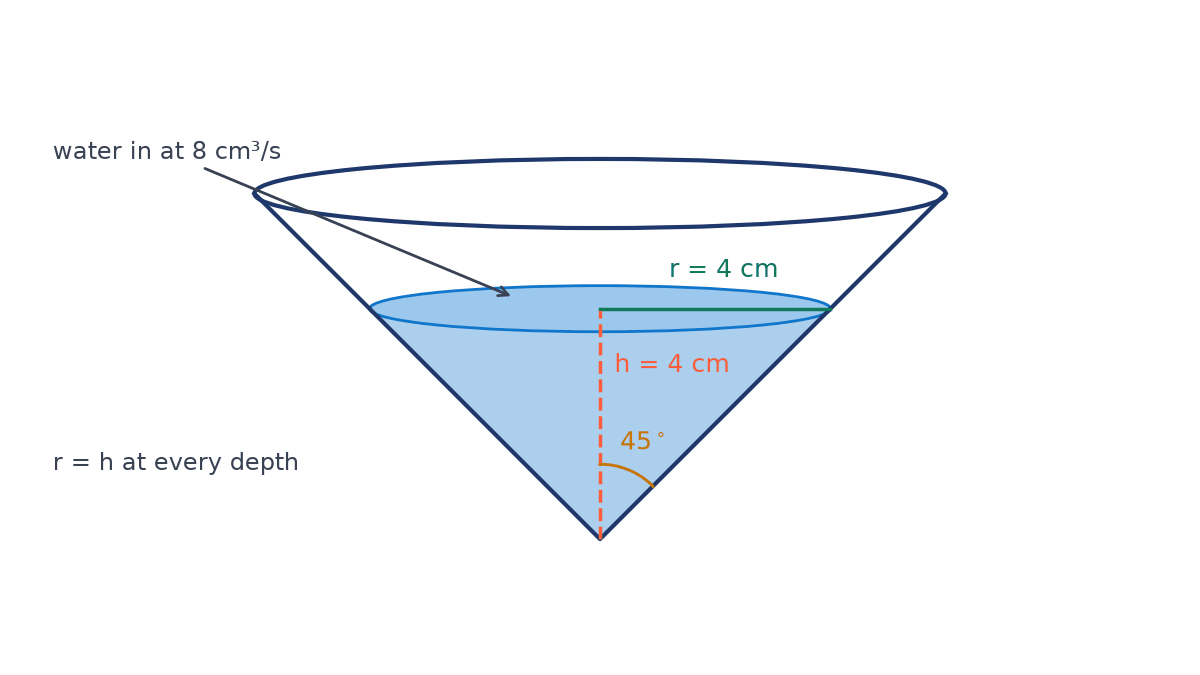
Exam­ple 3. Water pours into a cone (ver­tex down) of semi-ver­ti­cal angle 45∘45^\circ at 88 cm³/s. Here is the neat part: because of that angle, when the depth is hh the radius is also hh. Then V=13πh3\displaystyle V = \tfrac{1}{3}\pi h^3, so dVdt=πh2dhdt\displaystyle \tfrac{dV}{dt} = \pi h^2\tfrac{dh}{dt}; at h=4h = 4 cm, dhdt=816π=12π\displaystyle \tfrac{dh}{dt} = \tfrac{8}{16\pi} = \tfrac{1}{2\pi} cm/s.

A cone with its vertex down and semi-vertical angle 45 degrees, filled with water to depth h = 4 cm, so the water surface has radius r = 4 cm; water flows in at 8 cubic cm per second.
Water in a cone of semi-ver­ti­cal angle 45 degrees: the radius always equals the depth.

Exam­ple 4 (mar­ginal cost). In busi­ness, the deriv­a­tive of cost is called mar­ginal cost. C(x)=0.01x3−0.3x2+15x+400C(x) = 0.01x^3 - 0.3x^2 + 15x + 400 gives mar­ginal cost C′(x)=0.03x2−0.6x+15C'(x) = 0.03x^2 - 0.6x + 15. At x=20x = 20, C′(20)=12−12+15=15C'(20) = 12 - 12 + 15 = 15.

Increas­ing and decreas­ing func­tions

The sign of the deriv­a­tive tells the whole story. On an inter­val, ff is increas­ing if f′(x)>0f'(x) > 0 there, decreas­ing if f′(x)<0f'(x) < 0, and con­stant if f′(x)=0f'(x) = 0 through­out. So the method is sim­ple: find the points where f′(x)=0f'(x) = 0. They split the line into inter­vals, and on each one f′f' keeps a sin­gle sign.

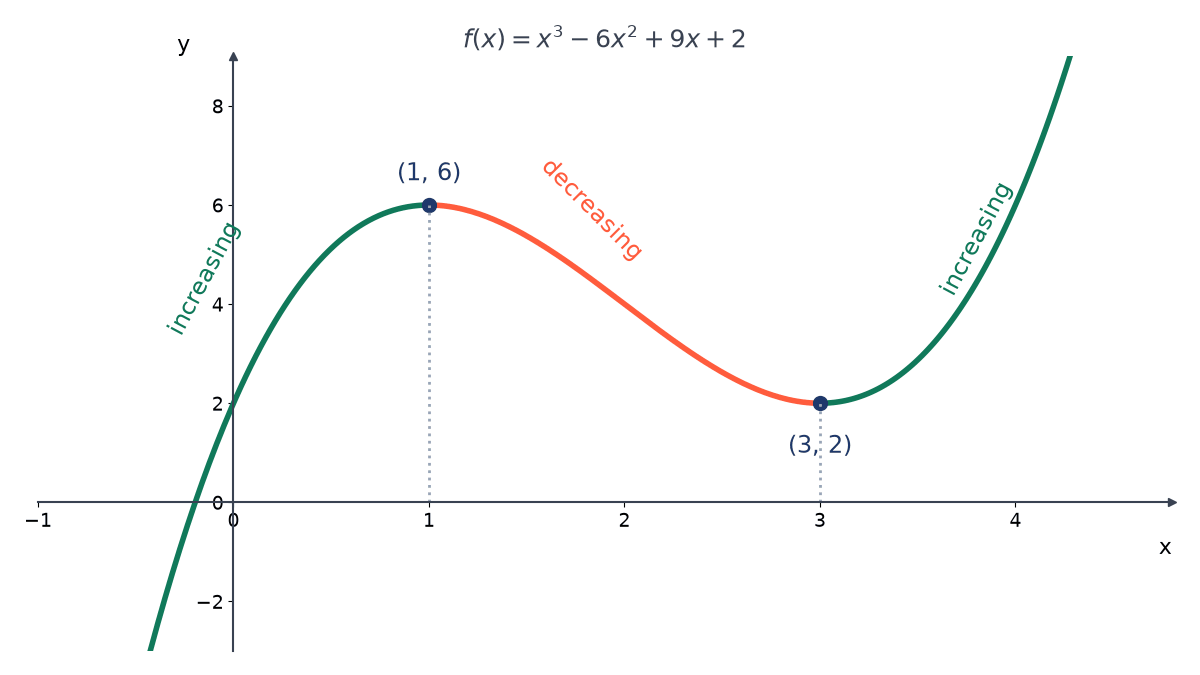
Exam­ple 5. f(x)=x3−6x2+9x+2f(x) = x^3 - 6x^2 + 9x + 2: f′(x)=3(x−1)(x−3)f'(x) = 3(x - 1)(x - 3). So the func­tion is increas­ing on (−∞,1)(-\infty, 1) and (3,∞)(3, \infty), and decreas­ing on (1,3)(1, 3).

Graph of f(x) = x cubed minus 6x squared plus 9x plus 2, rising up to the point (1, 6), falling to (3, 2), then rising again; the rising parts are green and the falling part red.
The cubic rises on (-infin­ity, 1), falls on (1, 3) and rises again after 3.

Exam­ple 6. f(x)=e2xf(x) = e^{2x} is increas­ing on R\mathbf{R} (f′=2e2x>0f' = 2e^{2x} > 0). f(x)=log⁡xf(x) = \log x is increas­ing on (0,∞)(0, \infty).

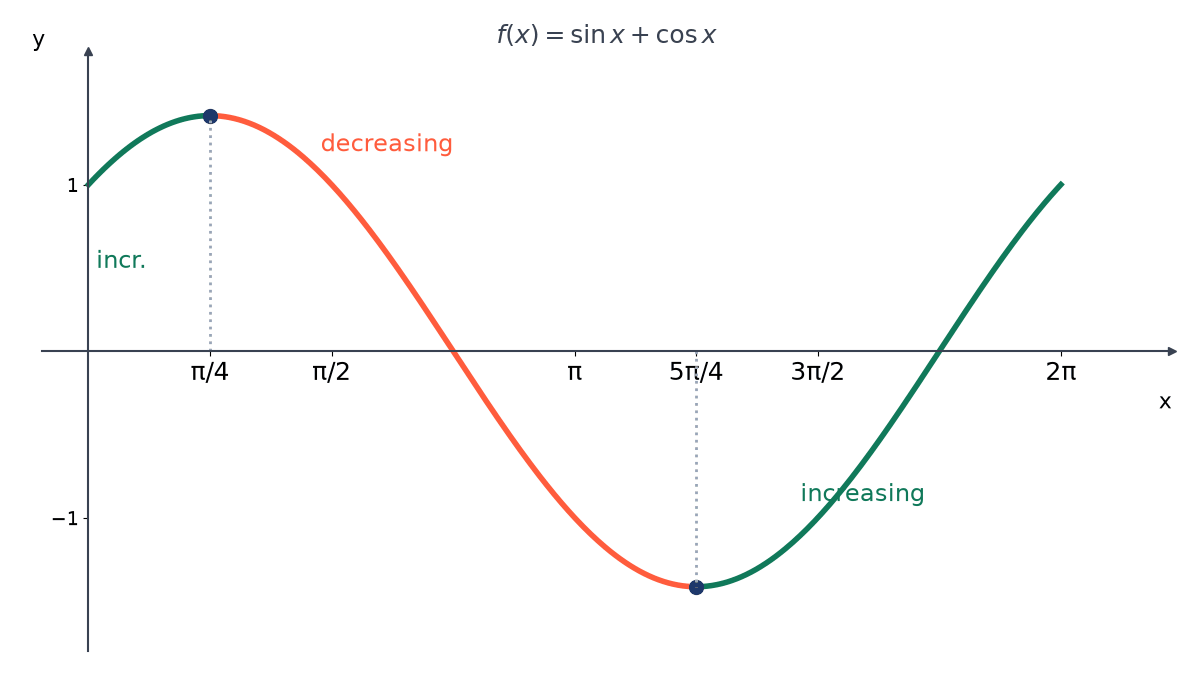
Exam­ple 7. f(x)=sin⁡x+cos⁡xf(x) = \sin x + \cos x on [0,2π][0, 2\pi]: f′(x)=cos⁡x−sin⁡xf'(x) = \cos x - \sin x, zero at π4\displaystyle \tfrac{\pi}{4} and 5π4\displaystyle \tfrac{5\pi}{4}. So it is increas­ing on [0,π4)\displaystyle [0, \tfrac{\pi}{4}) and (5π4,2π]\displaystyle (\tfrac{5\pi}{4}, 2\pi], decreas­ing on (π4,5π4)\displaystyle (\tfrac{\pi}{4}, \tfrac{5\pi}{4}).

Graph of sin x + cos x from 0 to 2 pi: it rises to a peak at x = pi/4, falls to a lowest point at x = 5 pi/4, then rises again; increasing parts green, decreasing part red.
sin x + cos x turns at pi/4 and at 5pi/4.

Try these your­self

  1. A bal­loon's radius grows at 0.50.5 cm/s. How fast is its vol­ume grow­ing when the radius is 66 cm?
  2. A lad­der 1010 m long leans on a wall. Its foot slides away at 1.51.5 m/s. How fast is the top slid­ing down at the moment the foot is 66 m from the wall?
  3. A stone thrown into a pond makes a cir­cu­lar ring whose radius grows at 33 cm/s. How fast does the enclosed area grow when the radius is 1212 cm?
  4. The total rev­enue from sell­ing xx units is R(x)=5x2+30x+10R(x) = 5x^2 + 30x + 10. Find the mar­ginal rev­enue at x=8x = 8.
  5. Find where f(x)=2x3−3x2−36x+7f(x) = 2x^3 - 3x^2 - 36x + 7 increases and decreases.
  6. Show that f(x)=x3+3xf(x) = x^3 + 3x is increas­ing on R\mathbf{R}.
  7. Find the inter­vals on which f(x)=x2e−xf(x) = x^2 e^{-x} increases.
  8. Show that f(x)=log⁡(sin⁡x)f(x) = \log(\sin x) is increas­ing on (0,π2)\displaystyle (0, \tfrac{\pi}{2}) and decreas­ing on (π2,π)\displaystyle (\tfrac{\pi}{2}, \pi).
  9. For what aa is f(x)=ax+cos⁡xf(x) = ax + \cos x increas­ing on R\mathbf{R}?
  10. A spher­i­cal snow­ball melts so that its vol­ume decreases at 1010 cm³/min. How fast does the radius shrink when the radius is 55 cm?

Answers to check against

Show answers
  1. 4πr2⋅0.5=72π4\pi r^2 \cdot 0.5 = 72\pi cm³/s.
  2. xx˙+yy˙=0x\dot x + y\dot y = 0 with x=6x = 6, y=8y = 8: y˙=−6×1.58=−1.125\displaystyle \dot y = -\tfrac{6 \times 1.5}{8} = -1.125 m/s.
  3. 2π⋅12⋅3=72π2\pi \cdot 12 \cdot 3 = 72\pi cm²/s.
  4. 10x+30=11010x + 30 = 110.
  5. f′=6(x−3)(x+2)f' = 6(x - 3)(x + 2): increas­ing on (−∞,−2)(-\infty, -2) and (3,∞)(3, \infty), decreas­ing on (−2,3)(-2, 3).
  6. f′=3x2+3>0f' = 3x^2 + 3 > 0.
  7. f′=xe−x(2−x)>0f' = xe^{-x}(2 - x) > 0 on (0,2)(0, 2).
  8. f′=cot⁡xf' = \cot x, which is pos­i­tive on the first inter­val and neg­a­tive on the sec­ond.
  9. a−sin⁡x≥0a - \sin x \ge 0 for all xx: a≥1a \ge 1.
  10. 4πr2drdt=−10\displaystyle 4\pi r^2\tfrac{dr}{dt} = -10: drdt=−110π\displaystyle \tfrac{dr}{dt} = -\tfrac{1}{10\pi} cm/min.