The top of the hill
Walk up a hill and at the very top, for one step, you are neither climbing nor descending. A function behaves the same way: where it stops rising and starts falling, it reaches a peak, a local maximum. Finding such points answers real design questions, such as the biggest box you can fold, the cheapest tank you can build, or the shortest path. We will locate maxima and minima with the first and second derivative tests, find the absolute extremes on a closed interval, solve optimisation problems, and end with mixed practice.
Local maxima and minima
At a local maximum or minimum of a differentiable function, ; such a point is called a critical point. But be careful, since not every critical point is an extreme. For example, has yet it keeps on increasing.
First derivative test. Watch the sign of as you pass through . If it changes from to , you have a local maximum; from to , a local minimum. If it does not change at all, it is neither (a point of inflection).
Second derivative test. Suppose . If , it is a local maximum; if , a local minimum. If , the test tells you nothing, and you fall back on the first test.
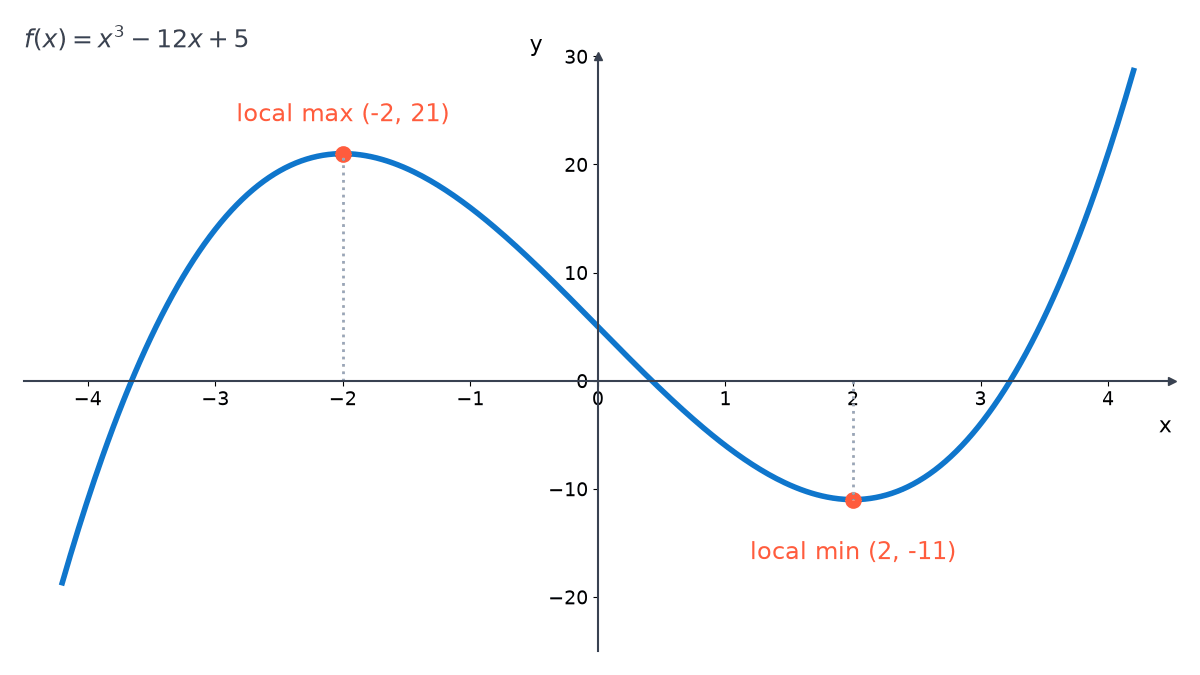
Example 1. : , so the critical points are . Now : gives a local max ; gives a local min .
Absolute extremes on
A continuous function on a closed interval always reaches an absolute maximum and minimum, either at a critical point or at an endpoint. So the recipe is short: work out at all of these points and compare.
Example 2. on : ; , , , . So the absolute max is at , and the absolute min is at . Notice both are at endpoints here.
Optimisation
The hardest step is usually the first one. Use the given condition to write the quantity you want to optimise as a function of just one variable. After that, differentiate as usual.
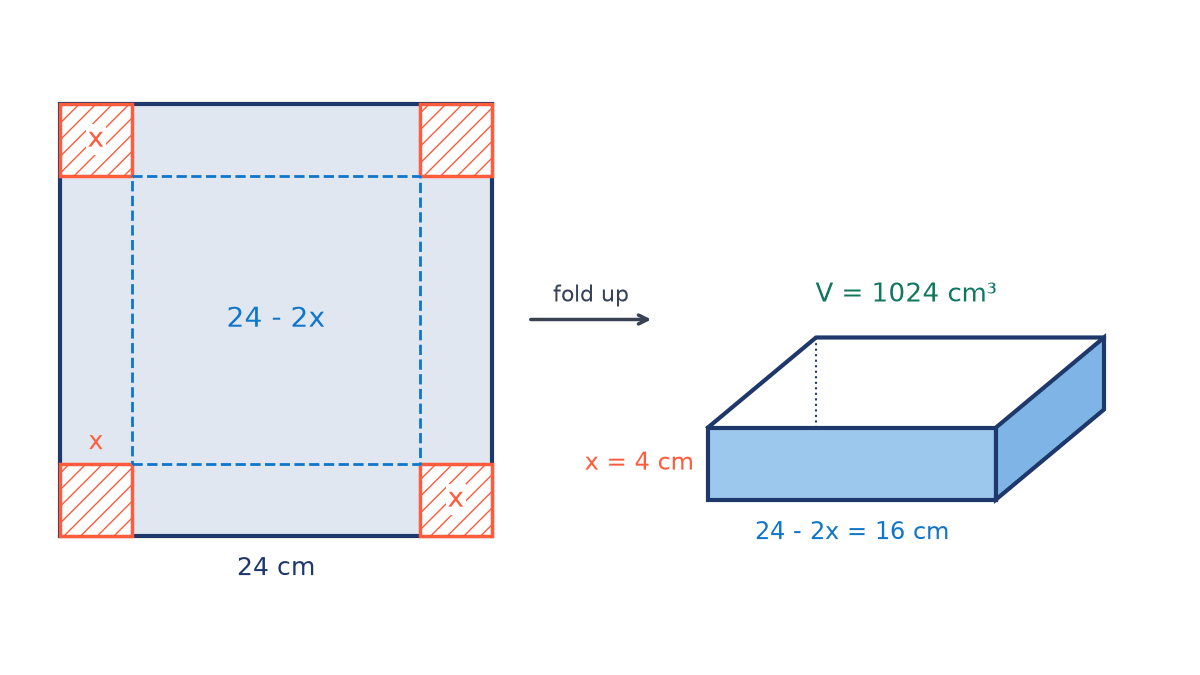
Example 3. An open box is made from a cm square sheet by cutting equal squares of side from the corners. ; gives (not , which would leave no base at all). cm³, a maximum.
Example 4. Of all rectangles with perimeter cm, which has the largest area? , at , so the answer is the square.
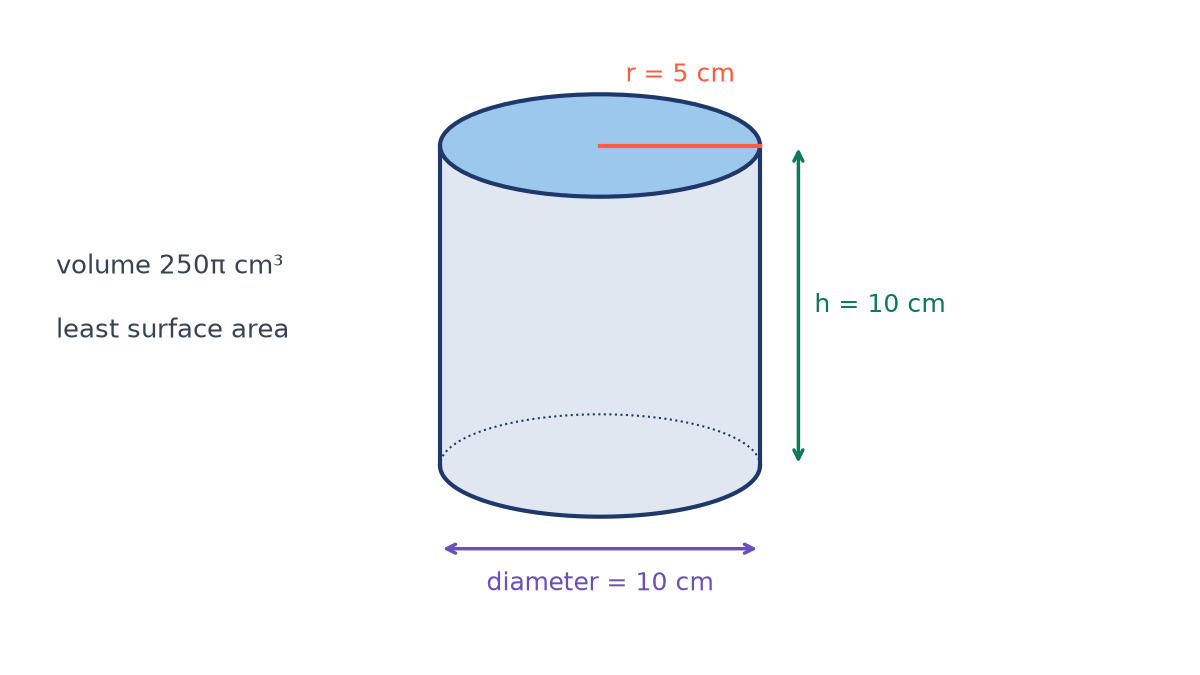
Example 5. A closed cylindrical can holds cm³. Which shape uses the least metal? gives ; ; at , . So the height equals the diameter.
Example 6. Two positive numbers add to . Make the product of one and the square of the other as large as possible: , at , so the numbers are and , with .
Mixed practice
- Find the local maxima and minima: ; for .
- Find absolute extremes of on .
- Find absolute extremes of on .
- Show that has no local extreme.
- Find two positive numbers whose sum is and whose product is greatest.
- A wire cm long is bent into a rectangle. Find the dimensions of maximum area.
- A rectangle is inscribed in a semicircle of radius with one side on the diameter. Find its largest area.
- An open tank with square base and volume m³ is to be built. Find the dimensions that minimise the area of sheet used.
- Find the points on nearest to .
- The cost of producing items is and each sells for ₹. Find the output that maximises profit.
- A m fence encloses a rectangular plot against a straight wall (the wall forms one side). Find the largest area.
- Find the local maximum value of .
Answers to check against
Show answers
- : local max , local min ; local min at , value .
- ; values , , , : max , min .
- Max at , min at .
- , so it never changes sign.
- and .
- cm.
- Area is largest at : .
- , ; at : base m, height m.
- , least at : points .
- ; at ; max at , so items, since .
- Sides : area largest at : m².
- : max at , value .