First, list what can happen
Before a cricket match the captains toss a coin, and everyone agrees it is a fair way to decide. Probability starts to become precise the moment you write down every outcome that could possibly happen. So we begin with random experiments, sample spaces and events. Then we learn to combine events with "and", "or", "not" and "but not", see what mutually exclusive and exhaustive events are, and finish with the few axioms every probability must obey.
Random experiments and sample spaces
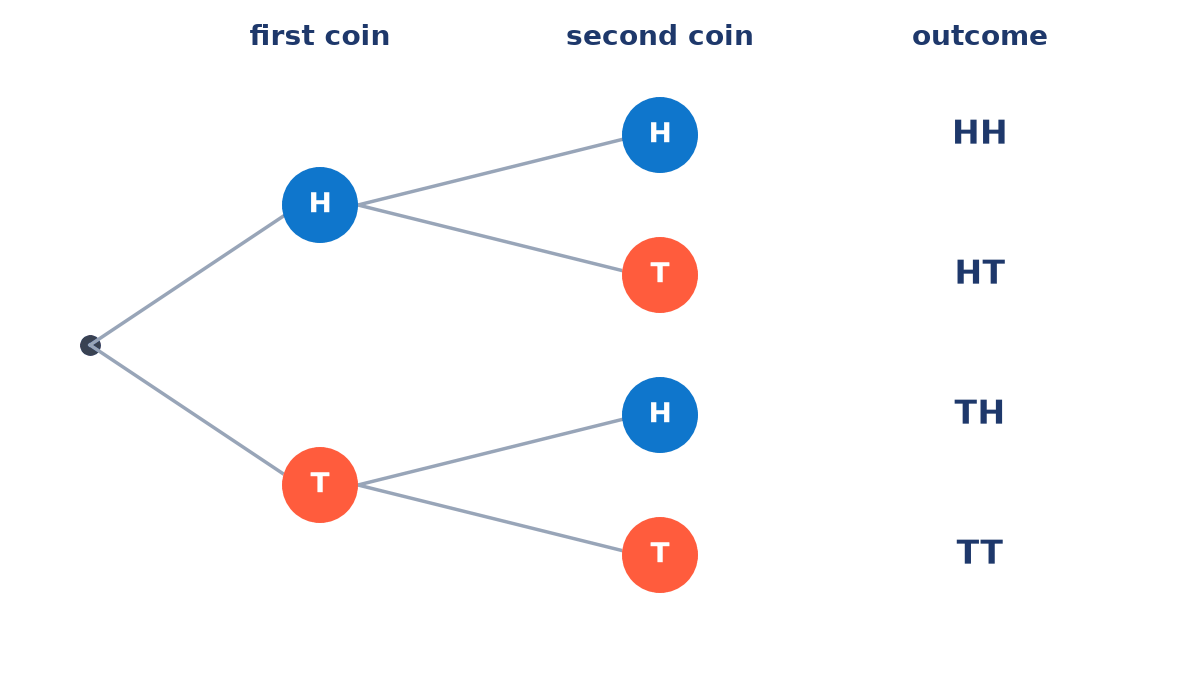
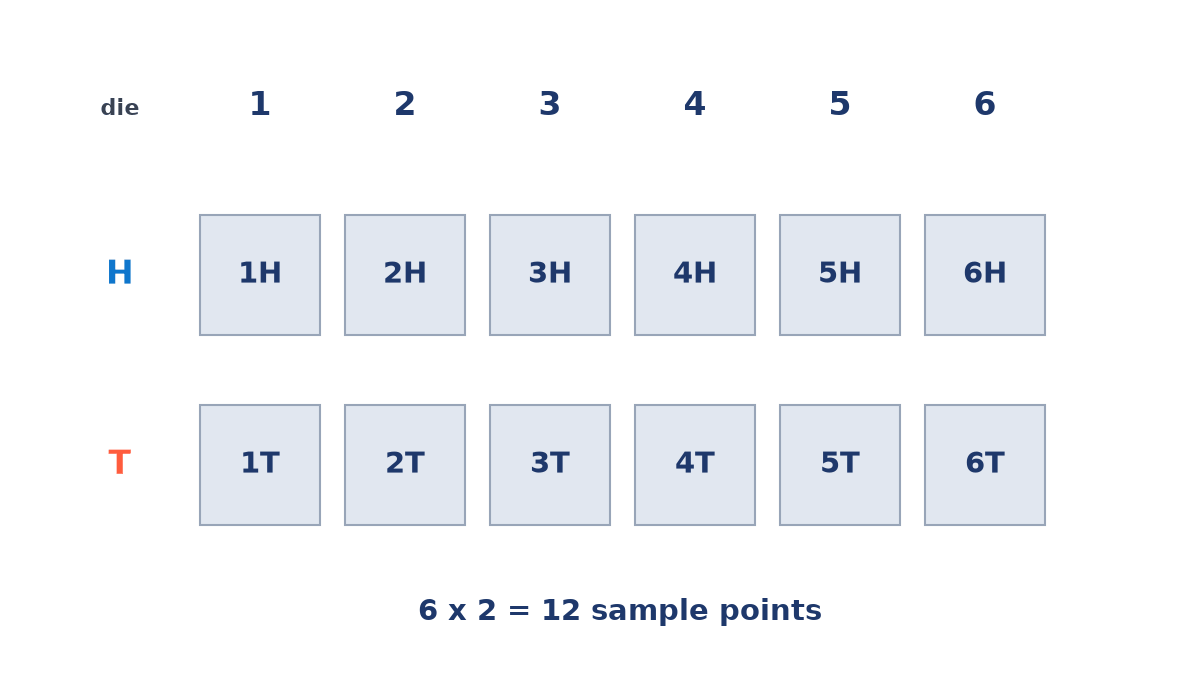
A random experiment is one that has more than one possible outcome, so you cannot predict exactly what will happen. Its sample space is the set of all possible outcomes, and each single outcome is called a sample point.
- Toss two coins: .
- Roll a die and toss a coin: , points.
- Toss a coin until a head appears: , infinite.
- Draw two balls from a bag of red and blue. You can describe by colours, , or by the individual balls, points.
Events
An event is a subset of . We say it occurs when the outcome we actually get belongs to it. is the impossible event, is the sure event, and an event with just one point is called simple.
Combining events. means or (or both). means both happen. (not ) . And means but not .
Mutually exclusive: , so the two can never happen together. Exhaustive: , so at least one of them is bound to happen.
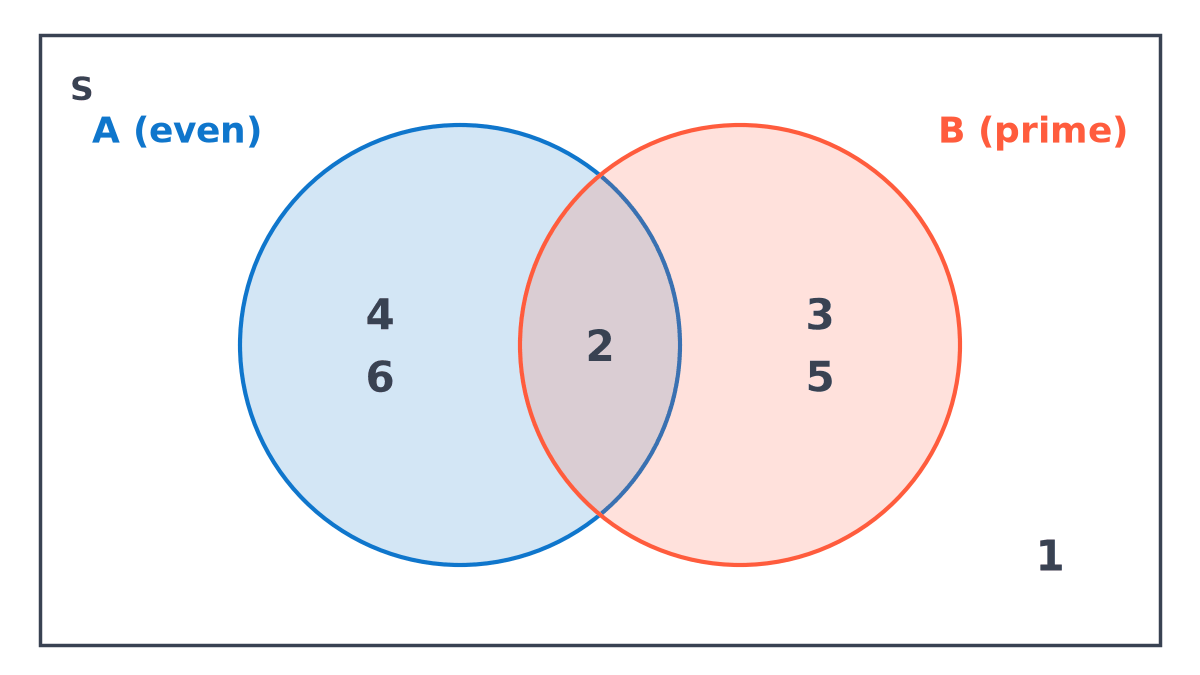
Example 1. Roll a die and let = even , = prime , = at most . ; ; ; . and are mutually exclusive and exhaustive.
Axioms of probability
A probability on a finite sample space gives each event a number, following three simple rules:
- for every event ;
- ;
- if and are mutually exclusive, .
Everything else follows from these. For instance , , and is the sum of the probabilities of its sample points. When all outcomes are equally likely, .
Example 2. Is the assignment , , , valid? Each value is non-negative and together they add to , so yes. Had we used in place of , the total would be , and the answer would be no.
Example 3. A die is loaded so that each even number is twice as likely as each odd number. Give each odd face probability and each even face . Then ; .
Try these yourself
- Write down the sample space for each: (a) a coin tossed three times; (b) a die rolled twice (how many points?); (c) a family's two children by sex, older first.
- A coin is tossed and, if it shows a head, a die is rolled. Describe .
- Two dice are rolled. List: = sum is ; = both show the same number; = first shows . Find , , in terms of counts.
- Which pairs from question 3 are mutually exclusive?
- A card is drawn from a pack. = heart, = king, = red. Describe , , .
- Check whether , , is a valid assignment on .
- A coin is biased so that heads is three times as likely as tails. Find and .
- In the loaded die of Example 3, find .
- Give an example of three events that are mutually exclusive but not exhaustive.
- Show that and are always mutually exclusive and exhaustive.
Answers to check against
Show answers
- (a) outcomes HHH, …, TTT; (b) ordered pairs; (c) .
- : points.
- ; has points; has . ; ; .
- None of the three pairs.
- King of hearts; all red cards (hearts are red); diamonds.
- They add to , so it is not valid.
- , .
- .
- On a die: .
- and .