From axioms to work­ing rules

Once the axioms are in place, the every­day rules for "or" and "not" fol­low almost for free. Add the count­ing you learnt in per­mu­ta­tions and com­bi­na­tions, and ques­tions about cards and com­mit­tees become straight­for­ward prob­a­bil­ity sums. We will prove the addi­tion rule and the com­ple­ment rule, use them on real ques­tions, and end with a mixed prac­tice set on the whole chap­ter.

The basic rules

Com­ple­ment. P(A′)=1−P(A)P(A') = 1 - P(A). This holds because AA and A′A' are mutu­ally exclu­sive and exhaus­tive. It is often far eas­ier to find the chance of some­thing not hap­pen­ing and sub­tract it from one.

Addi­tion rule. For any two events,

P(A∪B)=P(A)+P(B)−P(A∩B).P(A \cup B) = P(A) + P(B) - P(A \cap B).

Why sub­tract? Because A∪BA \cup B is the dis­joint union of AA and B−AB - A, and P(B−A)=P(B)−P(A∩B)P(B - A) = P(B) - P(A \cap B). When the events are mutu­ally exclu­sive, the last term is sim­ply 00.

"But not". P(A−B)=P(A)−P(A∩B)P(A - B) = P(A) - P(A \cap B).

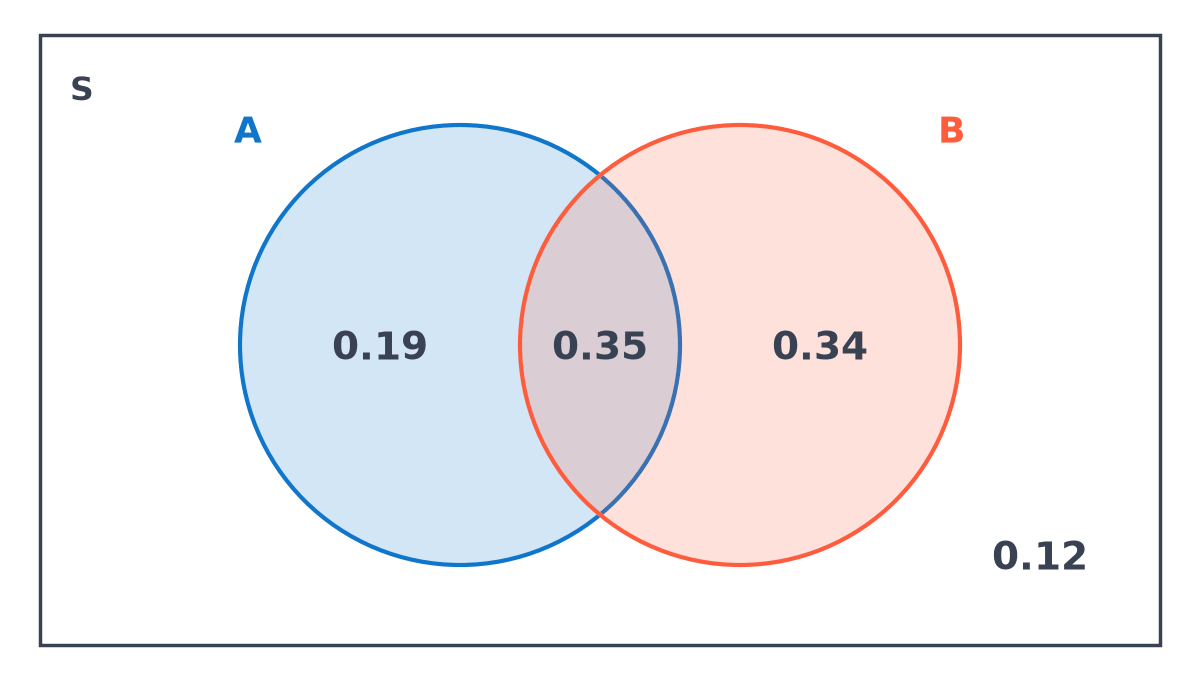
Exam­ple 1. Sup­pose P(A)=0.54P(A) = 0.54, P(B)=0.69P(B) = 0.69 and P(A∩B)=0.35P(A \cap B) = 0.35. Then P(A∪B)=0.88P(A \cup B) = 0.88; P(A′∩B′)=P((A∪B)′)=0.12P(A' \cap B') = P((A \cup B)') = 0.12; P(A∩B′)=0.19P(A \cap B') = 0.19.

Venn diagram of probabilities in S: A only 0.19, A and B together 0.35, B only 0.34, and 0.12 outside both, so P(A or B) = 0.88.
Exam­ple 1: the prob­a­bil­i­ties of the four regions

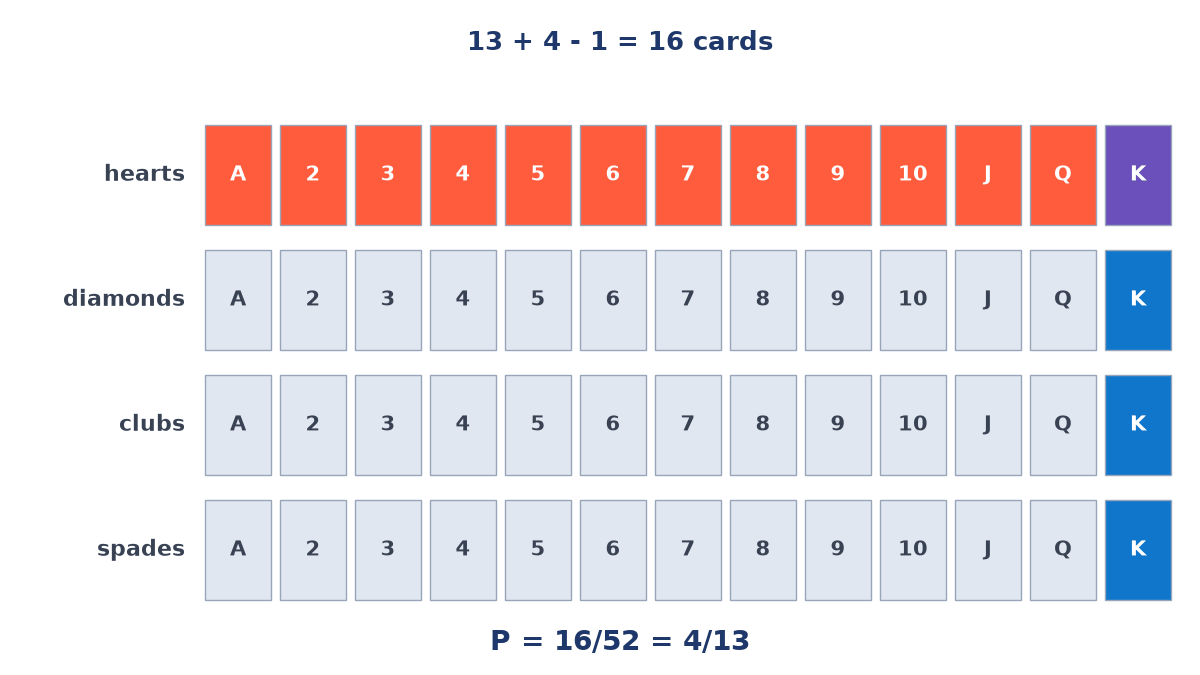
Exam­ple 2. A card is drawn from a pack. The king of hearts must not be counted twice, so P(king or heart)=452+1352−152=413\displaystyle P(\text{king or heart}) = \tfrac{4}{52} + \tfrac{13}{52} - \tfrac{1}{52} = \tfrac{4}{13}.

All 52 cards in four rows by suit; the 13 hearts and the 4 kings are coloured, with the king of hearts counted once, making 13 + 4 - 1 = 16 cards and P = 16/52 = 4/13.
Exam­ple 2: six­teen cards are a king or a heart

Count­ing with com­bi­na­tions

Exam­ple 3. Draw 44 cards from a pack. P(all four are aces)=152C4=1270,725\displaystyle P(\text{all four are aces}) = \tfrac{1}{^{52}C_4} = \tfrac{1}{270{,}725}. And P(exactly two hearts)=13C2 39C252C4=78×741270,725≈0.213\displaystyle P(\text{exactly two hearts}) = \tfrac{^{13}C_2\,{}^{39}C_2}{^{52}C_4} = \tfrac{78 \times 741}{270{,}725} \approx 0.213.

Exam­ple 4. A com­mit­tee of 33 is cho­sen from 55 men and 44 women. "At least one" is a sig­nal to use the com­ple­ment: P(at least one woman)=1−5C39C3=1−1084=3742\displaystyle P(\text{at least one woman}) = 1 - \tfrac{^5C_3}{^9C_3} = 1 - \tfrac{10}{84} = \tfrac{37}{42}.

Exam­ple 5. The let­ters of ASSIST are arranged at ran­dom. Tie the three S's together as one block, and P(the three S’s are together)=4!/16!/3!=24120=15\displaystyle P(\text{the three S's are together}) = \tfrac{4!/1}{6!/3!} = \tfrac{24}{120} = \tfrac{1}{5}.

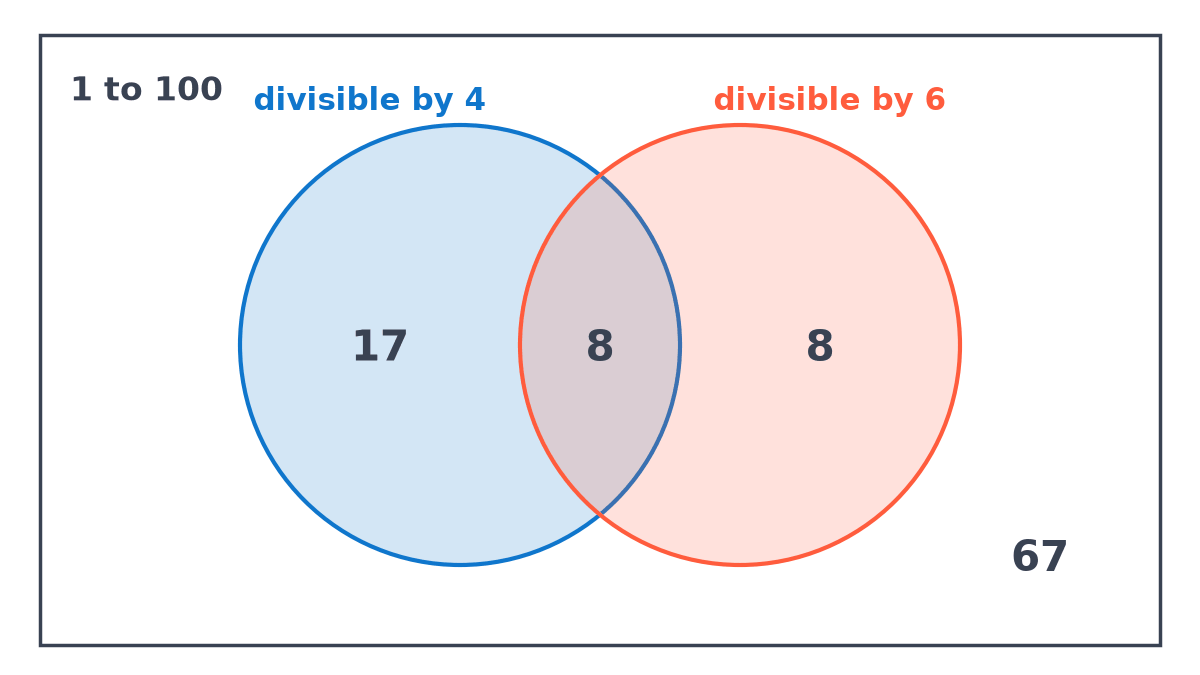
Exam­ple 6. A num­ber is cho­sen from 11 to 100100. Num­bers divis­i­ble by both are counted twice, so take them out once: P(divisible by 4 or 6)=25+16−8100=33100\displaystyle P(\text{divisible by } 4 \text{ or } 6) = \tfrac{25 + 16 - 8}{100} = \tfrac{33}{100}.

Venn diagram for the numbers 1 to 100: 17 divisible by 4 only, 8 divisible by both 4 and 6, 8 divisible by 6 only, and 67 divisible by neither.
Exam­ple 6: 25 + 16 - 8 = 33 num­bers are divis­i­ble by 4 or 6

Mixed prac­tice on the chap­ter

  1. Two dice are rolled. Find P(sum=9)P(\text{sum} = 9), P(doublet)P(\text{doublet}), P(sum≥10)P(\text{sum} \ge 10).
  2. Three coins are tossed. Find P(at least two heads)P(\text{at least two heads}) and P(no tail)P(\text{no tail}).
  3. P(A)=0.42P(A) = 0.42, P(B)=0.48P(B) = 0.48, P(A∩B)=0.16P(A \cap B) = 0.16. Find P(not A)P(\text{not } A), P(not B)P(\text{not } B), P(A or B)P(A \text{ or } B), P(neither)P(\text{neither}).
  4. In a class of 6060, 3030 play foot­ball, 3232 play cricket and 2424 play both. A stu­dent is cho­sen at ran­dom. Find P(plays neither)P(\text{plays neither}) and P(plays exactly one)P(\text{plays exactly one}).
  5. From a group of 66 boys and 44 girls, 33 are cho­sen at ran­dom. Find P(exactly 2 girls)P(\text{exactly } 2 \text{ girls}) and P(at least 1 girl)P(\text{at least } 1 \text{ girl}).
  6. A bag has 55 red, 44 blue and 33 green balls. Two are drawn. Find P(same colour)P(\text{same colour}).
  7. In a lot­tery a per­son picks 66 num­bers from 11 to 2020. Six num­bers are drawn at ran­dom. What is the chance of win­ning, that is, of all six match­ing?
  8. 55 boys and 33 girls sit in a row at ran­dom. Find P(the girls are all together)P(\text{the girls are all together}).
  9. Given P(A)=35\displaystyle P(A) = \tfrac{3}{5} and P(B)=15\displaystyle P(B) = \tfrac{1}{5}, find P(A∪B)P(A \cup B) if AA and BB are mutu­ally exclu­sive.
  10. A num­ber is cho­sen from the 44-digit num­bers formed by 1,2,3,4,51, 2, 3, 4, 5 with­out rep­e­ti­tion. Find P(it is divisible by 5)P(\text{it is divisible by } 5) and P(it is even)P(\text{it is even}).
  11. Could P(A)=0.6P(A) = 0.6, P(B)=0.5P(B) = 0.5, P(A∩B)=0.05P(A \cap B) = 0.05 all be true? Explain.
  12. Out of 5050 tick­ets num­bered 11–5050, one is drawn. Find P(it is a multiple of 3 or a square)P(\text{it is a multiple of } 3 \text{ or a square}).

Answers to check against

Show answers
  1. 436=19\displaystyle \tfrac{4}{36} = \tfrac{1}{9}; 16\displaystyle \tfrac{1}{6}; 636=16\displaystyle \tfrac{6}{36} = \tfrac{1}{6}.
  2. 12\displaystyle \tfrac{1}{2}; 18\displaystyle \tfrac{1}{8}.
  3. 0.580.58; 0.520.52; 0.740.74; 0.260.26.
  4. At least one sport: 30+32−24=3830 + 32 - 24 = 38 stu­dents. So nei­ther is 2260=1130\displaystyle \tfrac{22}{60} = \tfrac{11}{30}, and exactly one is 1460=730\displaystyle \tfrac{14}{60} = \tfrac{7}{30}.
  5. 4C2 6C110C3=36120=310\displaystyle \tfrac{^4C_2\,{}^6C_1}{^{10}C_3} = \tfrac{36}{120} = \tfrac{3}{10}; 1−20120=56\displaystyle 1 - \tfrac{20}{120} = \tfrac{5}{6}.
  6. 5C2+4C2+3C212C2=10+6+366=1966\displaystyle \tfrac{^5C_2 + {}^4C_2 + {}^3C_2}{^{12}C_2} = \tfrac{10 + 6 + 3}{66} = \tfrac{19}{66}.
  7. 120C6=138,760\displaystyle \tfrac{1}{^{20}C_6} = \tfrac{1}{38{,}760}.
  8. 6! 3!8!=328\displaystyle \tfrac{6!\,3!}{8!} = \tfrac{3}{28}.
  9. 45\displaystyle \tfrac{4}{5}.
  10. 15\displaystyle \tfrac{1}{5}; 25\displaystyle \tfrac{2}{5}.
  11. P(A∪B)=1.05>1P(A \cup B) = 1.05 > 1, which is impos­si­ble.
  12. Mul­ti­ples of 33: 1616; squares: 77; both (9,369, 36): 22: 2150\displaystyle \tfrac{21}{50}.