Before you begin
Twelve questions to finish the chapter. Before you write a single formula, ask yourself one question: does order matter here? If it does, you want a permutation; if not, a combination. After that, deal with any restriction first (a fixed letter, people who must sit together) and only then count the rest.
Questions
- How many -digit even numbers can be formed from without repetition?
- In how many ways can people sit in a row if two particular people refuse to sit together?
- How many arrangements of ENGINEERING are there? How many start and end with E?
- Find if .
- How many -letter words (with or without meaning) can be made from COMPUTER without repetition? How many contain the letter M?
- How many ways can prizes be given to students if a student may win more than one prize? If not?
- A cricket team of is chosen from batsmen, bowlers and all-rounders, with exactly batsmen, bowlers and all-rounders. How many ways?
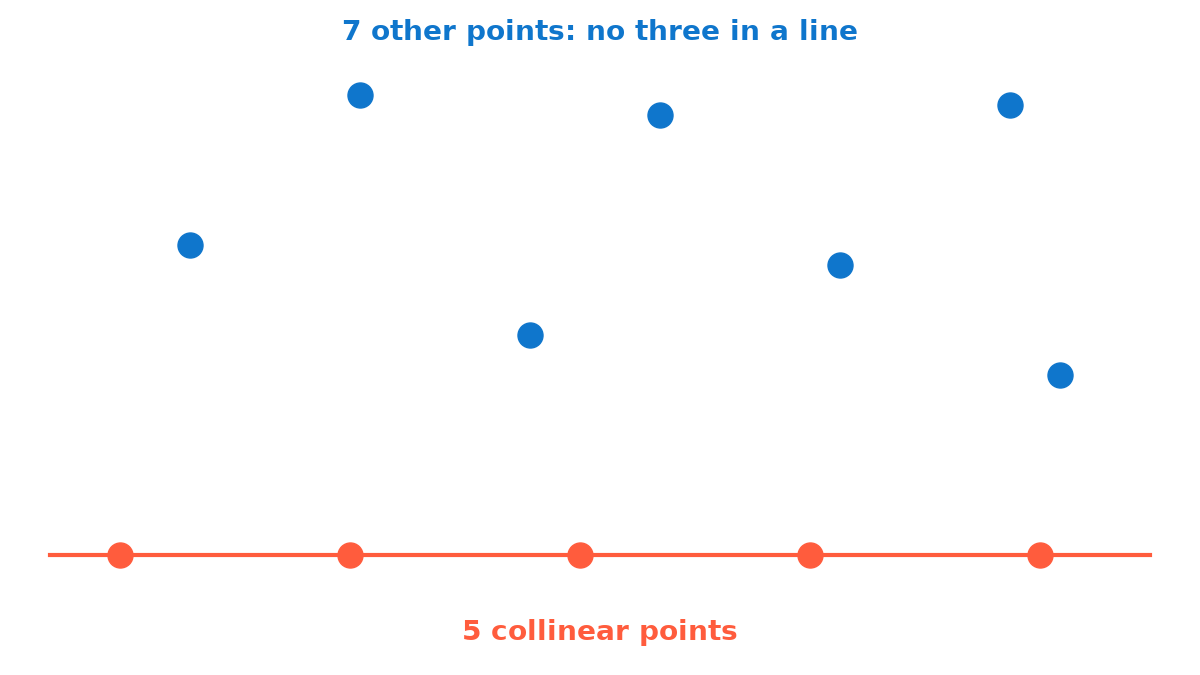
- points lie in a plane; of them are collinear and no other three are. How many lines? How many triangles?
- How many -card hands have exactly hearts?
- A question paper has two sections of questions each. A student must answer questions, with at least from each section. In how many ways can she choose?
- How many words can be formed from all letters of MATHEMATICS with the vowels together?
- Show that and hence that .
Answers
Show answers
- Last digit or : .
- Count all seatings and subtract those where the two sit together: .
- E3, N3, G2, I2, R1: ; with E at both ends: .
- gives , .
- ; containing M: .
- ; .
- .
- Lines ; triangles .
- .
- or : .
- Vowels A, E, A, I as one block ( orders); with M2, T2, H, C, S: units, ; total .
- ; and .