When order doesn't matter
Picking a team of from players is not the same as giving out medals. With medals, who gets gold matters. In a team, it doesn't; the same three people make the same team whichever way you name them. That is the whole difference between a permutation and a combination. We will define combinations, get the formula from what we know about permutations, prove the key identities, and then solve selection problems (committees, teams and hands of cards), including the "at least" and "at most" kind.
Combinations
A selection of objects from distinct objects, where order is ignored, is a combination. Here is the neat link with permutations. Each combination of objects can be arranged in ways, and doing that for every combination produces every permutation exactly once. So
Identities. First, . Next, , because choosing who is in is the same as choosing who is left out. It follows that or . Finally there is Pascal's rule, .
Example 1. From players you can form teams of .
Example 2. If , the two lower numbers must add up to the top one, so , and then .
Selections with conditions
For "at least" or "at most", don't try to do it in one go. Split the problem into separate cases, count each one, and add.
Example 3. A committee of is chosen from men and women. With exactly women, choose the women and the men separately: . With at least women, add up the cases of two, three and four women: .
Example 4. From a pack of cards, the number of -card hands with exactly one ace is .
Example 5. A student must answer of questions, including at least of the first . The cases give .
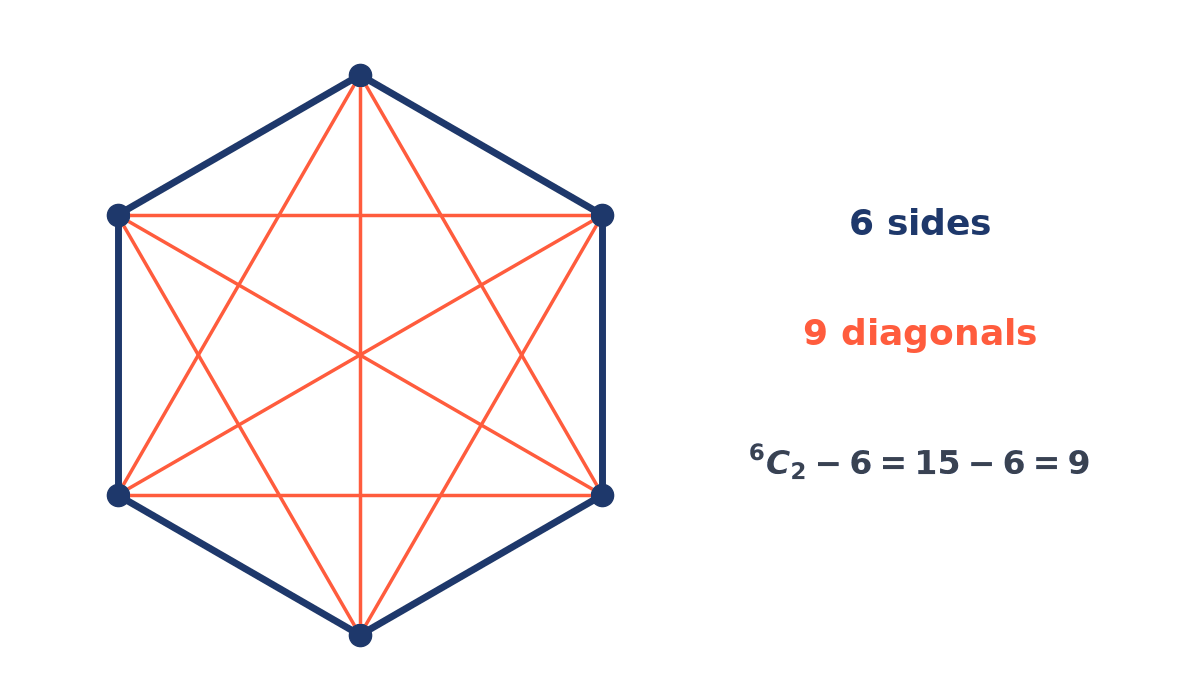
Example 6: lines and triangles. Take points in a plane, no three on a line. Any two points fix a line and any three fix a triangle, so there are lines and triangles. In the same way, a polygon with sides has diagonals, since the sides are not diagonals. A hexagon has .
Example 7: choose, then arrange. Many problems need both tools. How many words of vowels and consonants can be made from the letters of DAUGHTER (vowels A, U, E; consonants D, G, H, T, R)? First choose the letters, then arrange them: .
Practice questions
- Evaluate and . Why are they equal?
- Find : ; .
- How many chords can be drawn through points on a circle? How many triangles with vertices among them?
- In how many ways can a team of be chosen from players if particular players must be included? If a particular player is excluded?
- A bag holds red and white balls. In how many ways can balls be drawn with of each colour? With at least one red?
- How many diagonals has a decagon?
- A committee of is chosen from boys and girls with at least girls. How many ways?
- From the letters of EQUATION, how many -letter words use vowels and consonants?
- A person has friends and invites to dinner. In how many ways, if two of the friends refuse to come together?
- Prove algebraically.
Answers
Show answers
- both, because choosing to include is the same as choosing to leave out.
- ; gives , .
- ; .
- ; .
- ; .
- .
- .
- Vowels E, U, A, I, O; consonants Q, T, N: .
- .
- .