Counting without listing
How many -letter codes can be made from letters? In how many ways can people sit in a row? Listing them all is hopeless. The trick is to count by multiplying instead. We start with the fundamental principle of counting. Then come factorial notation and the formulas for arrangements (permutations): with repetition, without it, and when some objects are identical.
Fundamental principle of counting
If one event can happen in ways and, after it, a second can happen in ways, then the two together can happen in ways. The same goes for three or more events: keep multiplying.
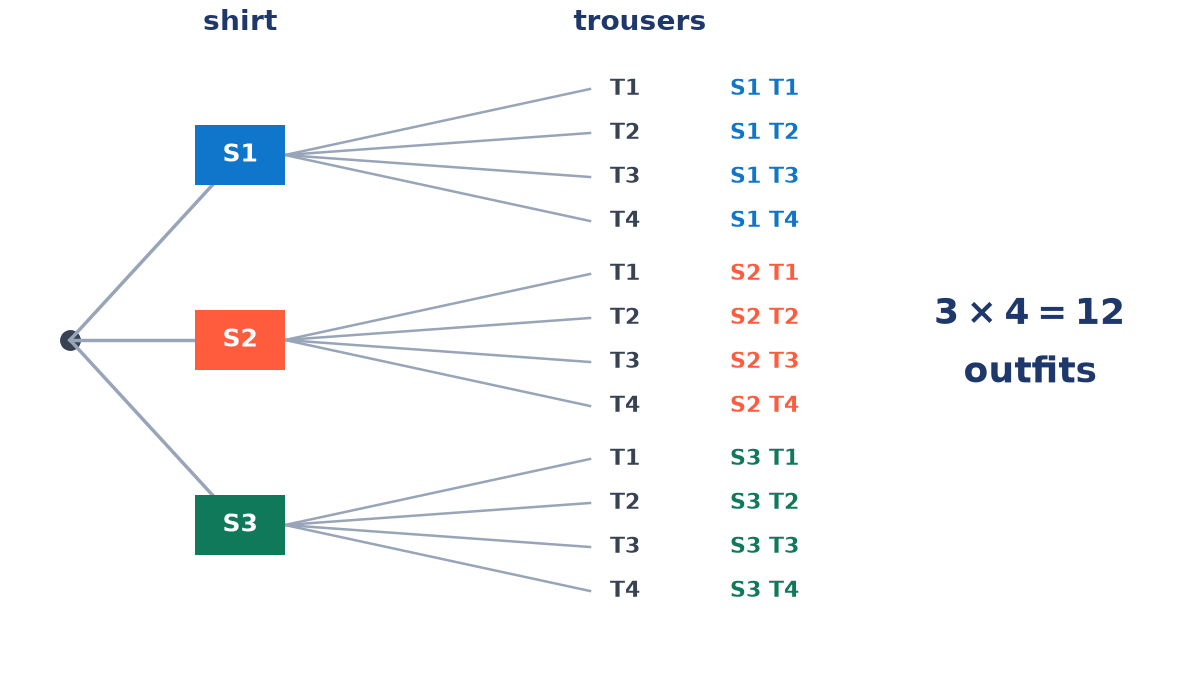
Example 1. With shirts and trousers you can make outfits, as the tree shows. A number plate with letters followed by digits, repetition allowed, can be made in ways.
Example 2. How many -digit numbers can be made from without repeating a digit? The answer is . How many of them are even? An even one must end in . Tip: fill the restricted place first. That gives .
Factorials
Products like these come up so often that they get their own symbol: , read "n factorial", with by agreement. A handy fact is . For example, . When dividing factorials, cancel rather than multiply out: .
Permutations
An ordered arrangement of objects chosen from distinct objects is called a permutation. Think of filling places one after another. The first place can be filled in ways, the second in , and so on, down to the th in :
If repetition is allowed, every place has all the choices again, and the count is .
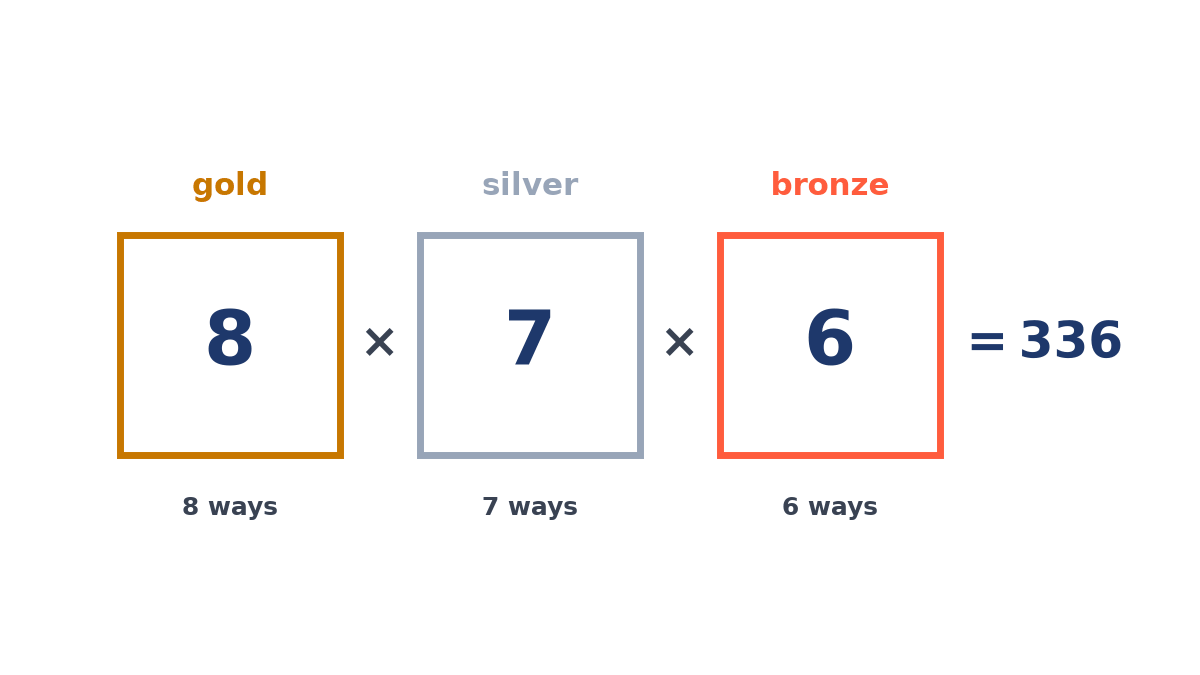
Example 3. Gold, silver and bronze can be shared among runners in ways.
Example 4. The letters of TRIANGLE can be arranged in ways. If the word must begin with T and end with E, those two are fixed, and only the middle letters move: .
Example 5. Find if . Cancelling the common factors leaves , so .
Objects that are alike
Swapping two identical letters gives the same word, so the plain factorial overcounts. We divide out the repeats. If among objects are alike of one kind, of another and of a third, with the rest all different, the number of distinct arrangements is
Example 6. BANANA has letters, with A three times and N twice, giving arrangements.
Example 7. STATISTICS has letters, with S times, T times and I twice. So there are arrangements.
Example 8. PERMUTATION has letters, with T twice. How many arrangements keep the vowels together? Tie E, U, A, I, O into one block. That leaves units with T twice, and the vowels can then be shuffled inside their block: .
Practice questions
- How many -digit numbers can be formed from (a) with repetition; (b) without repetition?
- How many -letter codes from the first letters of the alphabet, no letter repeated?
- Evaluate and find if .
- Find : ; .
- In how many ways can books be arranged on a shelf so that two particular books are always together?
- How many arrangements of MISSISSIPPI? How many begin with P?
- How many -digit numbers greater than can be formed from without repetition?
- How many arrangements of ORANGES keep the vowels in the odd places?
- In how many ways can boys and girls stand in a line so that no two girls are together?
- How many -digit telephone numbers can be made with digits –, starting with , no digit repeated?
Answers
Show answers
- ; .
- .
- ; .
- , ; gives , .
- .
- ; starting with P: .
- First digit , or : .
- Put the vowels O, A, E in the odd places: . The consonants R, N, G, S fill the rest: . Total .
- Line up the boys first: . The girls then go into the gaps: . Total .
- .