Before you start#
Twelve questions on limits and derivatives. With every limit, try plain substitution first. Only when it gives you 0 0 \displaystyle \tfrac{0}{0} 0 0
The questions#
lim x → 5 x 2 − 7 x + 10 x − 5 \displaystyle \lim_{x \to 5} \frac{x^2 - 7x + 10}{x - 5} x → 5 lim x − 5 x 2 − 7 x + 10 lim x → 1 x 15 − 1 x 10 − 1 \displaystyle \lim_{x \to 1} \frac{x^{15} - 1}{x^{10} - 1} x → 1 lim x 10 − 1 x 15 − 1 lim x → 0 sin 7 x tan 2 x \displaystyle \lim_{x \to 0} \frac{\sin 7x}{\tan 2x} x → 0 lim tan 2 x sin 7 x lim x → 0 cos 3 x − cos x x 2 \displaystyle \lim_{x \to 0} \frac{\cos 3x - \cos x}{x^2} x → 0 lim x 2 cos 3 x − cos x lim x → π / 2 tan 2 x x − π 2 \displaystyle \lim_{x \to \pi/2} \frac{\tan 2x}{x - \frac{\pi}{2}} x → π /2 lim x − 2 π tan 2 x Find a a a b b b lim x → 1 f ( x ) = f ( 1 ) \displaystyle \lim_{x \to 1} f(x) = f(1) x → 1 lim f ( x ) = f ( 1 ) f ( x ) = 3 x + a f(x) = 3x + a f ( x ) = 3 x + a x < 1 x < 1 x < 1 f ( 1 ) = 5 f(1) = 5 f ( 1 ) = 5 f ( x ) = b x − 2 f(x) = bx - 2 f ( x ) = b x − 2 x > 1 x > 1 x > 1
Find the derivative of f ( x ) = x 3 f(x) = x^3 f ( x ) = x 3 y = x 3 y = x^3 y = x 3 ( − 2 , − 8 ) (-2, -8) ( − 2 , − 8 )
Differentiate x 3 − 1 x 2 + 1 \displaystyle \frac{x^3 - 1}{x^2 + 1} x 2 + 1 x 3 − 1
Differentiate ( x 2 + 1 ) cos x (x^2 + 1)\cos x ( x 2 + 1 ) cos x
Differentiate sin x − x cos x x sin x + cos x \displaystyle \frac{\sin x - x\cos x}{x\sin x + \cos x} x sin x + cos x sin x − x cos x
A particle moves so that s = t 3 − 6 t 2 + 9 t s = t^3 - 6t^2 + 9t s = t 3 − 6 t 2 + 9 t t t t t = 2 t = 2 t = 2
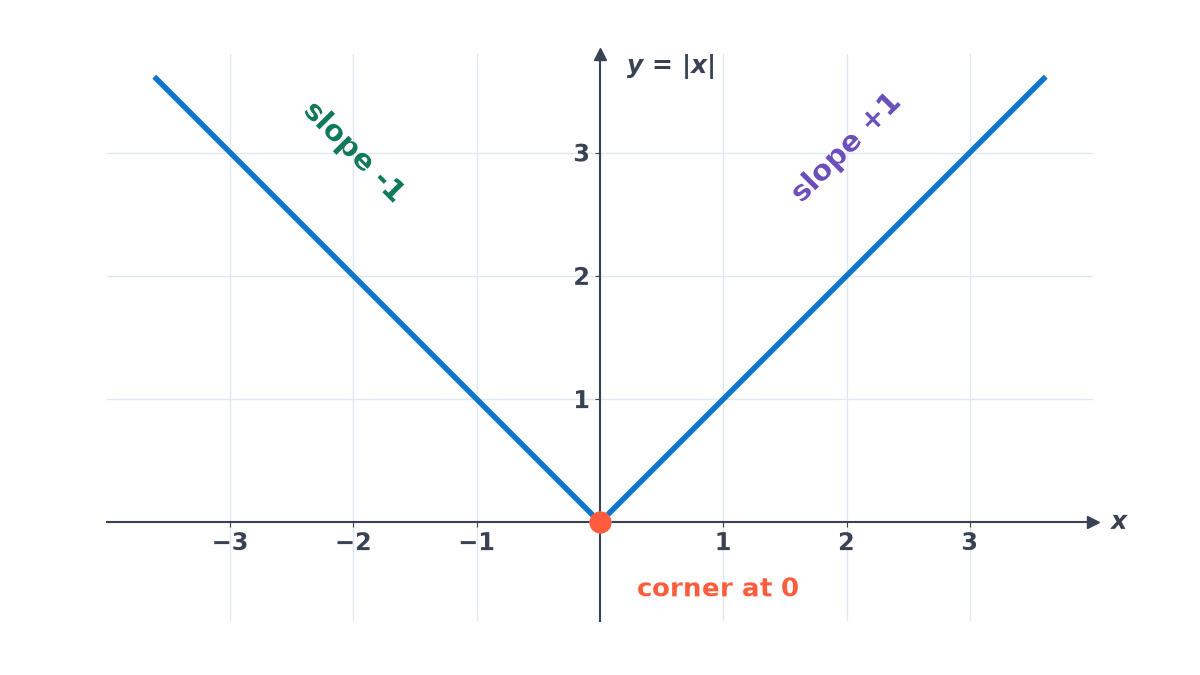
For f ( x ) = ∣ x ∣ f(x) = \lvert x \rvert f ( x ) = ∣ x ∣ lim h → 0 f ( h ) − f ( 0 ) h \displaystyle \lim_{h \to 0}\tfrac{f(h) - f(0)}{h} h → 0 lim h f ( h ) − f ( 0 ) ∣ x ∣ \lvert x \rvert ∣ x ∣ 0 0 0
Question 12: the graph of |x| has a corner at 0 Answers to check against#
Show answers
lim ( x − 2 ) = 3 \displaystyle \lim(x - 2) = 3 lim ( x − 2 ) = 3 15 10 = 3 2 \displaystyle \tfrac{15}{10} = \tfrac{3}{2} 10 15 = 2 3 7 2 \displaystyle \tfrac{7}{2} 2 7 − 2 sin 2 x sin x x 2 → − 4 \displaystyle \tfrac{-2\sin 2x \sin x}{x^2} \to -4 x 2 − 2 s i n 2 x s i n x → − 4 Put y = x − π 2 \displaystyle y = x - \tfrac{\pi}{2} y = x − 2 π tan ( 2 y + π ) = tan 2 y \tan(2y + \pi) = \tan 2y tan ( 2 y + π ) = tan 2 y lim tan 2 y y = 2 \displaystyle \lim \tfrac{\tan 2y}{y} = 2 lim y t a n 2 y = 2
3 + a = 5 3 + a = 5 3 + a = 5 b − 2 = 5 b - 2 = 5 b − 2 = 5 a = 2 a = 2 a = 2 b = 7 b = 7 b = 7 ( x + h ) 3 − x 3 h = 3 x 2 + 3 x h + h 2 → 3 x 2 \displaystyle \tfrac{(x + h)^3 - x^3}{h} = 3x^2 + 3xh + h^2 \to 3x^2 h ( x + h ) 3 − x 3 = 3 x 2 + 3 x h + h 2 → 3 x 2 12 12 12 3 x 2 ( x 2 + 1 ) − 2 x ( x 3 − 1 ) ( x 2 + 1 ) 2 = x 4 + 3 x 2 + 2 x ( x 2 + 1 ) 2 \displaystyle \tfrac{3x^2(x^2 + 1) - 2x(x^3 - 1)}{(x^2 + 1)^2} = \tfrac{x^4 + 3x^2 + 2x}{(x^2 + 1)^2} ( x 2 + 1 ) 2 3 x 2 ( x 2 + 1 ) − 2 x ( x 3 − 1 ) = ( x 2 + 1 ) 2 x 4 + 3 x 2 + 2 x 2 x cos x − ( x 2 + 1 ) sin x 2x\cos x - (x^2 + 1)\sin x 2 x cos x − ( x 2 + 1 ) sin x For the numerator u ′ = x sin x u' = x\sin x u ′ = x sin x v ′ = x cos x v' = x\cos x v ′ = x cos x x sin x ( x sin x + cos x ) − ( sin x − x cos x ) x cos x ( x sin x + cos x ) 2 = x 2 ( x sin x + cos x ) 2 \displaystyle \tfrac{x\sin x(x\sin x + \cos x) - (\sin x - x\cos x)x\cos x}{(x\sin x + \cos x)^2} = \tfrac{x^2}{(x\sin x + \cos x)^2} ( x s i n x + c o s x ) 2 x s i n x ( x s i n x + c o s x ) − ( s i n x − x c o s x ) x c o s x = ( x s i n x + c o s x ) 2 x 2
v = 3 t 2 − 12 t + 9 v = 3t^2 - 12t + 9 v = 3 t 2 − 12 t + 9 v ( 2 ) = − 3 v(2) = -3 v ( 2 ) = − 3 t = 1 t = 1 t = 1 t = 3 t = 3 t = 3 ∣ h ∣ h \displaystyle \tfrac{\lvert h \rvert}{h} h ∣ h ∣ 1 1 1 h > 0 h > 0 h > 0 − 1 -1 − 1 h < 0 h < 0 h < 0