Speed at one instant#
Drop a stone from a terrace. How fast is it moving at one exact instant? You cannot time it over zero seconds, but you can take its average speed over shorter and shorter intervals and see what those averages settle on. That limiting value is the derivative. We will define it from first principles, work out the derivatives of x n x^n x n sin x \sin x sin x cos x \cos x cos x
The derivative#
The derivative of f f f a a a
f ′ ( a ) = lim h → 0 f ( a + h ) − f ( a ) h , \displaystyle f'(a) = \lim_{h \to 0}\frac{f(a + h) - f(a)}{h}, f ′ ( a ) = h → 0 lim h f ( a + h ) − f ( a ) ,
provided the limit exists. On a graph, it is the slope of the tangent to y = f ( x ) y = f(x) y = f ( x ) ( a , f ( a ) ) (a, f(a)) ( a , f ( a )) f ′ ( x ) f'(x) f ′ ( x ) d y d x \displaystyle \tfrac{dy}{dx} d x d y d d x f ( x ) \displaystyle \tfrac{d}{dx}f(x) d x d f ( x )
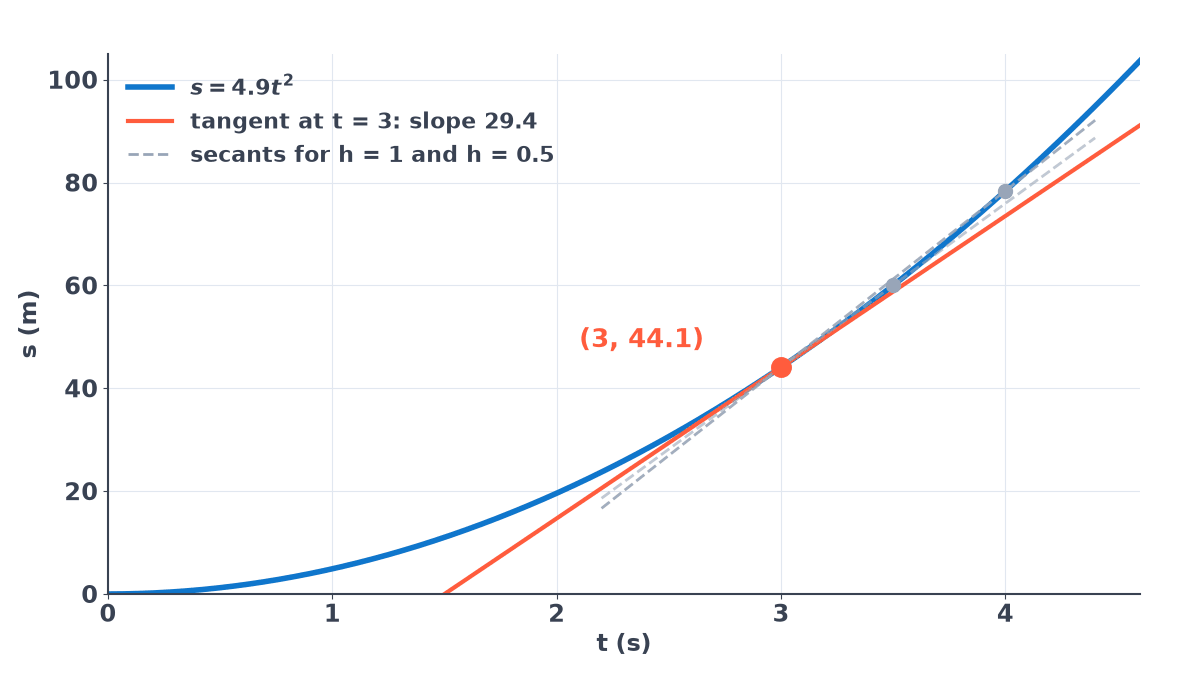
Example 1. A stone falls s = 4.9 t 2 s = 4.9t^2 s = 4.9 t 2 t t t t = 3 t = 3 t = 3 lim h → 0 4.9 [ ( 3 + h ) 2 − 9 ] h = lim 4.9 ( 6 + h ) = 29.4 \displaystyle \lim_{h \to 0}\tfrac{4.9[(3 + h)^2 - 9]}{h} = \lim 4.9(6 + h) = 29.4 h → 0 lim h 4.9 [( 3 + h ) 2 − 9 ] = lim 4.9 ( 6 + h ) = 29.4
Example 1: secant slopes approach the tangent slope 29.4 m/s at t = 3 Example 2 (from first principles). f ( x ) = 1 x \displaystyle f(x) = \tfrac{1}{x} f ( x ) = x 1 f ( x + h ) − f ( x ) h = 1 h ⋅ x − ( x + h ) x ( x + h ) = − 1 x ( x + h ) → − 1 x 2 \displaystyle \tfrac{f(x + h) - f(x)}{h} = \tfrac{1}{h}\cdot\tfrac{x - (x + h)}{x(x + h)} = -\tfrac{1}{x(x + h)} \to -\tfrac{1}{x^2} h f ( x + h ) − f ( x ) = h 1 ⋅ x ( x + h ) x − ( x + h ) = − x ( x + h ) 1 → − x 2 1
Example 3. f ( x ) = sin x f(x) = \sin x f ( x ) = sin x sin ( x + h ) − sin x h = 2 cos ( x + h / 2 ) sin ( h / 2 ) h → cos x \displaystyle \tfrac{\sin(x + h) - \sin x}{h} = \tfrac{2\cos(x + h/2)\sin(h/2)}{h} \to \cos x h s i n ( x + h ) − s i n x = h 2 c o s ( x + h /2 ) s i n ( h /2 ) → cos x d d x cos x = − sin x \displaystyle \tfrac{d}{dx}\cos x = -\sin x d x d cos x = − sin x
The rules that do the work#
d d x x n = n x n − 1 , d d x c = 0 \displaystyle \frac{d}{dx}x^n = nx^{n-1}, \qquad \frac{d}{dx}c = 0 d x d x n = n x n − 1 , d x d c = 0 ( u ± v ) ′ = u ′ ± v ′ , ( c u ) ′ = c u ′ (u \pm v)' = u' \pm v', \qquad (cu)' = cu' ( u ± v ) ′ = u ′ ± v ′ , ( c u ) ′ = c u ′ ( u v ) ′ = u ′ v + u v ′ (product rule) (uv)' = u'v + uv' \quad \text{(product rule)} ( uv ) ′ = u ′ v + u v ′ (product rule) ( u v ) ′ = u ′ v − u v ′ v 2 (quotient rule) \displaystyle \left(\frac{u}{v}\right)' = \frac{u'v - uv'}{v^2} \quad \text{(quotient rule)} ( v u ) ′ = v 2 u ′ v − u v ′ (quotient rule)
Why the product rule holds. Add and subtract one clever term, and u ( x + h ) v ( x + h ) − u ( x ) v ( x ) h = u ( x + h ) − u ( x ) h v ( x + h ) + u ( x ) v ( x + h ) − v ( x ) h → u ′ v + u v ′ \displaystyle \tfrac{u(x + h)v(x + h) - u(x)v(x)}{h} = \tfrac{u(x + h) - u(x)}{h}v(x + h) + u(x)\tfrac{v(x + h) - v(x)}{h} \to u'v + uv' h u ( x + h ) v ( x + h ) − u ( x ) v ( x ) = h u ( x + h ) − u ( x ) v ( x + h ) + u ( x ) h v ( x + h ) − v ( x ) → u ′ v + u v ′
Put the quotient rule to work on sine and cosine and you get the rest of the family: d d x tan x = sec 2 x \displaystyle \tfrac{d}{dx}\tan x = \sec^2 x d x d tan x = sec 2 x d d x cot x = − csc 2 x \displaystyle \tfrac{d}{dx}\cot x = -\csc^2 x d x d cot x = − csc 2 x d d x sec x = sec x tan x \displaystyle \tfrac{d}{dx}\sec x = \sec x\tan x d x d sec x = sec x tan x d d x csc x = − csc x cot x \displaystyle \tfrac{d}{dx}\csc x = -\csc x \cot x d x d csc x = − csc x cot x
Example 4. d d x ( 3 x 4 − 5 x 2 + 7 x − 2 ) = 12 x 3 − 10 x + 7 \displaystyle \tfrac{d}{dx}(3x^4 - 5x^2 + 7x - 2) = 12x^3 - 10x + 7 d x d ( 3 x 4 − 5 x 2 + 7 x − 2 ) = 12 x 3 − 10 x + 7
Example 5. d d x ( x 2 sin x ) = 2 x sin x + x 2 cos x \displaystyle \tfrac{d}{dx}(x^2 \sin x) = 2x\sin x + x^2\cos x d x d ( x 2 sin x ) = 2 x sin x + x 2 cos x
Example 6. d d x x + 1 x − 1 = ( x − 1 ) − ( x + 1 ) ( x − 1 ) 2 = − 2 ( x − 1 ) 2 \displaystyle \tfrac{d}{dx}\frac{x + 1}{x - 1} = \frac{(x - 1) - (x + 1)}{(x - 1)^2} = -\frac{2}{(x - 1)^2} d x d x − 1 x + 1 = ( x − 1 ) 2 ( x − 1 ) − ( x + 1 ) = − ( x − 1 ) 2 2
Example 7. d d x sin x 1 + cos x = cos x ( 1 + cos x ) + sin 2 x ( 1 + cos x ) 2 = 1 1 + cos x \displaystyle \tfrac{d}{dx}\frac{\sin x}{1 + \cos x} = \frac{\cos x(1 + \cos x) + \sin^2 x}{(1 + \cos x)^2} = \frac{1}{1 + \cos x} d x d 1 + cos x sin x = ( 1 + cos x ) 2 cos x ( 1 + cos x ) + sin 2 x = 1 + cos x 1
Try these yourself#
Find the derivative of each from first principles: x 2 + 3 x x^2 + 3x x 2 + 3 x x \sqrt{x} x cos x \cos x cos x
Find f ′ ( 2 ) f'(2) f ′ ( 2 ) f ( x ) = 5 x 3 − 4 x f(x) = 5x^3 - 4x f ( x ) = 5 x 3 − 4 x
Differentiate each: x − 3 + 2 x 1 / 2 x^{-3} + 2x^{1/2} x − 3 + 2 x 1/2 ( 2 x + 1 ) ( x 2 − 4 ) (2x + 1)(x^2 - 4) ( 2 x + 1 ) ( x 2 − 4 ) ( x − 1 ) 3 (x - 1)^3 ( x − 1 ) 3
Differentiate each: x 2 x + 3 \displaystyle \frac{x^2}{x + 3} x + 3 x 2 1 + sin x cos x \displaystyle \frac{1 + \sin x}{\cos x} cos x 1 + sin x x tan x x\tan x x tan x
Differentiate each: sin 2 x \sin^2 x sin 2 x sin x ⋅ sin x \sin x \cdot \sin x sin x ⋅ sin x sec x − tan x \sec x - \tan x sec x − tan x
Find the slope of the tangent to y = x 3 − 3 x + 1 y = x^3 - 3x + 1 y = x 3 − 3 x + 1 x = 2 x = 2 x = 2
The area of a circle is A = π r 2 A = \pi r^2 A = π r 2 A A A r r r r = 5 r = 5 r = 5
If f ( x ) = 1 + x + x 2 + ⋯ + x 50 f(x) = 1 + x + x^2 + \cdots + x^{50} f ( x ) = 1 + x + x 2 + ⋯ + x 50 f ′ ( 1 ) f'(1) f ′ ( 1 )
Derive d d x tan x = sec 2 x \displaystyle \tfrac{d}{dx}\tan x = \sec^2 x d x d tan x = sec 2 x
Find d d x ( a x + b c x + d ) \displaystyle \tfrac{d}{dx}\left(\frac{ax + b}{cx + d}\right) d x d ( c x + d a x + b )
Answers to check against#
Show answers
2 x + 3 2x + 3 2 x + 3 1 2 x \displaystyle \tfrac{1}{2\sqrt{x}} 2 x 1 − sin x -\sin x − sin x f ′ ( x ) = 15 x 2 − 4 f'(x) = 15x^2 - 4 f ′ ( x ) = 15 x 2 − 4 56 56 56 − 3 x − 4 + x − 1 / 2 -3x^{-4} + x^{-1/2} − 3 x − 4 + x − 1/2 6 x 2 + 2 x − 8 6x^2 + 2x - 8 6 x 2 + 2 x − 8 3 ( x − 1 ) 2 3(x - 1)^2 3 ( x − 1 ) 2 x 2 + 6 x ( x + 3 ) 2 \displaystyle \tfrac{x^2 + 6x}{(x + 3)^2} ( x + 3 ) 2 x 2 + 6 x cos 2 x + sin x ( 1 + sin x ) cos 2 x = 1 + sin x cos 2 x \displaystyle \tfrac{\cos^2 x + \sin x(1 + \sin x)}{\cos^2 x} = \tfrac{1 + \sin x}{\cos^2 x} c o s 2 x c o s 2 x + s i n x ( 1 + s i n x ) = c o s 2 x 1 + s i n x tan x + x sec 2 x \tan x + x\sec^2 x tan x + x sec 2 x 2 sin x cos x 2\sin x\cos x 2 sin x cos x sec x tan x − sec 2 x \sec x\tan x - \sec^2 x sec x tan x − sec 2 x 3 x 2 − 3 = 9 3x^2 - 3 = 9 3 x 2 − 3 = 9 x = ± 1 x = \pm 1 x = ± 1 2 π r = 10 π 2\pi r = 10\pi 2 π r = 10 π 1 + 2 + ⋯ + 50 = 1275 1 + 2 + \cdots + 50 = 1275 1 + 2 + ⋯ + 50 = 1275 cos x cos x + sin x sin x cos 2 x \displaystyle \tfrac{\cos x\cos x + \sin x\sin x}{\cos^2 x} c o s 2 x c o s x c o s x + s i n x s i n x a d − b c ( c x + d ) 2 \displaystyle \tfrac{ad - bc}{(cx + d)^2} ( c x + d ) 2 a d − b c