Get­ting close with­out arriv­ing

What value does x2−9x−3\displaystyle \tfrac{x^2 - 9}{x - 3} approach as xx approaches 33? At x=3x = 3 itself the for­mula breaks down, since you would be divid­ing by zero. Yet if you try val­ues just a lit­tle either side, the answers set­tle qui­etly towards 66. That value they set­tle on is called a limit, and it is the idea on which all of cal­cu­lus rests. We will look at left and right lim­its, learn the rules for com­bin­ing lim­its, and work out lim­its of poly­no­mial, ratio­nal and trigono­met­ric func­tions, includ­ing two results you will use again and again, lim⁡x→axn−anx−a=nan−1\displaystyle \lim_{x \to a}\tfrac{x^n - a^n}{x - a} = na^{n-1} and lim⁡x→0sin⁡xx=1\displaystyle \lim_{x \to 0}\tfrac{\sin x}{x} = 1.

What a limit means

lim⁡x→af(x)=L\displaystyle \lim_{x \to a} f(x) = L means you can make f(x)f(x) as close to LL as you like by tak­ing xx close enough to aa (but never equal to it). Notice what this does not say: the value f(a)f(a) itself plays no part at all.

One-sided lim­its. lim⁡x→a−\displaystyle \lim_{x \to a^-} looks only at x<ax < a, while lim⁡x→a+\displaystyle \lim_{x \to a^+} looks only at x>ax > a. The limit exists exactly when both of these exist and agree.

Exam­ple 1. f(x)=∣x∣x\displaystyle f(x) = \frac{\lvert x \rvert}{x}. From the left the limit at 00 is −1-1, from the right it is 11. They dis­agree, so there is no limit at 00.

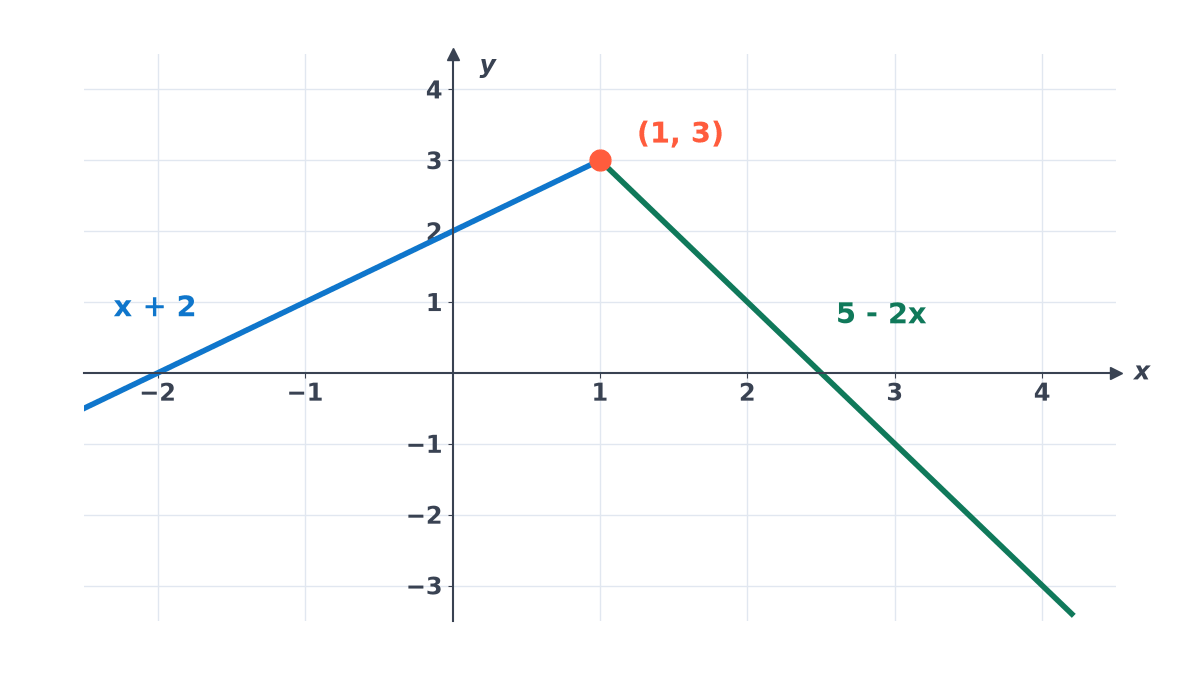
Exam­ple 2. f(x)={x+2,x<15−2x,x≥1f(x) = \begin{cases} x + 2, & x < 1 \\ 5 - 2x, & x \ge 1 \end{cases}: both one-sided lim­its at 11 equal 33, so lim⁡x→1f(x)=3\displaystyle \lim_{x \to 1} f(x) = 3.

Graph of the piecewise function: the line x + 2 for x less than 1 and the line 5 - 2x for x from 1 on; both pieces meet at the point (1, 3), so the limit at 1 is 3.
Exam­ple 2: both one-sided lim­its at 1 equal 3

Alge­bra of lim­its

Lim­its behave politely with arith­metic. If lim⁡f=l\displaystyle \lim f = l and lim⁡g=m\displaystyle \lim g = m at the same point, then lim⁡(f±g)=l±m\displaystyle \lim(f \pm g) = l \pm m; lim⁡(fg)=lm\displaystyle \lim(fg) = lm; lim⁡fg=lm\displaystyle \lim \tfrac{f}{g} = \tfrac{l}{m} if m≠0m \ne 0; lim⁡cf=cl\displaystyle \lim cf = cl.

In prac­tice this means: for a poly­no­mial, lim⁡x→ap(x)=p(a)\displaystyle \lim_{x \to a} p(x) = p(a). For a ratio­nal func­tion whose denom­i­na­tor is not zero at aa, just sub­sti­tute. If sub­sti­tut­ing gives 00\displaystyle \tfrac{0}{0}, do not panic; there is a com­mon fac­tor hid­ing, so can­cel it first.

Exam­ple 3. lim⁡x→2(x3−4x+7)=7\displaystyle \lim_{x \to 2}(x^3 - 4x + 7) = 7.

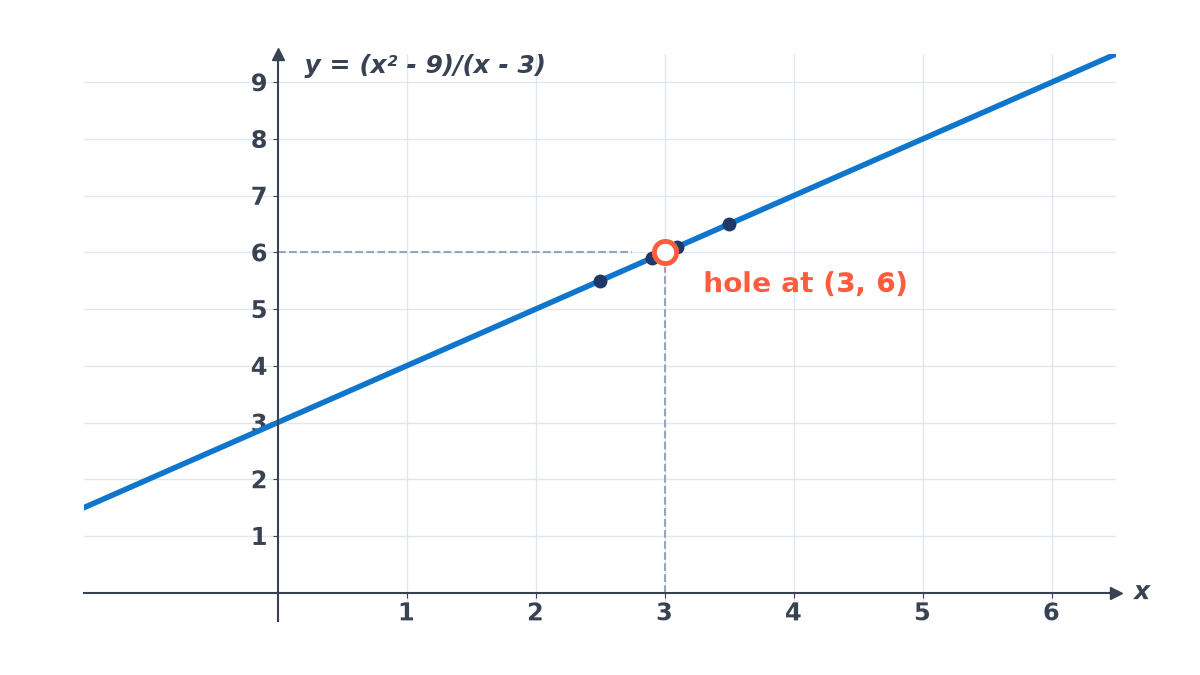
Exam­ple 4. lim⁡x→3x2−9x−3=lim⁡x→3(x+3)=6\displaystyle \lim_{x \to 3} \frac{x^2 - 9}{x - 3} = \lim_{x \to 3}(x + 3) = 6.

Graph of y = (x squared - 9)/(x - 3): the straight line y = x + 3 with an open circle, a hole, at (3, 6); points on either side close in on height 6.
Exam­ple 4: the graph has a hole at x = 3, but the val­ues approach 6

Exam­ple 5. lim⁡x→1x3−1x2+2x−3=lim⁡(x−1)(x2+x+1)(x−1)(x+3)=34\displaystyle \lim_{x \to 1} \frac{x^3 - 1}{x^2 + 2x - 3} = \lim \frac{(x - 1)(x^2 + x + 1)}{(x - 1)(x + 3)} = \frac{3}{4}.

A stan­dard limit

lim⁡x→axn−anx−a=nan−1\displaystyle \lim_{x \to a} \frac{x^n - a^n}{x - a} = n a^{n-1}

For pos­i­tive inte­gers nn you can prove this by fac­toris­ing xn−anx^n - a^n. It stays true for every ratio­nal nn pro­vided a>0a > 0.

Exam­ple 6. lim⁡x→2x5−32x−2=5⋅24=80\displaystyle \lim_{x \to 2} \frac{x^5 - 32}{x - 2} = 5 \cdot 2^4 = 80. lim⁡x→1x10−1x4−1=104=52\displaystyle \lim_{x \to 1} \frac{x^{10} - 1}{x^4 - 1} = \frac{10}{4} = \frac{5}{2}.

Exam­ple 7. lim⁡x→01+x−1x\displaystyle \lim_{x \to 0} \frac{\sqrt{1 + x} - 1}{x}. Put y=1+xy = 1 + x and it becomes lim⁡y→1y1/2−1y−1=12\displaystyle \lim_{y \to 1}\frac{y^{1/2} - 1}{y - 1} = \tfrac{1}{2}.

Trigono­met­ric lim­its

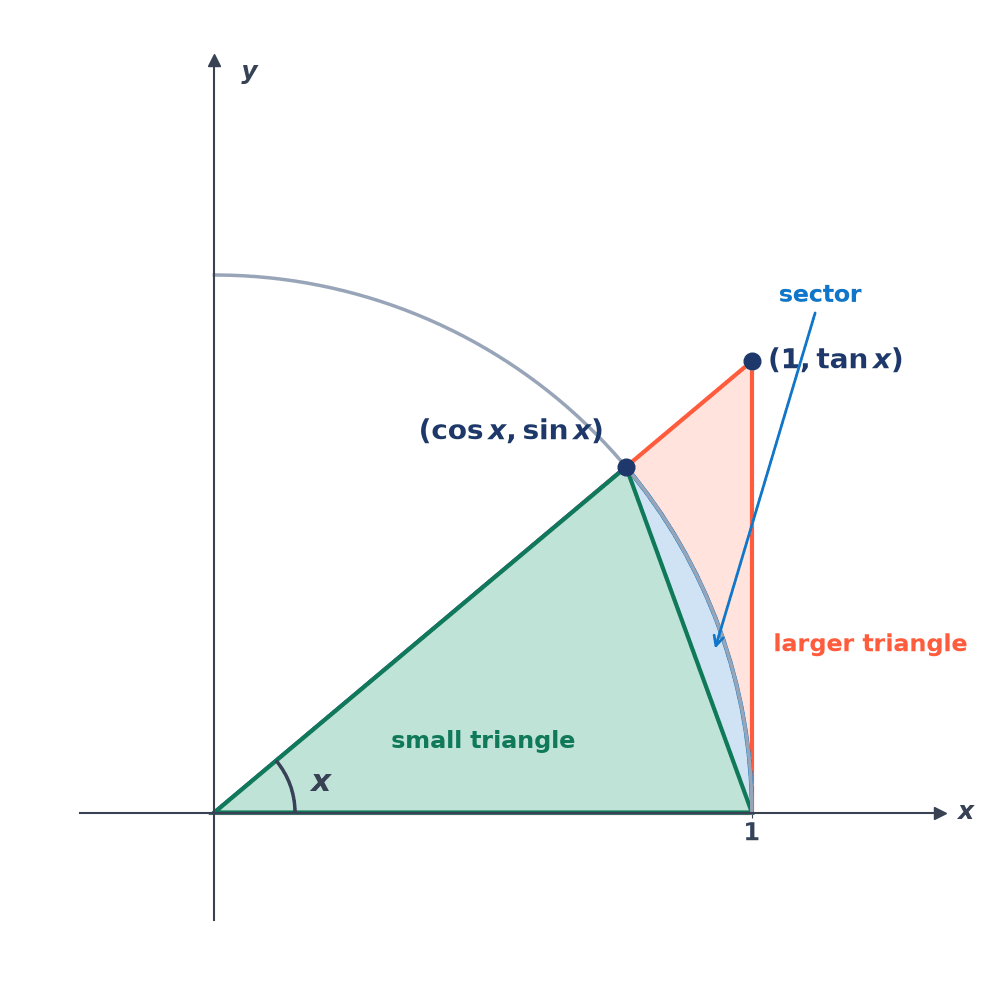
For 0<x<π2\displaystyle 0 < x < \tfrac{\pi}{2}, draw the unit cir­cle and com­pare three areas: a small tri­an­gle, a sec­tor, and a larger tri­an­gle. Their areas give cos⁡x<sin⁡xx<1\displaystyle \cos x < \tfrac{\sin x}{x} < 1. The mid­dle quan­tity is squeezed between the other two, so

Quarter of the unit circle with angle x at the origin: a small triangle to (cos x, sin x), the circular sector of angle x, and a larger triangle reaching (1, tan x), nested inside one another.
The tri­an­gle, the sec­tor and the larger tri­an­gle whose areas squeeze sin x / x

lim⁡x→0sin⁡xx=1,lim⁡x→01−cos⁡xx=0.\displaystyle \lim_{x \to 0}\frac{\sin x}{x} = 1, \qquad \lim_{x \to 0}\frac{1 - \cos x}{x} = 0.

Exam­ple 8. lim⁡x→0sin⁡5xsin⁡3x=lim⁡sin⁡5x5x⋅3xsin⁡3x⋅53=53\displaystyle \lim_{x \to 0} \frac{\sin 5x}{\sin 3x} = \lim \frac{\sin 5x}{5x}\cdot\frac{3x}{\sin 3x}\cdot\frac{5}{3} = \frac{5}{3}.

Exam­ple 9. lim⁡x→0tan⁡xx=1\displaystyle \lim_{x \to 0} \frac{\tan x}{x} = 1; lim⁡x→01−cos⁡2xx2=lim⁡2sin⁡2xx2=2\displaystyle \lim_{x \to 0} \frac{1 - \cos 2x}{x^2} = \lim \frac{2\sin^2 x}{x^2} = 2.

Try these your­self

  1. Eval­u­ate: lim⁡x→−1(2x2−3x+4)\displaystyle \lim_{x \to -1}(2x^2 - 3x + 4); lim⁡x→4x2−16x−4\displaystyle \lim_{x \to 4} \frac{x^2 - 16}{x - 4}; lim⁡x→2x2−5x+6x2−4\displaystyle \lim_{x \to 2} \frac{x^2 - 5x + 6}{x^2 - 4}.
  2. Eval­u­ate: lim⁡x→1x7−1x−1\displaystyle \lim_{x \to 1} \frac{x^7 - 1}{x - 1}; lim⁡x→3x4−81x2−9\displaystyle \lim_{x \to 3} \frac{x^4 - 81}{x^2 - 9}; lim⁡x→0(1+x)6−1x\displaystyle \lim_{x \to 0} \frac{(1 + x)^6 - 1}{x}.
  3. Eval­u­ate: lim⁡x→0sin⁡4xx\displaystyle \lim_{x \to 0} \frac{\sin 4x}{x}; lim⁡x→0tan⁡3xsin⁡2x\displaystyle \lim_{x \to 0} \frac{\tan 3x}{\sin 2x}; lim⁡x→01−cos⁡4xx2\displaystyle \lim_{x \to 0} \frac{1 - \cos 4x}{x^2}.
  4. Eval­u­ate: lim⁡x→04+x−2x\displaystyle \lim_{x \to 0} \frac{\sqrt{4 + x} - 2}{x}; lim⁡x→πsin⁡(π−x)π(π−x)\displaystyle \lim_{x \to \pi} \frac{\sin(\pi - x)}{\pi(\pi - x)}.
  5. Find the left and right lim­its at 00 of f(x)={2x+3,x≤03(x+1),x>0f(x) = \begin{cases} 2x + 3, & x \le 0 \\ 3(x + 1), & x > 0 \end{cases}. Does the limit exist?
  6. For what kk does lim⁡x→2f(x)\displaystyle \lim_{x \to 2} f(x) exist if f(x)=kx−1f(x) = kx - 1 for x<2x < 2 and x2+1x^2 + 1 for x≥2x \ge 2?
  7. Does lim⁡x→0[x]\displaystyle \lim_{x \to 0} [x] exist? What about lim⁡x→0.5[x]\displaystyle \lim_{x \to 0.5} [x]?
  8. Eval­u­ate lim⁡x→0xcos⁡x+sin⁡xx2+tan⁡x\displaystyle \lim_{x \to 0} \frac{x\cos x + \sin x}{x^2 + \tan x}.
  9. Eval­u­ate lim⁡x→asin⁡x−sin⁡ax−a\displaystyle \lim_{x \to a} \frac{\sin x - \sin a}{x - a}.
  10. Eval­u­ate lim⁡x→0sin⁡ax+bxax+sin⁡bx\displaystyle \lim_{x \to 0} \frac{\sin ax + bx}{ax + \sin bx} for non-zero a,ba, b with a+b≠0a + b \ne 0.

Answers to check against

Show answers
  1. 99; 88; (x−2)(x−3)(x−2)(x+2)→−14\displaystyle \tfrac{(x - 2)(x - 3)}{(x - 2)(x + 2)} \to -\tfrac{1}{4}.
  2. 77; 4⋅272⋅3=18\displaystyle \tfrac{4 \cdot 27}{2 \cdot 3} = 18; 66.
  3. 44; 32\displaystyle \tfrac{3}{2}; 88.
  4. 14\displaystyle \tfrac{1}{4}; 1π\displaystyle \tfrac{1}{\pi}.
  5. 33 and 33; yes, 33.
  6. 2k−1=52k - 1 = 5, k=3k = 3.
  7. No, since the left limit is −1-1 and the right limit 00; yes, it is 00.
  8. Divide by xx: cos⁡x+sin⁡xxx+tan⁡xx→2\displaystyle \tfrac{\cos x + \frac{\sin x}{x}}{x + \frac{\tan x}{x}} \to 2.
  9. 2cos⁡x+a2sin⁡x−a2x−a→cos⁡a\displaystyle \tfrac{2\cos\frac{x + a}{2}\sin\frac{x - a}{2}}{x - a} \to \cos a.
  10. Divide by xx: a+ba+b=1\displaystyle \tfrac{a + b}{a + b} = 1.