Two pins and a loop of string#
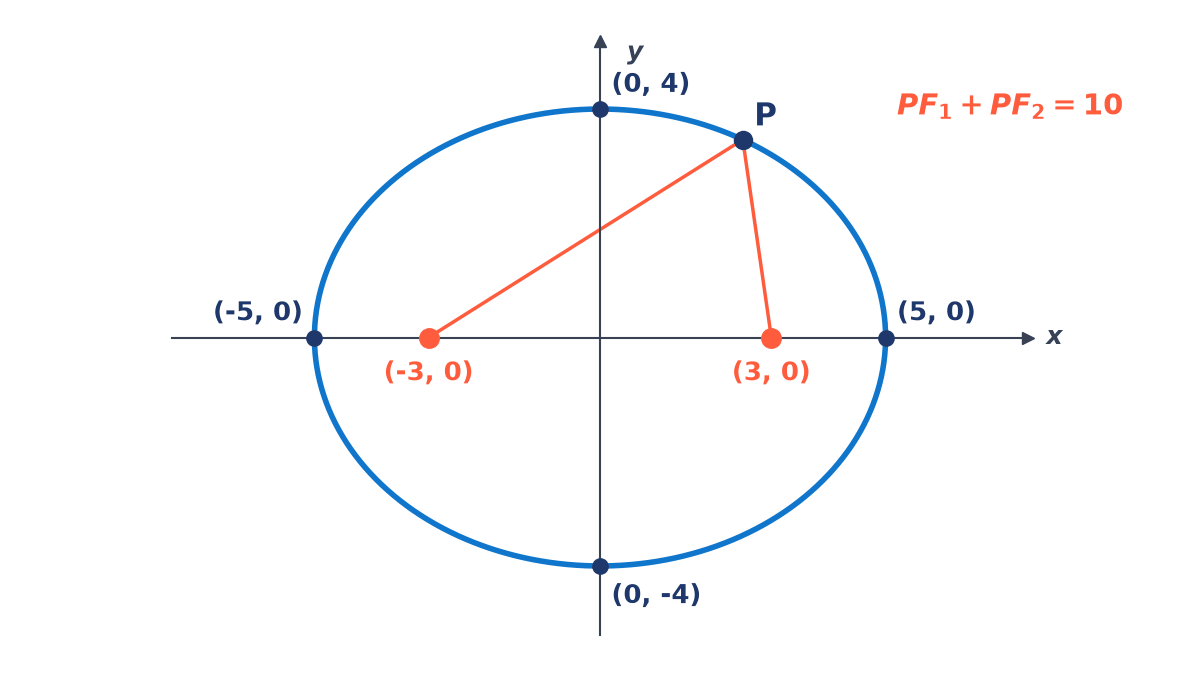
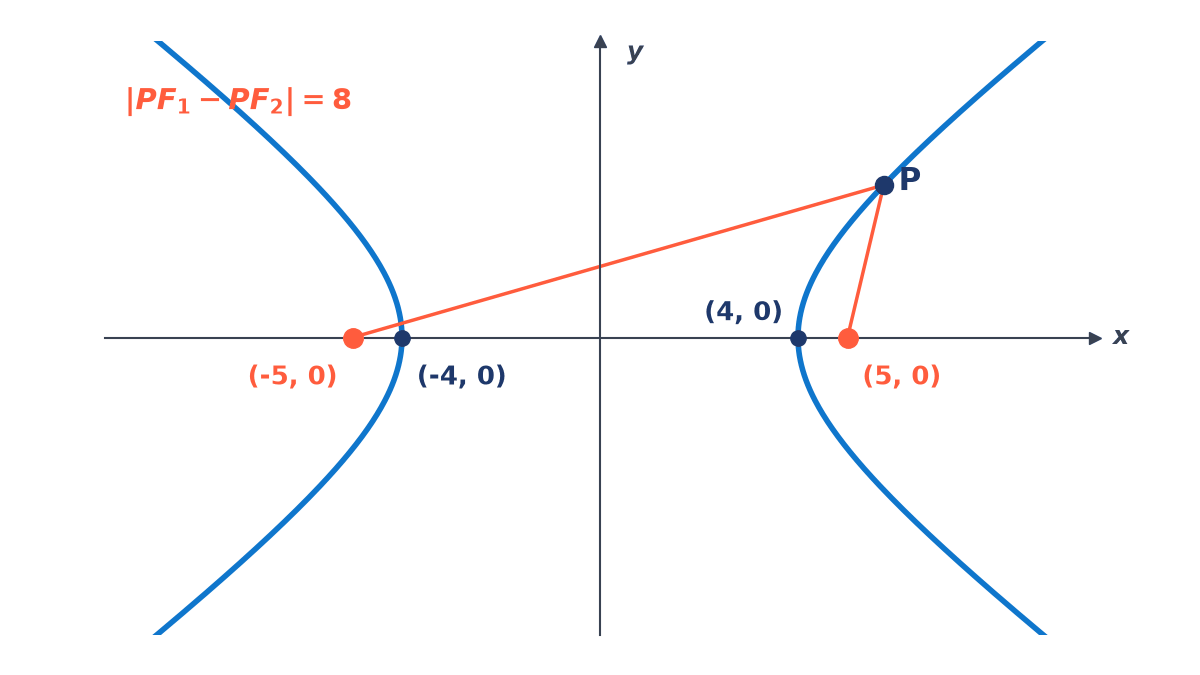
Push two pins into a board, loop a string round them, pull it tight with a pencil and draw. You get an ellipse, because the sum of the pencil's distances to the two pins never changes. If instead the difference of the distances stays fixed, the curve is a hyperbola. We will write down the standard equation of each, learn to read off the foci, vertices, eccentricity and latus rectum, and finish with a mixed practice set on all the conics.
The ellipse#
Formally, an ellipse is the set of points whose distances from two fixed points (the foci ) add to a constant 2 a 2a 2 a ( ± c , 0 ) (\pm c, 0) ( ± c , 0 )
x 2 a 2 + y 2 b 2 = 1 , b 2 = a 2 − c 2 , a > b . \displaystyle \frac{x^2}{a^2} + \frac{y^2}{b^2} = 1, \qquad b^2 = a^2 - c^2, \quad a > b. a 2 x 2 + b 2 y 2 = 1 , b 2 = a 2 − c 2 , a > b .
Major axis on the x x x 2 a 2a 2 a ( ± a , 0 ) (\pm a, 0) ( ± a , 0 )
Minor axis length 2 b 2b 2 b
Eccentricity e = c a < 1 \displaystyle e = \tfrac{c}{a} < 1 e = a c < 1 0 0 0 Latus rectum length 2 b 2 a \displaystyle \tfrac{2b^2}{a} a 2 b 2
When the major axis stands vertical, the equation becomes x 2 b 2 + y 2 a 2 = 1 \displaystyle \tfrac{x^2}{b^2} + \tfrac{y^2}{a^2} = 1 b 2 x 2 + a 2 y 2 = 1 ( 0 , ± c ) (0, \pm c) ( 0 , ± c )
Example 1. x 2 25 + y 2 16 = 1 \displaystyle \tfrac{x^2}{25} + \tfrac{y^2}{16} = 1 25 x 2 + 16 y 2 = 1 a = 5 a = 5 a = 5 b = 4 b = 4 b = 4 c = 3 c = 3 c = 3 ( ± 3 , 0 ) (\pm 3, 0) ( ± 3 , 0 ) e = 3 5 \displaystyle e = \tfrac{3}{5} e = 5 3 32 5 \displaystyle \tfrac{32}{5} 5 32
Example 1: the ellipse with a = 5, b = 4 and foci at 3 and -3 Example 2. 9 x 2 + 4 y 2 = 36 9x^2 + 4y^2 = 36 9 x 2 + 4 y 2 = 36 x 2 4 + y 2 9 = 1 \displaystyle \tfrac{x^2}{4} + \tfrac{y^2}{9} = 1 4 x 2 + 9 y 2 = 1 a = 3 a = 3 a = 3 b = 2 b = 2 b = 2 c = 5 c = \sqrt{5} c = 5 ( 0 , ± 5 ) (0, \pm\sqrt{5}) ( 0 , ± 5 )
Example 3. Given foci ( ± 4 , 0 ) (\pm 4, 0) ( ± 4 , 0 ) ( ± 6 , 0 ) (\pm 6, 0) ( ± 6 , 0 ) b 2 = 36 − 16 = 20 b^2 = 36 - 16 = 20 b 2 = 36 − 16 = 20 x 2 36 + y 2 20 = 1 \displaystyle \tfrac{x^2}{36} + \tfrac{y^2}{20} = 1 36 x 2 + 20 y 2 = 1
Example 4. The major axis is vertical, the ellipse is passing through ( 3 , 0 ) (3, 0) ( 3 , 0 ) 4 5 \displaystyle \tfrac{4}{5} 5 4 b = 3 b = 3 b = 3 c = 4 a 5 \displaystyle c = \tfrac{4a}{5} c = 5 4 a a 2 − 16 a 2 25 = 9 \displaystyle a^2 - \tfrac{16a^2}{25} = 9 a 2 − 25 16 a 2 = 9 a = 5 a = 5 a = 5 x 2 9 + y 2 25 = 1 \displaystyle \tfrac{x^2}{9} + \tfrac{y^2}{25} = 1 9 x 2 + 25 y 2 = 1
The hyperbola#
A hyperbola is the set of points for which the difference of the distances from two foci is a constant 2 a 2a 2 a ( ± c , 0 ) (\pm c, 0) ( ± c , 0 )
x 2 a 2 − y 2 b 2 = 1 , b 2 = c 2 − a 2 . \displaystyle \frac{x^2}{a^2} - \frac{y^2}{b^2} = 1, \qquad b^2 = c^2 - a^2. a 2 x 2 − b 2 y 2 = 1 , b 2 = c 2 − a 2 .
Transverse axis length 2 a 2a 2 a ( ± a , 0 ) (\pm a, 0) ( ± a , 0 ) 2 b 2b 2 b
e = c a > 1 \displaystyle e = \tfrac{c}{a} > 1 e = a c > 1 2 b 2 a \displaystyle \tfrac{2b^2}{a} a 2 b 2 If the y 2 y^2 y 2 y 2 a 2 − x 2 b 2 = 1 \displaystyle \tfrac{y^2}{a^2} - \tfrac{x^2}{b^2} = 1 a 2 y 2 − b 2 x 2 = 1 ( 0 , ± c ) (0, \pm c) ( 0 , ± c )
Unlike the ellipse, here a a a b b b a = b a = b a = b rectangular , e = 2 e = \sqrt{2} e = 2
Example 5. x 2 16 − y 2 9 = 1 \displaystyle \tfrac{x^2}{16} - \tfrac{y^2}{9} = 1 16 x 2 − 9 y 2 = 1 c = 5 c = 5 c = 5 ( ± 5 , 0 ) (\pm 5, 0) ( ± 5 , 0 ) e = 5 4 \displaystyle e = \tfrac{5}{4} e = 4 5 9 2 \displaystyle \tfrac{9}{2} 2 9
Example 5: the hyperbola with a = 4, b = 3 and foci at 5 and -5 Example 6. 5 y 2 − 9 x 2 = 45 5y^2 - 9x^2 = 45 5 y 2 − 9 x 2 = 45 y 2 9 − x 2 5 = 1 \displaystyle \tfrac{y^2}{9} - \tfrac{x^2}{5} = 1 9 y 2 − 5 x 2 = 1 c = 14 c = \sqrt{14} c = 14 ( 0 , ± 14 ) (0, \pm\sqrt{14}) ( 0 , ± 14 ) e = 14 3 \displaystyle e = \tfrac{\sqrt{14}}{3} e = 3 14
Example 7. With foci ( 0 , ± 13 ) (0, \pm 13) ( 0 , ± 13 ) 24 24 24 b = 12 b = 12 b = 12 a = 5 a = 5 a = 5 y 2 25 − x 2 144 = 1 \displaystyle \tfrac{y^2}{25} - \tfrac{x^2}{144} = 1 25 y 2 − 144 x 2 = 1
Mixed practice on conics#
Find foci, vertices, eccentricity and latus rectum of x 2 49 + y 2 36 = 1 \displaystyle \tfrac{x^2}{49} + \tfrac{y^2}{36} = 1 49 x 2 + 36 y 2 = 1 16 x 2 + y 2 = 16 16x^2 + y^2 = 16 16 x 2 + y 2 = 16
Find the ellipse with vertices ( 0 , ± 10 ) (0, \pm 10) ( 0 , ± 10 ) e = 3 5 \displaystyle e = \tfrac{3}{5} e = 5 3
Find the ellipse with centre at the origin, major axis on the x x x ( 4 , 3 ) (4, 3) ( 4 , 3 ) ( − 1 , 4 ) (-1, 4) ( − 1 , 4 )
Find foci, vertices, eccentricity and latus rectum of y 2 16 − x 2 9 = 1 \displaystyle \tfrac{y^2}{16} - \tfrac{x^2}{9} = 1 16 y 2 − 9 x 2 = 1 3 x 2 − y 2 = 3 3x^2 - y^2 = 3 3 x 2 − y 2 = 3
Find the hyperbola with vertices ( ± 7 , 0 ) (\pm 7, 0) ( ± 7 , 0 ) e = 4 3 \displaystyle e = \tfrac{4}{3} e = 3 4
Find the hyperbola with foci ( ± 4 , 0 ) (\pm 4, 0) ( ± 4 , 0 ) 12 12 12
Name the conic in each case: x 2 + y 2 − 4 x = 0 x^2 + y^2 - 4x = 0 x 2 + y 2 − 4 x = 0 4 x 2 + 9 y 2 = 36 4x^2 + 9y^2 = 36 4 x 2 + 9 y 2 = 36 x 2 − 4 y 2 = 4 x^2 - 4y^2 = 4 x 2 − 4 y 2 = 4 y 2 = − 6 x y^2 = -6x y 2 = − 6 x
A rod of length 15 15 15 P P P 5 5 5 x x x
An arch is a semi-ellipse 10 10 10 3 3 3 2 2 2
The distance between the foci of an ellipse is 8 8 8 6 6 6
Answers to check against#
Show answers
c = 13 c = \sqrt{13} c = 13 ( ± 13 , 0 ) (\pm\sqrt{13}, 0) ( ± 13 , 0 ) ( ± 7 , 0 ) (\pm 7, 0) ( ± 7 , 0 ) e = 13 7 \displaystyle e = \tfrac{\sqrt{13}}{7} e = 7 13 72 7 \displaystyle \tfrac{72}{7} 7 72 x 2 1 + y 2 16 = 1 \displaystyle \tfrac{x^2}{1} + \tfrac{y^2}{16} = 1 1 x 2 + 16 y 2 = 1 ( 0 , ± 15 ) (0, \pm\sqrt{15}) ( 0 , ± 15 ) ( 0 , ± 4 ) (0, \pm 4) ( 0 , ± 4 ) e = 15 4 \displaystyle e = \tfrac{\sqrt{15}}{4} e = 4 15 1 2 \displaystyle \tfrac{1}{2} 2 1 c = 6 c = 6 c = 6 b = 8 b = 8 b = 8 x 2 64 + y 2 100 = 1 \displaystyle \tfrac{x^2}{64} + \tfrac{y^2}{100} = 1 64 x 2 + 100 y 2 = 1 16 a 2 + 9 b 2 = 1 \displaystyle \tfrac{16}{a^2} + \tfrac{9}{b^2} = 1 a 2 16 + b 2 9 = 1 1 a 2 + 16 b 2 = 1 \displaystyle \tfrac{1}{a^2} + \tfrac{16}{b^2} = 1 a 2 1 + b 2 16 = 1 a 2 = 247 7 \displaystyle a^2 = \tfrac{247}{7} a 2 = 7 247 b 2 = 247 15 \displaystyle b^2 = \tfrac{247}{15} b 2 = 15 247 c = 5 c = 5 c = 5 ( 0 , ± 5 ) (0, \pm 5) ( 0 , ± 5 ) ( 0 , ± 4 ) (0, \pm 4) ( 0 , ± 4 ) e = 5 4 \displaystyle e = \tfrac{5}{4} e = 4 5 9 2 \displaystyle \tfrac{9}{2} 2 9 x 2 − y 2 3 = 1 \displaystyle x^2 - \tfrac{y^2}{3} = 1 x 2 − 3 y 2 = 1 ( ± 2 , 0 ) (\pm 2, 0) ( ± 2 , 0 ) ( ± 1 , 0 ) (\pm 1, 0) ( ± 1 , 0 ) e = 2 e = 2 e = 2 6 6 6 c = 28 3 \displaystyle c = \tfrac{28}{3} c = 3 28 b 2 = 784 9 − 49 = 343 9 \displaystyle b^2 = \tfrac{784}{9} - 49 = \tfrac{343}{9} b 2 = 9 784 − 49 = 9 343 x 2 49 − 9 y 2 343 = 1 \displaystyle \tfrac{x^2}{49} - \tfrac{9y^2}{343} = 1 49 x 2 − 343 9 y 2 = 1 2 b 2 a = 12 \displaystyle \tfrac{2b^2}{a} = 12 a 2 b 2 = 12 a 2 + b 2 = 16 a^2 + b^2 = 16 a 2 + b 2 = 16 a 2 + 6 a − 16 = 0 a^2 + 6a - 16 = 0 a 2 + 6 a − 16 = 0 a = 2 a = 2 a = 2 b 2 = 12 b^2 = 12 b 2 = 12 x 2 4 − y 2 12 = 1 \displaystyle \tfrac{x^2}{4} - \tfrac{y^2}{12} = 1 4 x 2 − 12 y 2 = 1 Circle; ellipse; hyperbola; parabola.
With the ends at ( α , 0 ) (\alpha, 0) ( α , 0 ) ( 0 , β ) (0, \beta) ( 0 , β ) α 2 + β 2 = 225 \alpha^2 + \beta^2 = 225 α 2 + β 2 = 225 P = ( 2 α 3 , β 3 ) \displaystyle P = \left(\tfrac{2\alpha}{3}, \tfrac{\beta}{3}\right) P = ( 3 2 α , 3 β ) α = 3 x 2 \displaystyle \alpha = \tfrac{3x}{2} α = 2 3 x β = 3 y \beta = 3y β = 3 y x 2 100 + y 2 25 = 1 \displaystyle \tfrac{x^2}{100} + \tfrac{y^2}{25} = 1 100 x 2 + 25 y 2 = 1
x 2 25 + y 2 9 = 1 \displaystyle \tfrac{x^2}{25} + \tfrac{y^2}{9} = 1 25 x 2 + 9 y 2 = 1 x = 3 x = 3 x = 3 y = 3 1 − 9 25 = 12 5 = 2.4 \displaystyle y = 3\sqrt{1 - \tfrac{9}{25}} = \tfrac{12}{5} = 2.4 y = 3 1 − 25 9 = 5 12 = 2.4 c = 4 c = 4 c = 4 b = 3 b = 3 b = 3 a = 5 a = 5 a = 5 e = 4 5 \displaystyle e = \tfrac{4}{5} e = 5 4