Slic­ing a cone

Imag­ine cut­ting through a dou­ble cone with a flat knife. Depend­ing on how you tilt the knife, the cut edge is a cir­cle, an ellipse, a parabola or a hyper­bola. These curves are the conic sec­tions. After a quick look at all four, we set­tle down with two of them: the cir­cle, with its stan­dard and gen­eral equa­tions, and the parabola, with its focus, direc­trix, axis and latus rec­tum.

Conic sec­tions

Here is the pre­cise pic­ture. Take a dou­ble cone with ver­ti­cal axis and semi-ver­ti­cal angle α\alpha, cut by a plane mak­ing angle β\beta with the axis:

  • β=90∘\beta = 90^\circ: a cir­cle;
  • α<β<90∘\alpha < \beta < 90^\circ: an ellipse;
  • β=α\beta = \alpha: a parabola;
  • 0≤β<α0 \le \beta < \alpha: a hyper­bola.

If the plane hap­pens to pass through the ver­tex, the cut col­lapses into a point, a line or a pair of lines.

The cir­cle

You know a cir­cle already: it is the set of points at a fixed dis­tance rr from a fixed cen­tre (h,k)(h, k):

(x−h)2+(y−k)2=r2.(x - h)^2 + (y - k)^2 = r^2.

Open out the brack­ets and you get the gen­eral form x2+y2+2gx+2fy+c=0x^2 + y^2 + 2gx + 2fy + c = 0, with cen­tre (−g,−f)(-g, -f) and radius g2+f2−c\sqrt{g^2 + f^2 - c} (for a real cir­cle you need g2+f2>cg^2 + f^2 > c).

Exam­ple 1. With cen­tre (−3,2)(-3, 2) and radius 55 we get x2+y2+6x−4y−12=0x^2 + y^2 + 6x - 4y - 12 = 0.

Exam­ple 2. x2+y2−8x+10y−12=0x^2 + y^2 - 8x + 10y - 12 = 0. Com­plete the squares: (x−4)2+(y+5)2=53(x - 4)^2 + (y + 5)^2 = 53, so the cen­tre is (4,−5)(4, -5) and the radius is 53\sqrt{53}.

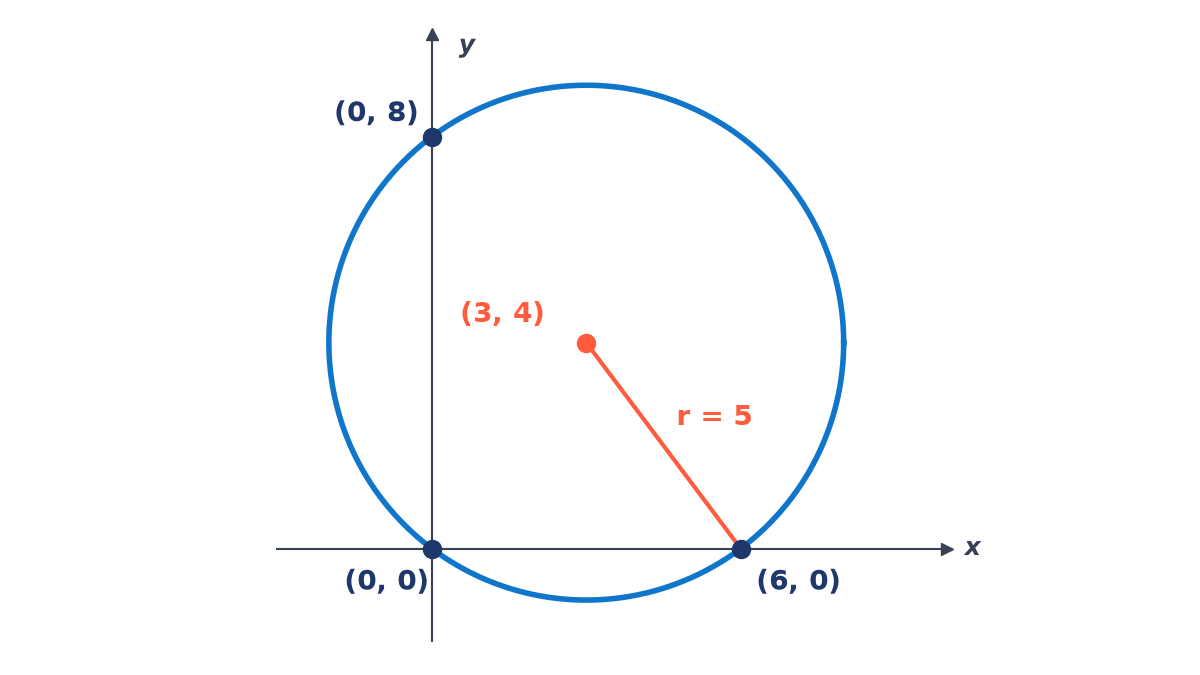
Exam­ple 3. The cir­cle through (0,0)(0, 0), (6,0)(6, 0) and (0,8)(0, 8). Since the ori­gin lies on it, c=0c = 0. Then 36+12g=036 + 12g = 0 gives g=−3g = -3; 64+16f=064 + 16f = 0 gives f=−4f = -4: x2+y2−6x−8y=0x^2 + y^2 - 6x - 8y = 0, cen­tre (3,4)(3, 4), radius 55.

Circle with centre (3, 4) and radius 5 passing through the three points (0, 0), (6, 0) and (0, 8); one radius is drawn from the centre to (6, 0).
Exam­ple 3: the cir­cle through (0, 0), (6, 0) and (0, 8)

Exam­ple 4. Sup­pose the cen­tre lies on the line x+y=4x + y = 4, and the cir­cle passes through (2,5)(2, 5) and (6,1)(6, 1). Both points are the same dis­tance from the cen­tre, so (h−2)2+(k−5)2=(h−6)2+(k−1)2(h - 2)^2 + (k - 5)^2 = (h - 6)^2 + (k - 1)^2 gives h−k=1h - k = 1; with h+k=4h + k = 4: h=52\displaystyle h = \tfrac{5}{2}, k=32\displaystyle k = \tfrac{3}{2}; r2=14+494=252\displaystyle r^2 = \tfrac{1}{4} + \tfrac{49}{4} = \tfrac{25}{2}.

The parabola

A parabola is the set of points that stay equally far from a fixed point (the focus) and a fixed line (the direc­trix). With focus (a,0)(a, 0) and direc­trix x=−ax = -a (a>0a > 0):

y2=4ax.y^2 = 4ax.

Here the axis is the xx-axis and the ver­tex is the ori­gin. The latus rec­tum is the chord through the focus per­pen­dic­u­lar to the axis; its length is 4a4a. The table below shows how the pic­ture changes as the parabola turns to face other direc­tions.

Equa­tion Focus Direc­trix Opens
y2=4axy^2 = 4ax (a,0)(a, 0) x=−ax = -a right
y2=−4axy^2 = -4ax (−a,0)(-a, 0) x=ax = a left
x2=4ayx^2 = 4ay (0,a)(0, a) y=−ay = -a up
x2=−4ayx^2 = -4ay (0,−a)(0, -a) y=ay = a down

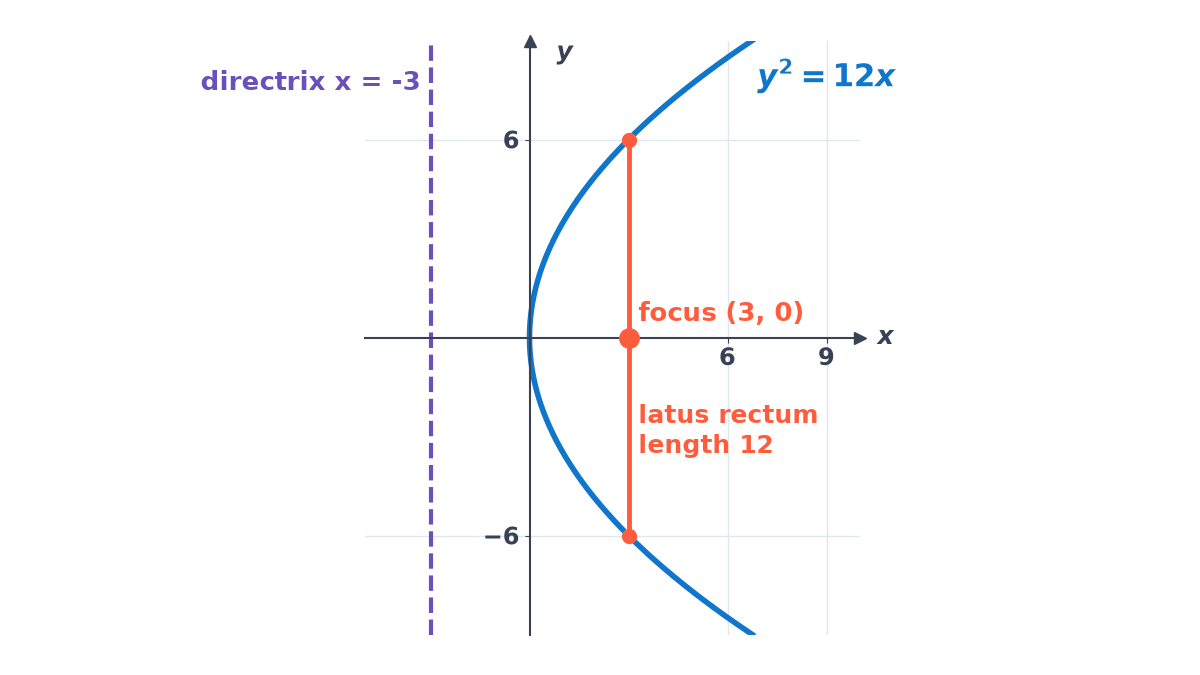
Exam­ple 5. y2=12xy^2 = 12x: a=3a = 3; focus (3,0)(3, 0), direc­trix x=−3x = -3, latus rec­tum 1212.

Parabola y squared = 12x opening to the right from the origin, with focus (3, 0), the dashed directrix x = -3, and the latus rectum from (3, -6) to (3, 6), of length 12.
Exam­ple 5: focus, direc­trix and latus rec­tum of y squared = 12x

Exam­ple 6. x2=−10yx^2 = -10y: a=52\displaystyle a = \tfrac{5}{2}; focus (0,−52)\displaystyle (0, -\tfrac{5}{2}), direc­trix y=52\displaystyle y = \tfrac{5}{2}.

Exam­ple 7. Ver­tex (0,0)(0, 0), axis the yy-axis, through (4,−2)(4, -2): x2=−4ayx^2 = -4ay with 16=8a16 = 8a: x2=−8yx^2 = -8y.

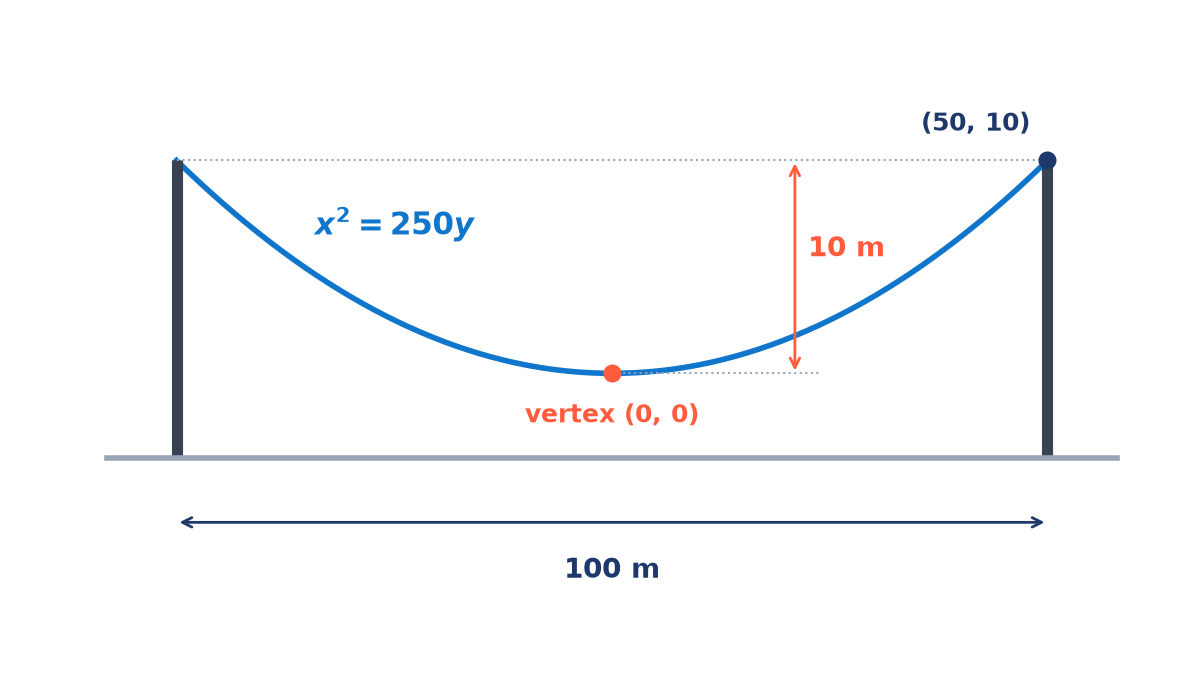
Exam­ple 8. The cable of a sus­pen­sion bridge hangs as a parabola, with 100100 m between tow­ers, and its low­est point 1010 m below the tower tops. Put the ver­tex at the ori­gin; then x2=4ayx^2 = 4ay through (50,10)(50, 10): x2=250yx^2 = 250y.

Bridge cable hanging as the parabola x squared = 250y between two towers 100 m apart; its lowest point is the vertex (0, 0), 10 m below the tower tops, and it meets a tower at (50, 10).
Exam­ple 8: the bridge cable with its ver­tex at the ori­gin

Try these your­self

  1. Find the cir­cle with cen­tre (1,−2)(1, -2) and radius 44; with cen­tre (−a,−b)(-a, -b) and radius a2−b2\sqrt{a^2 - b^2}.
  2. Find the cen­tre and radius of each: x2+y2+4x−6y=3x^2 + y^2 + 4x - 6y = 3; 2x2+2y2−x=02x^2 + 2y^2 - x = 0.
  3. Find the cir­cle through (2,3)(2, 3) and (−1,1)(-1, 1) with cen­tre on x−3y−11=0x - 3y - 11 = 0.
  4. Find the cir­cle with radius 55, cen­tre on the xx-axis, pass­ing through (2,3)(2, 3).
  5. Does (−2.5,3.5)(-2.5, 3.5) lie inside, on or out­side x2+y2=25x^2 + y^2 = 25?
  6. Find the focus, direc­trix and latus rec­tum of each: y2=8xy^2 = 8x; x2=6yx^2 = 6y; y2=−16xy^2 = -16x.
  7. Find the parabola with focus (0,−4)(0, -4) and direc­trix y=4y = 4.
  8. Find the parabola with ver­tex (0,0)(0, 0), axis along the xx-axis, through (3,−6)(3, -6).
  9. Find the area of the tri­an­gle formed by the ver­tex of x2=12yx^2 = 12y and the ends of its latus rec­tum.
  10. An arch is a parabola with ver­ti­cal axis, 88 m wide at the base and 66 m high. How wide is it 22 m below the top?

Answers to check against

Show answers
  1. x2+y2−2x+4y−11=0x^2 + y^2 - 2x + 4y - 11 = 0; x2+y2+2ax+2by+2b2=0x^2 + y^2 + 2ax + 2by + 2b^2 = 0.
  2. (−2,3)(-2, 3), 44; (14,0)\displaystyle (\tfrac{1}{4}, 0), 14\displaystyle \tfrac{1}{4}.
  3. (h−2)2+(k−3)2=(h+1)2+(k−1)2(h - 2)^2 + (k - 3)^2 = (h + 1)^2 + (k - 1)^2 gives 6h+4k=116h + 4k = 11; with h−3k=11h - 3k = 11: h=72\displaystyle h = \tfrac{7}{2}, k=−52\displaystyle k = -\tfrac{5}{2}; r2=652\displaystyle r^2 = \tfrac{65}{2}: x2+y2−7x+5y−14=0x^2 + y^2 - 7x + 5y - 14 = 0.
  4. (h−2)2+9=25(h - 2)^2 + 9 = 25: h=6h = 6 or −2-2: (x−6)2+y2=25(x - 6)^2 + y^2 = 25 or (x+2)2+y2=25(x + 2)^2 + y^2 = 25.
  5. 6.25+12.25=18.5<256.25 + 12.25 = 18.5 < 25, so the point is inside.
  6. (2,0)(2, 0), x=−2x = -2, 88; (0,32)\displaystyle (0, \tfrac{3}{2}), y=−32\displaystyle y = -\tfrac{3}{2}, 66; (−4,0)(-4, 0), x=4x = 4, 1616.
  7. x2=−16yx^2 = -16y.
  8. y2=12xy^2 = 12x.
  9. Ends (±6,3)(\pm 6, 3): area 12⋅12⋅3=18\displaystyle \tfrac{1}{2} \cdot 12 \cdot 3 = 18.
  10. Put the ver­tex at the top: x2=−4ayx^2 = -4ay through (4,−6)(4, -6): 16=24a16 = 24a; at y=−2y = -2: x2=163\displaystyle x^2 = \tfrac{16}{3}, width 2163=83≈4.62\displaystyle 2\sqrt{\tfrac{16}{3}} = \tfrac{8}{\sqrt{3}} \approx 4.62 m.