Where we are headed#
( a + b ) 2 (a + b)^2 ( a + b ) 2 ( a + b ) 3 (a + b)^3 ( a + b ) 3 ( a + b ) 10 (a + b)^{10} ( a + b ) 10
Pascal's triangle#
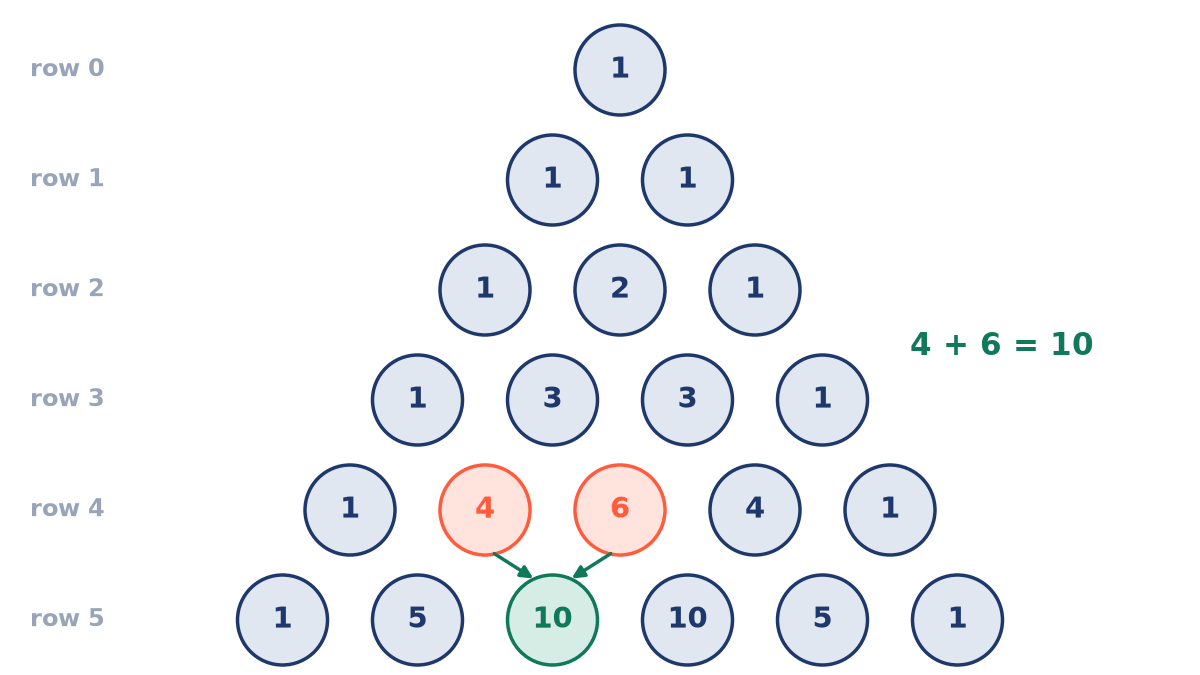
1 1 1 1 2 1 1 3 3 1 1 4 6 4 1 1 5 10 10 5 1 \begin{array}{c} 1 \\ 1\quad 1 \\ 1\quad 2\quad 1 \\ 1\quad 3\quad 3\quad 1 \\ 1\quad 4\quad 6\quad 4\quad 1 \\ 1\quad 5\quad 10\quad 10\quad 5\quad 1 \end{array} 1 1 1 1 2 1 1 3 3 1 1 4 6 4 1 1 5 10 10 5 1
Look at any entry: it is the sum of the two numbers just above it. That is Pascal's rule, n C r − 1 + n C r = n + 1 C r ^nC_{r-1} + {}^nC_r = {}^{n+1}C_r n C r − 1 + n C r = n + 1 C r n n n n C 0 , n C 1 , … , n C n ^nC_0, {}^nC_1, \ldots, {}^nC_n n C 0 , n C 1 , … , n C n Meru Prastara .
Pascal's triangle: each entry is the sum of the two above it The binomial theorem#
For a positive integer n n n
( a + b ) n = ∑ k = 0 n n C k a n − k b k = n C 0 a n + n C 1 a n − 1 b + ⋯ + n C n b n . \displaystyle (a + b)^n = \sum_{k=0}^{n} {}^nC_k\, a^{n-k} b^k = {}^nC_0 a^n + {}^nC_1 a^{n-1} b + \cdots + {}^nC_n b^n. ( a + b ) n = k = 0 ∑ n n C k a n − k b k = n C 0 a n + n C 1 a n − 1 b + ⋯ + n C n b n .
Why does this work? When you multiply out the brackets, each term is made by picking a a a b b b n n n a n − k b k a^{n-k}b^k a n − k b k k k k b b b n C k ^nC_k n C k
Things worth noticing. You get n + 1 n + 1 n + 1 a a a n n n 0 0 0 b b b a = b = 1 a = b = 1 a = b = 1 ∑ n C k = 2 n \displaystyle \sum {}^nC_k = 2^n ∑ n C k = 2 n a = 1 a = 1 a = 1 b = − 1 b = -1 b = − 1 n C 0 − n C 1 + n C 2 − ⋯ = 0 ^nC_0 - {}^nC_1 + {}^nC_2 - \cdots = 0 n C 0 − n C 1 + n C 2 − ⋯ = 0
Two cases you will use constantly. ( a − b ) n = ∑ ( − 1 ) k n C k a n − k b k \displaystyle (a - b)^n = \sum (-1)^k\, {}^nC_k\, a^{n-k}b^k ( a − b ) n = ∑ ( − 1 ) k n C k a n − k b k ( 1 + x ) n = ∑ n C k x k \displaystyle (1 + x)^n = \sum {}^nC_k x^k ( 1 + x ) n = ∑ n C k x k
Putting it to work#
Example 1. ( 2 x + 3 ) 4 = 16 x 4 + 4 ( 8 x 3 ) ( 3 ) + 6 ( 4 x 2 ) ( 9 ) + 4 ( 2 x ) ( 27 ) + 81 = 16 x 4 + 96 x 3 + 216 x 2 + 216 x + 81 (2x + 3)^4 = 16x^4 + 4(8x^3)(3) + 6(4x^2)(9) + 4(2x)(27) + 81 = 16x^4 + 96x^3 + 216x^2 + 216x + 81 ( 2 x + 3 ) 4 = 16 x 4 + 4 ( 8 x 3 ) ( 3 ) + 6 ( 4 x 2 ) ( 9 ) + 4 ( 2 x ) ( 27 ) + 81 = 16 x 4 + 96 x 3 + 216 x 2 + 216 x + 81
Example 2. ( x − 1 x ) 5 = x 5 − 5 x 3 + 10 x − 10 x + 5 x 3 − 1 x 5 \displaystyle \left(x - \tfrac{1}{x}\right)^5 = x^5 - 5x^3 + 10x - \tfrac{10}{x} + \tfrac{5}{x^3} - \tfrac{1}{x^5} ( x − x 1 ) 5 = x 5 − 5 x 3 + 10 x − x 10 + x 3 5 − x 5 1
Example 3. A neat trick for mental arithmetic: ( 99 ) 4 = ( 100 − 1 ) 4 = 10 8 − 4 ⋅ 10 6 + 6 ⋅ 10 4 − 4 ⋅ 10 2 + 1 = 96,059,601 (99)^4 = (100 - 1)^4 = 10^8 - 4 \cdot 10^6 + 6 \cdot 10^4 - 4 \cdot 10^2 + 1 = 96{,}059{,}601 ( 99 ) 4 = ( 100 − 1 ) 4 = 1 0 8 − 4 ⋅ 1 0 6 + 6 ⋅ 1 0 4 − 4 ⋅ 1 0 2 + 1 = 96 , 059 , 601
Example 4. Which is bigger, ( 1.02 ) 50 (1.02)^{50} ( 1.02 ) 50 2 2 2 ( 1 + 0.02 ) 50 = 1 + 50 ( 0.02 ) + 50 ⋅ 49 2 ( 0.0004 ) + ⋯ = 1 + 1 + 0.49 + ⋯ > 2 \displaystyle (1 + 0.02)^{50} = 1 + 50(0.02) + \tfrac{50 \cdot 49}{2}(0.0004) + \cdots = 1 + 1 + 0.49 + \cdots > 2 ( 1 + 0.02 ) 50 = 1 + 50 ( 0.02 ) + 2 50 ⋅ 49 ( 0.0004 ) + ⋯ = 1 + 1 + 0.49 + ⋯ > 2
Example 5. ( a + b ) 4 − ( a − b ) 4 = 2 [ 4 a 3 b + 4 a b 3 ] = 8 a b ( a 2 + b 2 ) (a + b)^4 - (a - b)^4 = 2[4a^3 b + 4ab^3] = 8ab(a^2 + b^2) ( a + b ) 4 − ( a − b ) 4 = 2 [ 4 a 3 b + 4 a b 3 ] = 8 ab ( a 2 + b 2 ) ( 3 + 2 ) 4 − ( 3 − 2 ) 4 = 8 6 ( 5 ) = 40 6 (\sqrt{3} + \sqrt{2})^4 - (\sqrt{3} - \sqrt{2})^4 = 8\sqrt{6}(5) = 40\sqrt{6} ( 3 + 2 ) 4 − ( 3 − 2 ) 4 = 8 6 ( 5 ) = 40 6
Example 6. 6 n − 5 n 6^n - 5n 6 n − 5 n 1 1 1 25 25 25 6 n = ( 1 + 5 ) n = 1 + 5 n + 25 [ n C 2 + 5 n C 3 + ⋯ ] 6^n = (1 + 5)^n = 1 + 5n + 25\left[{}^nC_2 + 5\,{}^nC_3 + \cdots\right] 6 n = ( 1 + 5 ) n = 1 + 5 n + 25 [ n C 2 + 5 n C 3 + ⋯ ]
Try these yourself#
Write row 7 7 7
Expand: ( x + 2 y ) 5 (x + 2y)^5 ( x + 2 y ) 5 ( 3 − x ) 4 (3 - x)^4 ( 3 − x ) 4 ( x 2 + 2 x ) 4 \displaystyle \left(\tfrac{x}{2} + \tfrac{2}{x}\right)^4 ( 2 x + x 2 ) 4
Use the theorem to work out ( 102 ) 5 (102)^5 ( 102 ) 5 ( 98 ) 4 (98)^4 ( 98 ) 4 ( 1.1 ) 5 (1.1)^5 ( 1.1 ) 5
Which is bigger, ( 1.01 ) 100 (1.01)^{100} ( 1.01 ) 100 2 2 2
Find ( x + 1 ) 6 + ( x − 1 ) 6 (x + 1)^6 + (x - 1)^6 ( x + 1 ) 6 + ( x − 1 ) 6 ( 2 + 1 ) 6 + ( 2 − 1 ) 6 (\sqrt{2} + 1)^6 + (\sqrt{2} - 1)^6 ( 2 + 1 ) 6 + ( 2 − 1 ) 6
Show that 9 n + 1 − 8 n − 9 9^{n+1} - 8n - 9 9 n + 1 − 8 n − 9 64 64 64 n n n
Find the sum 10 C 0 + 10 C 1 + ⋯ + 10 C 10 ^{10}C_0 + {}^{10}C_1 + \cdots + {}^{10}C_{10} 10 C 0 + 10 C 1 + ⋯ + 10 C 10 10 C 0 + 10 C 2 + ⋯ + 10 C 10 ^{10}C_0 + {}^{10}C_2 + \cdots + {}^{10}C_{10} 10 C 0 + 10 C 2 + ⋯ + 10 C 10
Expand ( 1 + x + x 2 ) 3 (1 + x + x^2)^3 ( 1 + x + x 2 ) 3 ( 1 + ( x + x 2 ) ) 3 (1 + (x + x^2))^3 ( 1 + ( x + x 2 ) ) 3
Answers to check against#
Show answers
1 , 7 , 21 , 35 , 35 , 21 , 7 , 1 1, 7, 21, 35, 35, 21, 7, 1 1 , 7 , 21 , 35 , 35 , 21 , 7 , 1 x 5 + 10 x 4 y + 40 x 3 y 2 + 80 x 2 y 3 + 80 x y 4 + 32 y 5 x^5 + 10x^4 y + 40x^3y^2 + 80x^2y^3 + 80xy^4 + 32y^5 x 5 + 10 x 4 y + 40 x 3 y 2 + 80 x 2 y 3 + 80 x y 4 + 32 y 5 81 − 108 x + 54 x 2 − 12 x 3 + x 4 81 - 108x + 54x^2 - 12x^3 + x^4 81 − 108 x + 54 x 2 − 12 x 3 + x 4 x 4 16 + x 2 + 6 + 16 x 2 + 16 x 4 \displaystyle \tfrac{x^4}{16} + x^2 + 6 + \tfrac{16}{x^2} + \tfrac{16}{x^4} 16 x 4 + x 2 + 6 + x 2 16 + x 4 16 11,040,808,032 11{,}040{,}808{,}032 11 , 040 , 808 , 032 92,236,816 92{,}236{,}816 92 , 236 , 816 1.61051 1.61051 1.61051 ( 1.01 ) 100 > 1 + 100 ( 0.01 ) = 2 (1.01)^{100} > 1 + 100(0.01) = 2 ( 1.01 ) 100 > 1 + 100 ( 0.01 ) = 2 2 ( x 6 + 15 x 4 + 15 x 2 + 1 ) 2(x^6 + 15x^4 + 15x^2 + 1) 2 ( x 6 + 15 x 4 + 15 x 2 + 1 ) x = 2 x = \sqrt{2} x = 2 2 ( 8 + 60 + 30 + 1 ) = 198 2(8 + 60 + 30 + 1) = 198 2 ( 8 + 60 + 30 + 1 ) = 198 9 n + 1 = ( 1 + 8 ) n + 1 = 1 + 8 ( n + 1 ) + 64 [ ⋯ ] 9^{n+1} = (1 + 8)^{n+1} = 1 + 8(n + 1) + 64[\cdots] 9 n + 1 = ( 1 + 8 ) n + 1 = 1 + 8 ( n + 1 ) + 64 [ ⋯ ] 1024 1024 1024 512 512 512 1 + 3 x + 6 x 2 + 7 x 3 + 6 x 4 + 3 x 5 + x 6 1 + 3x + 6x^2 + 7x^3 + 6x^4 + 3x^5 + x^6 1 + 3 x + 6 x 2 + 7 x 3 + 6 x 4 + 3 x 5 + x 6