Why bother with one term?#
Most exam questions never ask you to write out the whole expansion. They want just one piece of it: the coefficient of x 7 x^7 x 7 x x x
The general term#
Every term of ( a + b ) n (a + b)^n ( a + b ) n ( r + 1 ) (r + 1) ( r + 1 )
T r + 1 = n C r a n − r b r . T_{r+1} = {}^nC_r\, a^{n-r} b^r. T r + 1 = n C r a n − r b r .
Finding the middle#
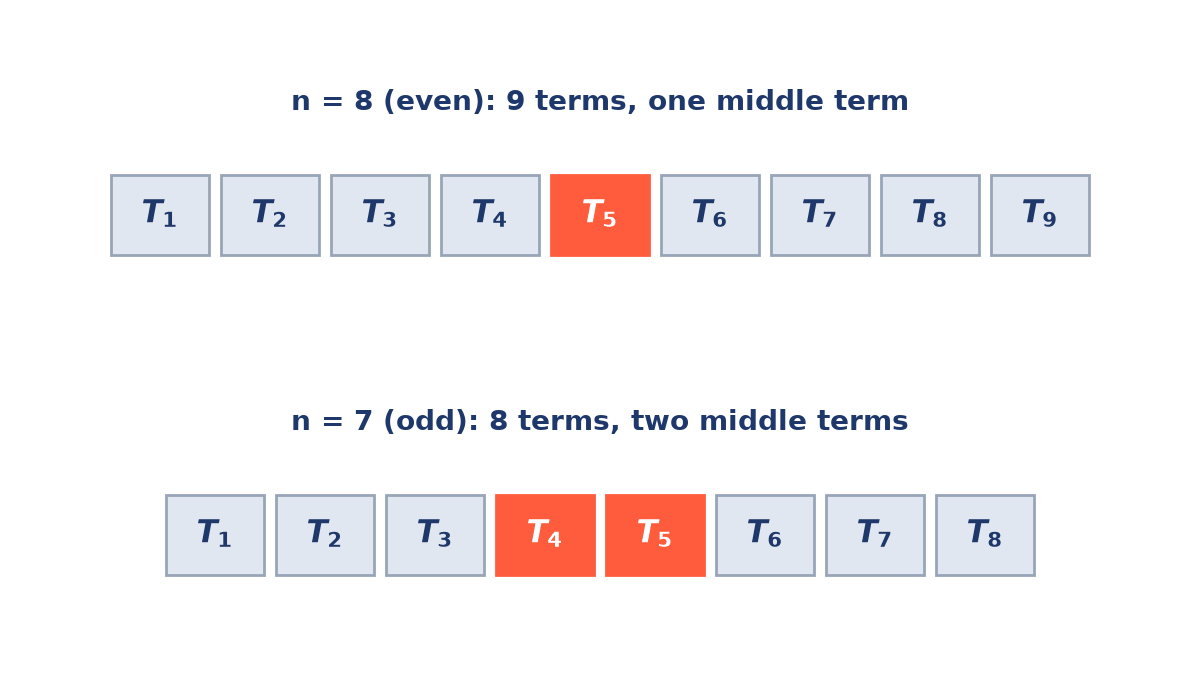
Count the terms first. When n n n T n 2 + 1 \displaystyle T_{\frac{n}{2} + 1} T 2 n + 1 n n n T n + 1 2 \displaystyle T_{\frac{n+1}{2}} T 2 n + 1 T n + 3 2 \displaystyle T_{\frac{n+3}{2}} T 2 n + 3
Even n has one middle term; odd n has two Example 1. Find the middle term of ( x − 2 x ) 8 \displaystyle \left(x - \tfrac{2}{x}\right)^8 ( x − x 2 ) 8 T 5 = 8 C 4 x 4 ( − 2 x ) 4 = 70 × 16 = 1120 \displaystyle T_5 = {}^8C_4\, x^4 \left(-\tfrac{2}{x}\right)^4 = 70 \times 16 = 1120 T 5 = 8 C 4 x 4 ( − x 2 ) 4 = 70 × 16 = 1120
Example 2. Now the middle terms of ( 2 x + y ) 7 (2x + y)^7 ( 2 x + y ) 7 T 4 = 7 C 3 ( 2 x ) 4 y 3 = 560 x 4 y 3 T_4 = {}^7C_3 (2x)^4 y^3 = 560x^4y^3 T 4 = 7 C 3 ( 2 x ) 4 y 3 = 560 x 4 y 3 T 5 = 7 C 4 ( 2 x ) 3 y 4 = 280 x 3 y 4 T_5 = {}^7C_4 (2x)^3 y^4 = 280x^3y^4 T 5 = 7 C 4 ( 2 x ) 3 y 4 = 280 x 3 y 4
Picking out a particular term#
Example 3. We want the coefficient of x 5 x^5 x 5 ( x + 3 ) 8 (x + 3)^8 ( x + 3 ) 8 T r + 1 = 8 C r x 8 − r 3 r T_{r+1} = {}^8C_r x^{8-r} 3^r T r + 1 = 8 C r x 8 − r 3 r 8 − r = 5 8 - r = 5 8 − r = 5 r = 3 r = 3 r = 3 8 C 3 ⋅ 27 = 1512 ^8C_3 \cdot 27 = 1512 8 C 3 ⋅ 27 = 1512
Example 4. Look for the term independent of x x x ( x 2 − 1 x ) 9 \displaystyle \left(x^2 - \tfrac{1}{x}\right)^9 ( x 2 − x 1 ) 9 T r + 1 = 9 C r x 18 − 2 r ( − 1 ) r x − r T_{r+1} = {}^9C_r x^{18-2r}(-1)^r x^{-r} T r + 1 = 9 C r x 18 − 2 r ( − 1 ) r x − r 18 − 3 r = 0 18 - 3r = 0 18 − 3 r = 0 r = 6 r = 6 r = 6 9 C 6 = 84 ^9C_6 = 84 9 C 6 = 84
Example 5. The coefficient of x 6 y 3 x^6y^3 x 6 y 3 ( x + 2 y ) 9 (x + 2y)^9 ( x + 2 y ) 9 9 C 3 ⋅ 2 3 = 672 ^9C_3 \cdot 2^3 = 672 9 C 3 ⋅ 2 3 = 672
Example 6. If the coefficients of x r − 1 x^{r-1} x r − 1 x r x^r x r x r + 1 x^{r+1} x r + 1 ( 1 + x ) n (1 + x)^n ( 1 + x ) n 1 : 3 : 5 1 : 3 : 5 1 : 3 : 5 n C r n C r − 1 = n − r + 1 r = 3 \displaystyle \tfrac{^nC_r}{^nC_{r-1}} = \tfrac{n - r + 1}{r} = 3 n C r − 1 n C r = r n − r + 1 = 3 n C r + 1 n C r = n − r r + 1 = 5 3 \displaystyle \tfrac{^nC_{r+1}}{^nC_r} = \tfrac{n - r}{r + 1} = \tfrac{5}{3} n C r n C r + 1 = r + 1 n − r = 3 5 n = 7 n = 7 n = 7 r = 2 r = 2 r = 2
Example 7. If the 3 3 3 4 4 4 5 5 5 ( a + b ) n (a + b)^n ( a + b ) n 84 84 84 280 280 280 560 560 560 T 4 T 3 = n − 2 3 ⋅ b a = 10 3 \displaystyle \tfrac{T_4}{T_3} = \tfrac{n - 2}{3}\cdot\tfrac{b}{a} = \tfrac{10}{3} T 3 T 4 = 3 n − 2 ⋅ a b = 3 10 T 5 T 4 = n − 3 4 ⋅ b a = 2 \displaystyle \tfrac{T_5}{T_4} = \tfrac{n - 3}{4}\cdot\tfrac{b}{a} = 2 T 4 T 5 = 4 n − 3 ⋅ a b = 2 4 ( n − 2 ) 3 ( n − 3 ) = 5 3 \displaystyle \tfrac{4(n - 2)}{3(n - 3)} = \tfrac{5}{3} 3 ( n − 3 ) 4 ( n − 2 ) = 3 5 n = 7 n = 7 n = 7 b a = 2 \displaystyle \tfrac{b}{a} = 2 a b = 2 T 3 = 21 a 5 b 2 = 84 a 7 = 84 T_3 = 21a^5b^2 = 84a^7 = 84 T 3 = 21 a 5 b 2 = 84 a 7 = 84 a = 1 a = 1 a = 1 b = 2 b = 2 b = 2
Mixed practice on the chapter#
Write the general term of ( 3 x − y 2 ) 6 (3x - y^2)^6 ( 3 x − y 2 ) 6 4 4 4
Find the coefficient of x 4 x^4 x 4 ( 1 − 2 x ) 9 (1 - 2x)^9 ( 1 − 2 x ) 9
Find the term free of x x x ( 2 x + 1 3 x 2 ) 9 \displaystyle \left(2x + \tfrac{1}{3x^2}\right)^9 ( 2 x + 3 x 2 1 ) 9
Find the middle term(s) of ( x 3 + 3 y ) 6 \displaystyle \left(\tfrac{x}{3} + 3y\right)^6 ( 3 x + 3 y ) 6 ( 1 − x ) 11 (1 - x)^{11} ( 1 − x ) 11
Find the coefficient of a 5 b 7 a^5b^7 a 5 b 7 ( a − 2 b ) 12 (a - 2b)^{12} ( a − 2 b ) 12
Show that the coefficient of the middle term of ( 1 + x ) 2 n (1 + x)^{2n} ( 1 + x ) 2 n ( 1 + x ) 2 n − 1 (1 + x)^{2n-1} ( 1 + x ) 2 n − 1
The coefficients of x 2 x^2 x 2 x 3 x^3 x 3 ( 3 + a x ) 9 (3 + ax)^9 ( 3 + a x ) 9 a a a
Find the coefficient of x 5 x^5 x 5 ( 1 + 2 x ) 6 ( 1 − x ) 7 (1 + 2x)^6(1 - x)^7 ( 1 + 2 x ) 6 ( 1 − x ) 7
Find a a a 17 17 17 18 18 18 ( 2 + a ) 50 (2 + a)^{50} ( 2 + a ) 50
Using the theorem, find the remainder when 7 103 7^{103} 7 103 25 25 25
Answers to check against#
Show answers
T r + 1 = 6 C r ( 3 x ) 6 − r ( − y 2 ) r T_{r+1} = {}^6C_r (3x)^{6-r}(-y^2)^r T r + 1 = 6 C r ( 3 x ) 6 − r ( − y 2 ) r T 4 = − 20 ⋅ 27 x 3 y 6 = − 540 x 3 y 6 T_4 = -20 \cdot 27x^3y^6 = -540x^3y^6 T 4 = − 20 ⋅ 27 x 3 y 6 = − 540 x 3 y 6 9 C 4 ⋅ 16 = 2016 ^9C_4 \cdot 16 = 2016 9 C 4 ⋅ 16 = 2016 T r + 1 = 9 C r 2 9 − r 3 − r x 9 − 3 r T_{r+1} = {}^9C_r 2^{9-r} 3^{-r} x^{9-3r} T r + 1 = 9 C r 2 9 − r 3 − r x 9 − 3 r r = 3 r = 3 r = 3 84 ⋅ 64 ⋅ 1 27 = 1792 9 \displaystyle 84 \cdot 64 \cdot \tfrac{1}{27} = \tfrac{1792}{9} 84 ⋅ 64 ⋅ 27 1 = 9 1792 T 4 = 20 ⋅ x 3 27 ⋅ 27 y 3 = 20 x 3 y 3 \displaystyle T_4 = 20 \cdot \tfrac{x^3}{27} \cdot 27y^3 = 20x^3y^3 T 4 = 20 ⋅ 27 x 3 ⋅ 27 y 3 = 20 x 3 y 3 T 6 = − 462 x 5 T_6 = -462x^5 T 6 = − 462 x 5 T 7 = 462 x 6 T_7 = 462x^6 T 7 = 462 x 6 12 C 7 ( − 2 ) 7 = 792 × ( − 128 ) = − 101,376 ^{12}C_7 (-2)^7 = 792 \times (-128) = -101{,}376 12 C 7 ( − 2 ) 7 = 792 × ( − 128 ) = − 101 , 376 2 n C n = 2 n − 1 C n − 1 + 2 n − 1 C n ^{2n}C_n = {}^{2n-1}C_{n-1} + {}^{2n-1}C_n 2 n C n = 2 n − 1 C n − 1 + 2 n − 1 C n 9 C 2 3 7 a 2 = 9 C 3 3 6 a 3 ^9C_2\, 3^7 a^2 = {}^9C_3\, 3^6 a^3 9 C 2 3 7 a 2 = 9 C 3 3 6 a 3 36 ⋅ 3 = 84 a 36 \cdot 3 = 84a 36 ⋅ 3 = 84 a a = 9 7 \displaystyle a = \tfrac{9}{7} a = 7 9 ∑ 6 C i 2 i ⋅ 7 C 5 − i ( − 1 ) 5 − i \displaystyle \sum {}^6C_i 2^i \cdot {}^7C_{5-i}(-1)^{5-i} ∑ 6 C i 2 i ⋅ 7 C 5 − i ( − 1 ) 5 − i i = 0 i = 0 i = 0 5 5 5 − 21 + 12 ⋅ 35 − 60 ⋅ 35 + 160 ⋅ 21 − 240 ⋅ 7 + 192 = 171 -21 + 12 \cdot 35 - 60 \cdot 35 + 160 \cdot 21 - 240 \cdot 7 + 192 = 171 − 21 + 12 ⋅ 35 − 60 ⋅ 35 + 160 ⋅ 21 − 240 ⋅ 7 + 192 = 171 50 C 16 2 34 a 16 = 50 C 17 2 33 a 17 ^{50}C_{16}\, 2^{34} a^{16} = {}^{50}C_{17}\, 2^{33} a^{17} 50 C 16 2 34 a 16 = 50 C 17 2 33 a 17 a = 2 ⋅ 17 34 = 1 \displaystyle a = \tfrac{2 \cdot 17}{34} = 1 a = 34 2 ⋅ 17 = 1 7 103 = 7 ⋅ 49 51 = 7 ( 50 − 1 ) 51 = 7 ( 50 k − 1 ) 7^{103} = 7 \cdot 49^{51} = 7(50 - 1)^{51} = 7(50k - 1) 7 103 = 7 ⋅ 4 9 51 = 7 ( 50 − 1 ) 51 = 7 ( 50 k − 1 ) − 7 -7 − 7 25 25 25 18 18 18