Measuring the uncertain
Will it rain today? Will our school win the match? Nobody knows for certain. Still, some outcomes are clearly more likely than others, and probability is how we measure that likelihood, on a scale from to . In this lesson we will say what randomness means and set up the scale. Then we look at the two honest ways of putting a number on likelihood. One is to count what happened in repeated trials. The other is to reason about outcomes that are equally likely.
Randomness
A random experiment is something you can repeat, such as tossing a coin, rolling a die or drawing a slip from a box. You know all the possible results in advance, but you do not know the result of any one trial. You can say what could happen, but never what will.
That unpredictability is actually useful. Think of the toss before a cricket match. It decides who bats first because neither captain can influence it. It is fair precisely because it is random.
Rain is random in the same way. It depends on so many factors, and so delicately, that no one can be certain about a particular day. Even so, the likelihood can be estimated from patterns.
The probability scale
Probability runs from , which means impossible, to , which means certain. In the middle, means an even chance.
| Probability | Meaning | Example |
|---|---|---|
| impossible | rolling a on an ordinary die | |
| near | unlikely | rolling a (one face in six) |
| even chance | a fair coin showing heads | |
| near | likely | drawing a number card ( to ) from a pack: of |
| certain | drawing a red sweet from a bag of only red sweets |
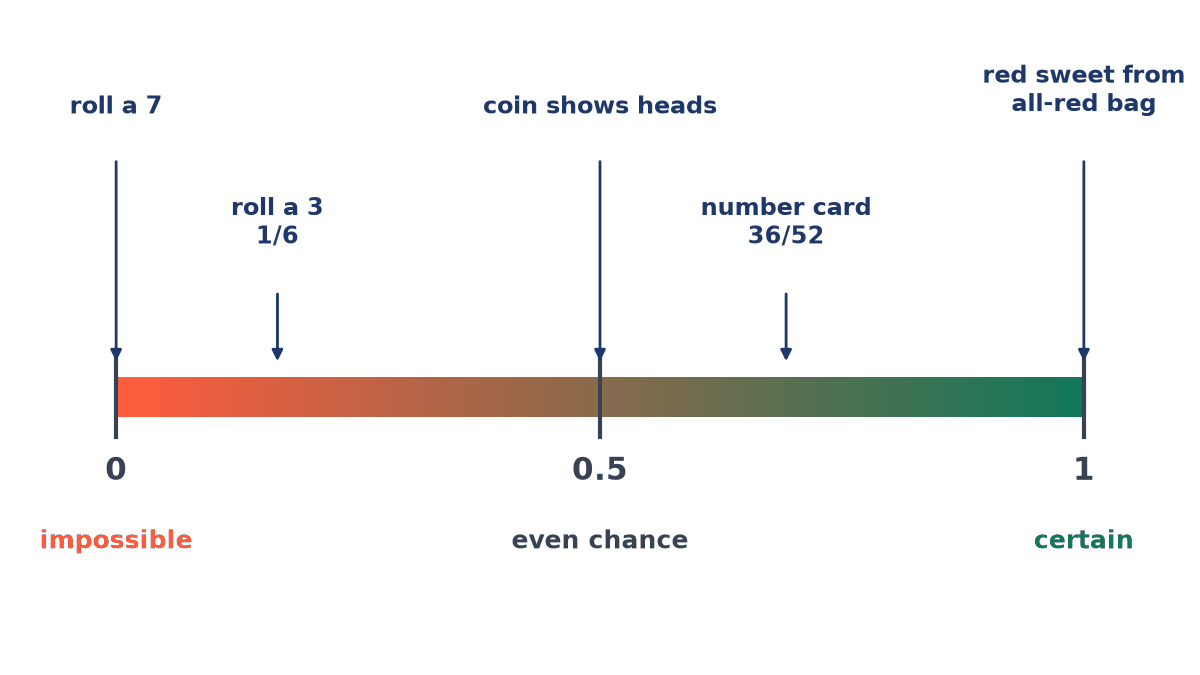
You can say the same thing with percentages, so is a chance. And remember, a probability can never be negative, and it can never be more than .
Experimental probability
The first way is simple: repeat an experiment many times, and count.
This fraction is also called the relative frequency of the event.
Example 1. A die is rolled times and shows a on of them. So the experimental probability of a is .
Example 2. A drawing pin is tossed times and lands point-up times. Our estimate of the probability of point-up is . Could we have worked this out just by thinking? No. The pin is not symmetric, so experiment is the only way.
Theoretical probability
The second way needs no experiment at all. It works when every outcome is equally likely, as with a fair coin, a fair die or a well-shuffled pack.
Example 3. For a fair die, , and .
Example 4. A letter is picked at random from MATHEMATICS. There are eleven letters, and appears twice, as does . So , (A, E, A, I).
Example 5. A bag has red and blue marbles. . Notice that the outcomes "red" and "blue" are not equally likely. It is the thirteen marbles that are equally likely, and that is what we count.
Experiment versus theory
Example 6. A die is rolled times and shows a four times. The experimental probability is , but the theoretical one is . Why the difference? Twelve trials are just too few. With or rolls, we would expect the experimental value to settle close to . This tendency is called the law of large numbers.
Probability from data and samples
Data that has already been collected works like an experiment that has already been done.
Example 7. In a class of , prefer mango, apple, banana, guava. For a student picked at random from the class, .
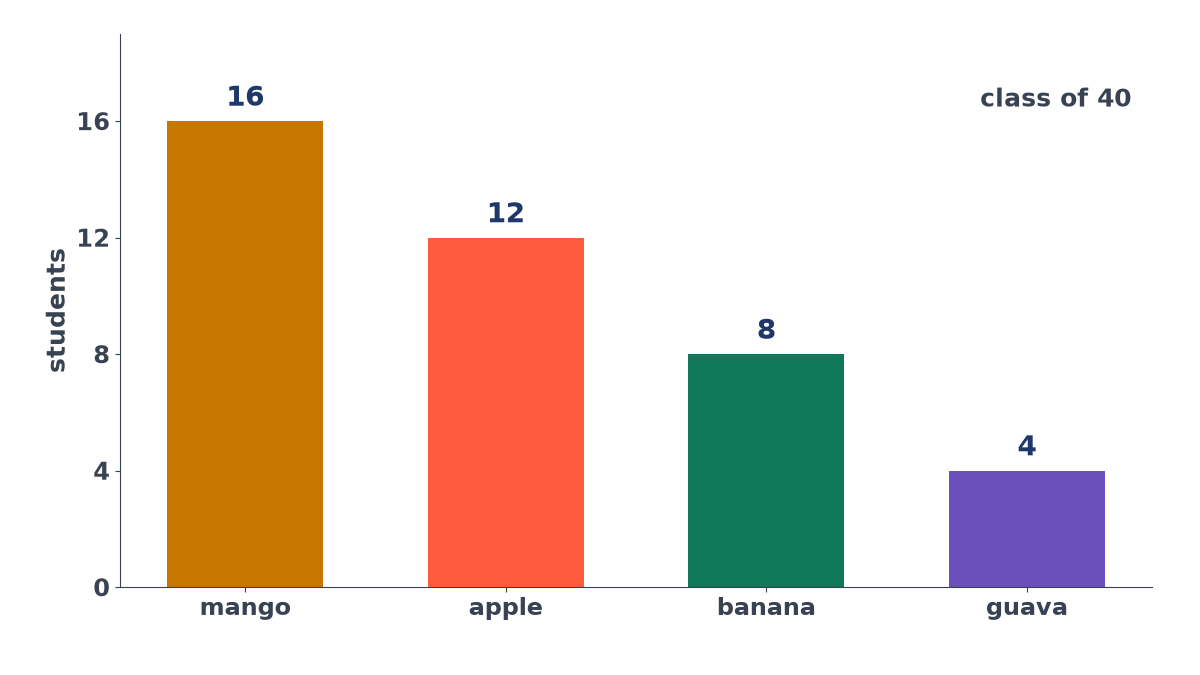
Suppose the school has students and this class is a fair sample of the school. Then about students prefer mango. A larger and more varied sample, with students from several classes instead of one, gives an estimate you can trust more. Choosing the sample well is called sampling.
Example 8. A factory tests bulbs and fail. So the estimated probability that a bulb fails is . In a batch of , we would expect roughly failures.
The gambler's fallacy
A fair coin shows heads six times running. Is tails now "due"? Many people feel it must be, but no. The coin has no memory. The next toss is heads and tails, exactly as the first one was. Believing that a run of one outcome makes the other more likely is called the gambler's fallacy. Probability describes the long run, not the very next trial.
Two words before we practise. A fair or unbiased coin or die is symmetric enough that no face is favoured. And "at random" means the draw is made without looking or interfering.
Practice
- Place each event on the scale, impossible, unlikely, even, likely, certain, with a reason: (a) the sun rises tomorrow; (b) a fair die shows a number less than ; (c) a card drawn from a pack is a spade; (d) it snows in Chennai in May; (e) a fair coin shows tails.
- A spinner is spun times and stops on green times. Find the experimental probability of green.
- A sample of sweets from a large jar has orange, lemon, mint. (a) Find the probability that a sweet from the sample is lemon. (b) Estimate how many of the jar's sweets are mint.
- A letter is chosen at random from PROBABILITY. Find the probability of (a) B; (b) a vowel; (c) a letter that appears exactly once.
- A fair die is rolled. Find the probability of (a) a prime; (b) a number greater than ; (c) a .
- A die is rolled times and shows a eight times. Give the experimental and theoretical probabilities of a , and say what you would expect after rolls.
- A coin has come up tails five times in a row. What is the probability of tails on the next toss, and what is the name of the mistake in expecting heads?
- Which of these have equally likely outcomes? (a) A car starts or does not start. (b) A fair die is rolled. (c) A marble is drawn from a bag of red and blue: red or blue. (d) A fair coin is tossed.
Answers
Show answers
- (a) Certain, . (b) Likely, . (c) Unlikely, . (d) Impossible for practical purposes, . (e) Even, .
- .
- (a) . (b) .
- Eleven letters. (a) . (b) O, A, I, I (the I appears twice): . (c) P, R, O, A, L, T, Y: .
- (a) : . (b) . (c) .
- Experimental ; theoretical . After rolls the experimental value should be close to .
- ; the gambler's fallacy.
- (b) and (d) only. In (a) the two results are not symmetric; in (c) the ten marbles are equally likely but the two colours are not.