First, list everything
Before you can work out any probability, you have to write down everything that could happen, completely and with no repeats. That list is called the sample space. In this lesson you will learn the rules for writing one and see that an event is just a part of it. Then we meet the tree diagram, the dependable way to list every outcome of an experiment that happens in stages.
The sample space
The sample space of a random experiment is the set of all its possible outcomes. When you write one, follow two rules.
- every possible outcome must be included;
- no outcome may appear twice.
The number of outcomes is written .
| Experiment | ||
|---|---|---|
| Toss a coin | ||
| Roll a die | ||
| A match | ||
| Toss two coins | ||
| Pick a whole number from to |
The sample space should fit the question being asked. For "will it rain?", is enough. But if you want to tell a drizzle from a downpour, you need .
Two coins. and are different outcomes. In one, the first coin shows heads and the second tails, and in the other it is the other way round. If you write , you lose an outcome, and the three that remain look equally likely when they are not.
A die and a coin together. Each of the six faces can pair with each of the two sides, giving , .
A bag of green and red balls. For one draw, the sample space is the eight balls. It is best written and not , because the eight balls are equally likely while the two colours are not.
Events
An event is a collection of outcomes, which means it is a subset of the sample space. "The die shows more than " is the event . "At least one head in two tosses" is the event .
When the outcomes are equally likely, the probability is a simple count:
Example 1. With two coins, ; ; .
Example 2. With a die and a coin, .
Example 3. A stall at a fair sells three snacks, samosa, vada and idli, and two drinks, tea or lassi. A visitor chooses one of each at random. Then has pairs. The event "chooses vada" is , so its probability is .
Example 4. A whole number from to is chosen at random. , . ; . Be careful here: and are not squares.
Tree diagrams
Some experiments happen in stages. You toss a coin, then toss again. Or you pick from one basket, then from another. The outcomes are then sequences, and it is easy to miss one. A tree diagram lists them all for you. From a starting point, draw one branch for each outcome of the first stage. From the end of each of those, draw one branch for each outcome of the second stage, and so on. Each complete path from the root to a tip is one outcome, and all the tips together make the sample space.
Example 5. Toss a fair coin twice.
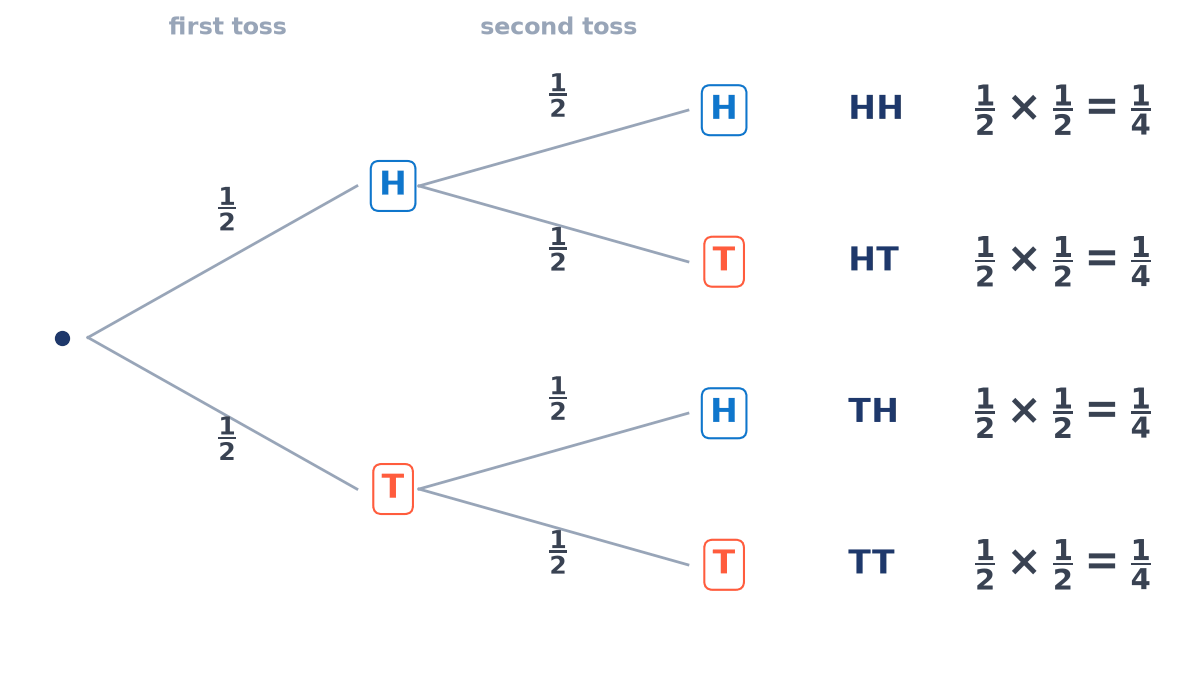
The first stage gives or . From each of these, the second stage again gives or . That makes four paths: . If we write on every branch, each path has probability . So .
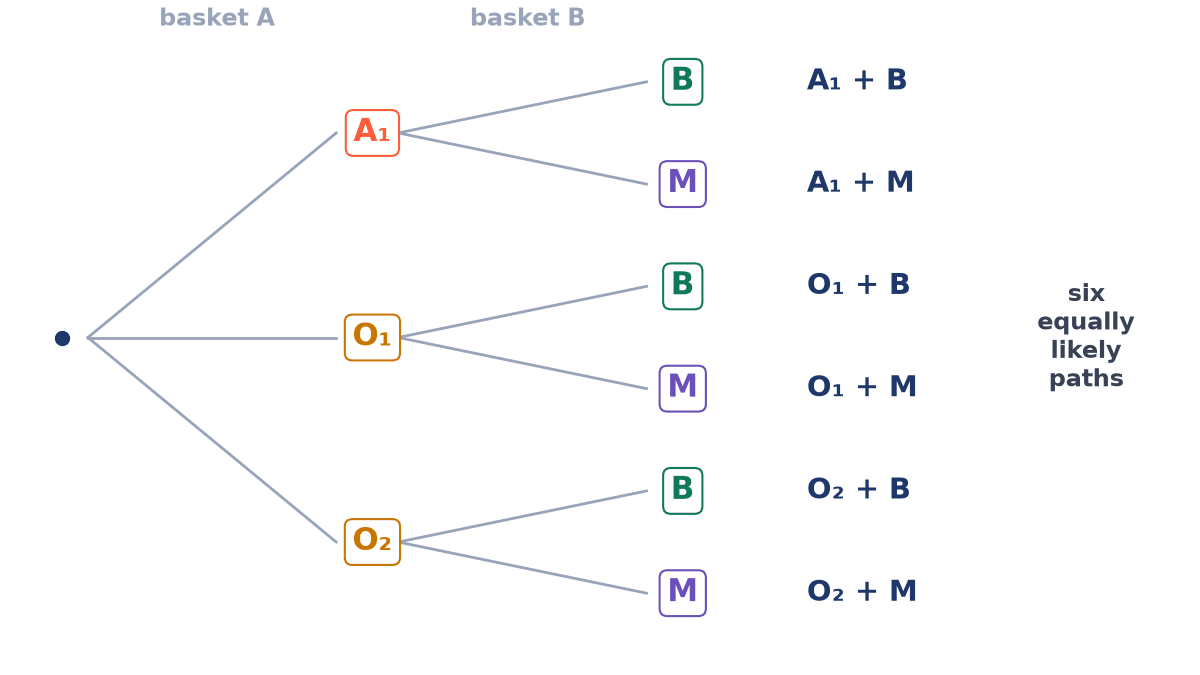
Example 6. Basket A holds one apple and two oranges; basket B holds one banana and one mango. One fruit is taken from each.
From the root there are three branches (, , ), and from each of those, two more (, ). That gives six paths. . .
Example 7. A box has red and black pens. You pick one, note its colour and put it back, and then a friend picks one. As colours, the outcomes are , but watch out, because these are not equally likely. If we count pens instead, there are equally likely paths. covers of them, and covers . So .
Here is the rule of thumb for trees. Along a path, multiply: . Across different paths, add.
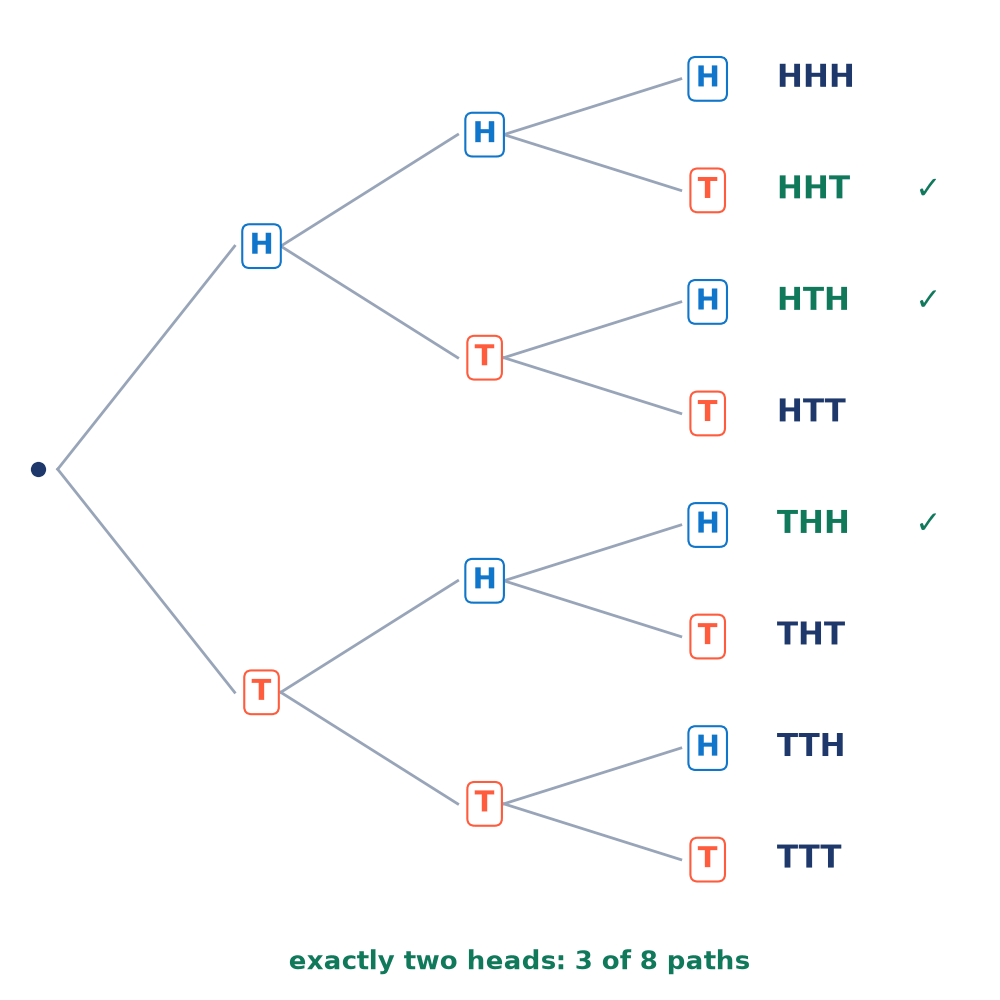
Example 8. Now take three coins. The tree has tips: . .
Practice
- Write the sample space and for: (a) rolling a die and noting whether the result is odd or even; (b) choosing a month of the year at random; (c) drawing one ball from a bag of white and black balls.
- A child has shirts (red, blue) and trousers (jeans, khaki, shorts). List the sample space of outfits as a table, and find the probability that a random outfit includes the red shirt and shorts.
- Two coins are tossed. Find and .
- A die is rolled and a coin tossed. Find the probability of (a) a and a tail; (b) an odd number; (c) a number less than with a head.
- Draw a tree diagram for tossing a coin three times. Find and .
- Bag P has red and blue marbles; bag Q has red and blue. One marble is taken from each. Use a tree to find and .
- A spinner with three equal sectors, , , , is spun twice. List all outcomes and find the probability that the two numbers add to .
- A card is drawn from ten cards numbered to , replaced, and a second card drawn. Find and .
Answers
Show answers
- (a) , . (b) , . (c) The ten balls, .
- Six outfits: (red, jeans), (red, khaki), (red, shorts), (blue, jeans), (blue, khaki), (blue, shorts). .
- ; : .
- . (a) . (b) . (c) : .
- Eight paths. At least two tails: : . All the same: : .
- Nine equally likely paths. Both red: : . Different colours: red-then-blue , blue-then-red : .
- Nine outcomes . Sum : : .
- outcomes. Both even: : . Sum : only : .