How to use this set
These twelve questions come from across the chapter. For each one, begin by deciding whether the probability is experimental, coming from counts, or theoretical, coming from equally likely outcomes. Then write down the sample space or the total number of trials, and only after that do the calculation. Give answers as fractions in lowest terms, adding a decimal where it helps.
Section A, The scale and its ends
- Fill the blanks: the probability of an impossible event is ___; of a certain event is ___; the set of all possible outcomes is called the ___; a fair coin shows heads with probability ___.
- Which experiments have equally likely outcomes? (a) A seed planted either sprouts or does not. (b) A fair die is rolled. (c) A card is drawn from a pack and its suit noted. (d) A bag of red and blue marble: the colour drawn.
Section B, Experimental and statistical probability
- In a survey of students, said they cycle to school. What are the frequency and the relative frequency of cycling?
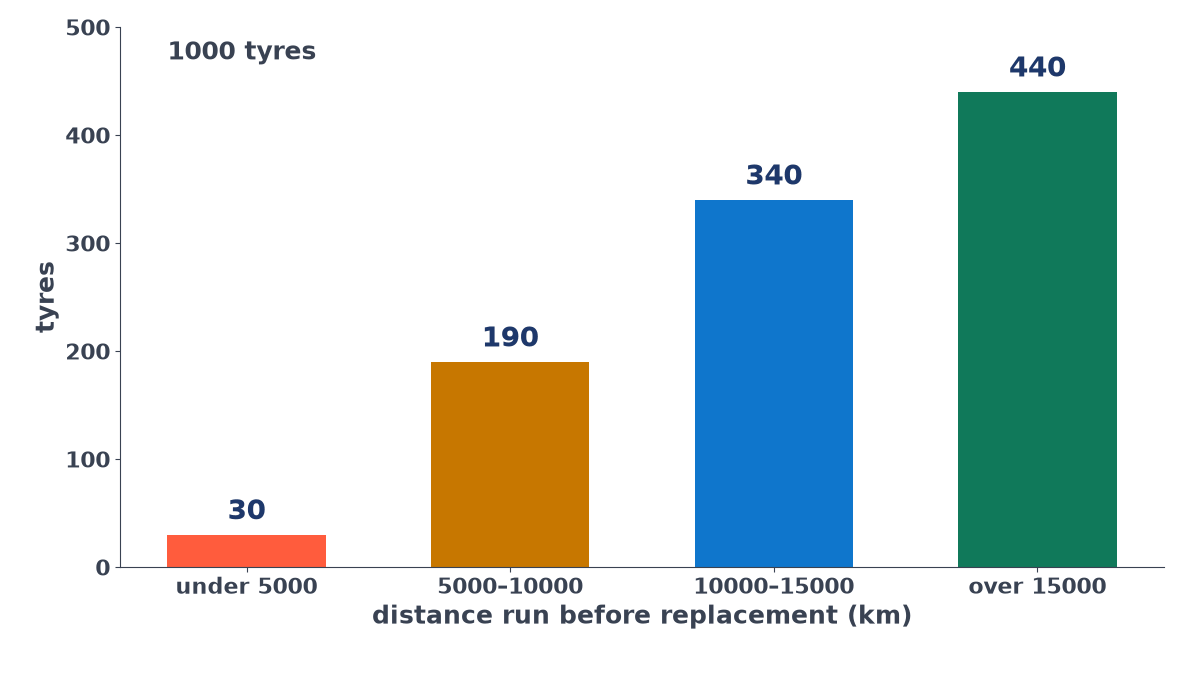
- A tyre company records how far tyres ran before replacement: under km, tyres; – km, ; – km, ; over km, . Find the probability that a randomly chosen tyre from this batch lasted (a) under km; (b) between and km; (c) more than km.
- A coin is tossed times and shows heads times. Find the experimental probability of heads, compare with the theoretical value, and say whether the result suggests the coin is unfair.
- A survey of students finds prefer science club, arts, sports, debate. The school has students. Estimate how many students prefer sports, and suggest what would make your estimate more reliable.
Section C, Theoretical probability
- A card is drawn from ten cards numbered to . Find the probability of (a) an even number; (b) a multiple of ; (c) a number greater than .
- A bag holds red, blue and green ball. One is drawn at random. Find the probability that it is (a) green; (b) not red; (c) red or blue.
- The letters of TEACHER are written on cards and one is drawn. Find the probability of (a) an E; (b) a T, A or C; (c) a consonant.
- Two coins are tossed. Find the probability of at least one head. Three coins are tossed. Find the probability of exactly two heads.
Section D, Multi-stage experiments
- A die is rolled twice. List the outcomes in which the two numbers are equal and find their probability. Find also the probability that the first roll is larger than the second.
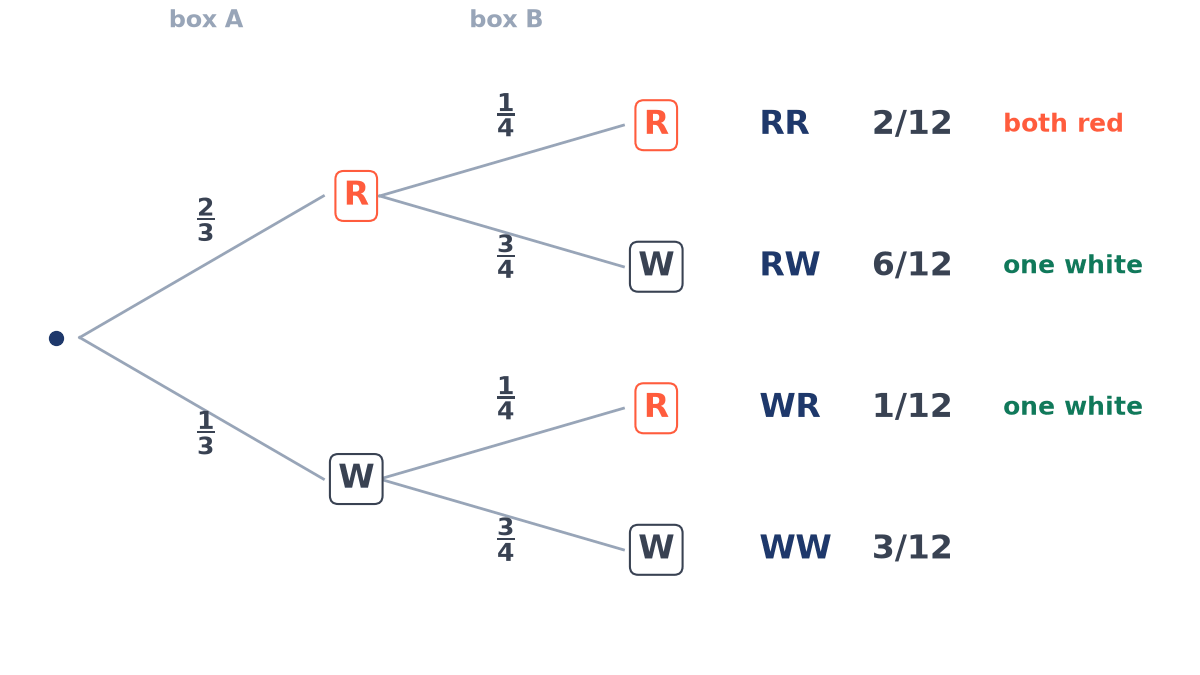
- Box A contains red and white counter; box B contains red and white. One counter is drawn from each box. Draw a tree diagram and find the probability that (a) both are red; (b) exactly one is white.
Answers
Show answers
- ; ; sample space; .
- (b) and (c) only. In (a) sprouting and not sprouting need not be equally likely; in (d) the marbles are equally likely but the colours are not.
- Frequency ; relative frequency .
- (a) . (b) . (c) .
- against . A difference of over tosses is within ordinary variation; it does not by itself show the coin is unfair.
- . A larger sample drawn from all classes and grades, not one group.
- (a) . (b) : . (c) .
- (a) . (b) . (c) .
- Seven letters. (a) . (b) . (c) T, C, H, R: .
- . Three coins: out of : .
- Equal: , six of : . The remaining outcomes split evenly between "first larger" and "second larger": .
- Twelve equally likely paths (). (a) Both red: : . (b) Red then white: ; white then red: ; total : .