Counting squares
Area is simply the number of unit squares a region can hold. That is why a longer boundary does not automatically mean a bigger region. We begin with rectangles and the paths that run around and across them. Then we get the triangle formula by fitting a triangle inside a rectangle, check that it still works when the triangle leans over, and put it to use in two ways: finding a missing altitude, and proving that a median cuts a triangle exactly in half.
Rectangles
A rectangle holds unit squares, and an one holds . So the area of a rectangle length width, written in cm² or "sq cm".
Draw a diagonal and the rectangle splits into two congruent triangles, each with half the area. For the rectangle, that is cm² each.
Here is a surprise: a square can be cut into four parts of equal area in infinitely many ways. Cut it into four equal strips, then squash each strip along one edge while stretching it along another by the same amount.
Perimeter is not area
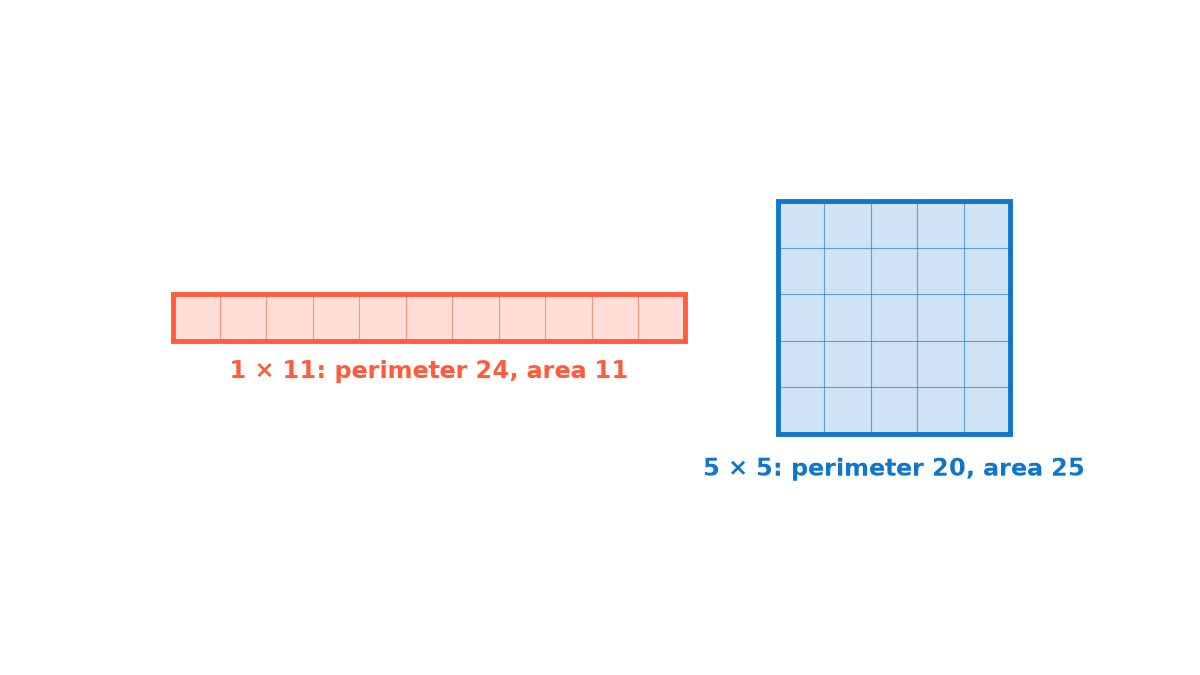
A rectangle has perimeter and area . A square has perimeter and area . Bigger perimeter, smaller area! Two regions with the same perimeter can have different areas, and two with the same area can have different perimeters. Picture a long thin strip next to a compact square and you will see why.
Example 1. A rectangle has area m² and width m, so its length is m. Two rectangles standing side by side have areas and in² and share a height of in, so their widths are and in.
Paths
A path round a park. Imagine a rectangular park sitting inside a bigger rectangle . The ring between them is the path. Its area is the outer area minus the inner one: . If the path has the same width all round a park of size , the outer rectangle is , and the path's area is . Even if you slide the outer rectangle so the park is off-centre, the path's area does not change. It is still outer minus inner.
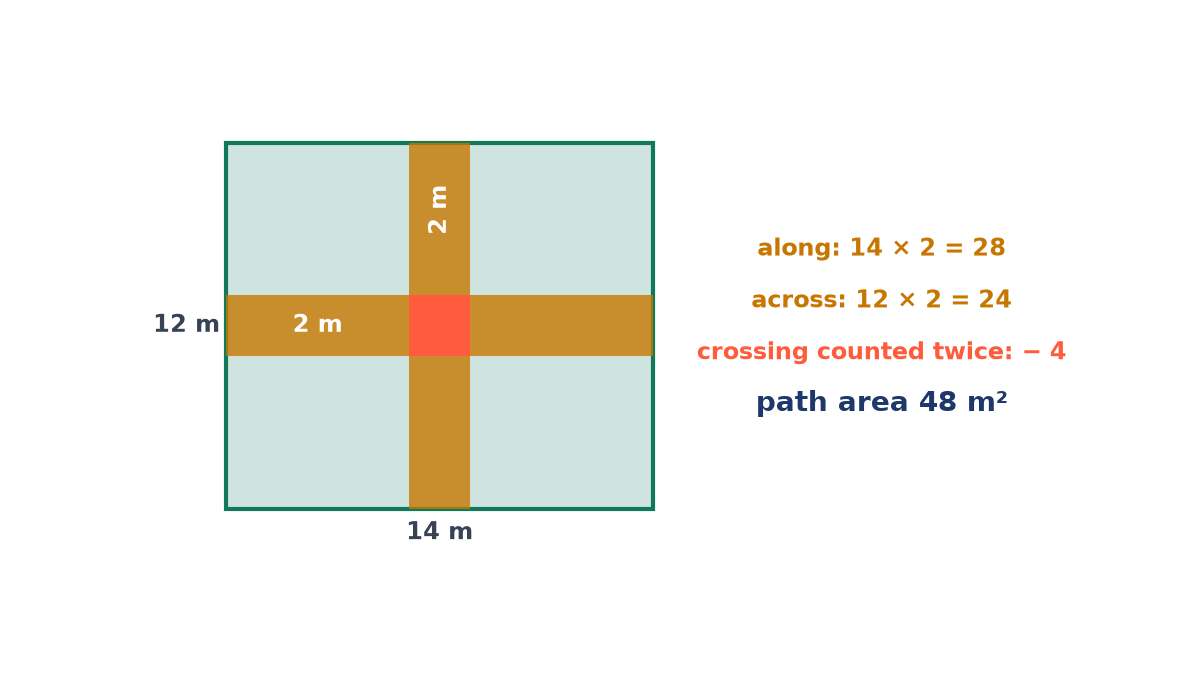
A cross path. Now two straight paths of width cross a plot , one parallel to each side. Their area is . Why subtract? The little square where they cross gets counted twice, so we take it away once.
Example 2. A plot has a cross path m wide: m².
A spiral tube of even width has the same area as a straight tube of that width whose length equals the length of the spiral's centre line. Just straighten it out in your mind.
Example 3. If you double the side of a square, its area becomes times as big. Any region inside that grows along with the square is also multiplied by .
Triangles
Take a rectangle and draw two triangles on its base , with apexes and anywhere on the opposite side. Each triangle has exactly half the rectangle's area. To see why, drop a perpendicular from the apex: it splits the triangle into two right triangles, and each is half of a smaller rectangle.
So for any triangle, fit it inside a rectangle whose sides are the base and the height:
Here the height is the perpendicular from the opposite vertex to the line of the base.
When the triangle leans. Sometimes the apex sits beyond the base , so the perpendicular lands on the line extended, at . Then area area area. So the formula works for every triangle, leaning or not.
Example 4. Base , height : area . A right triangle with legs and : area (the two legs serve as base and height).
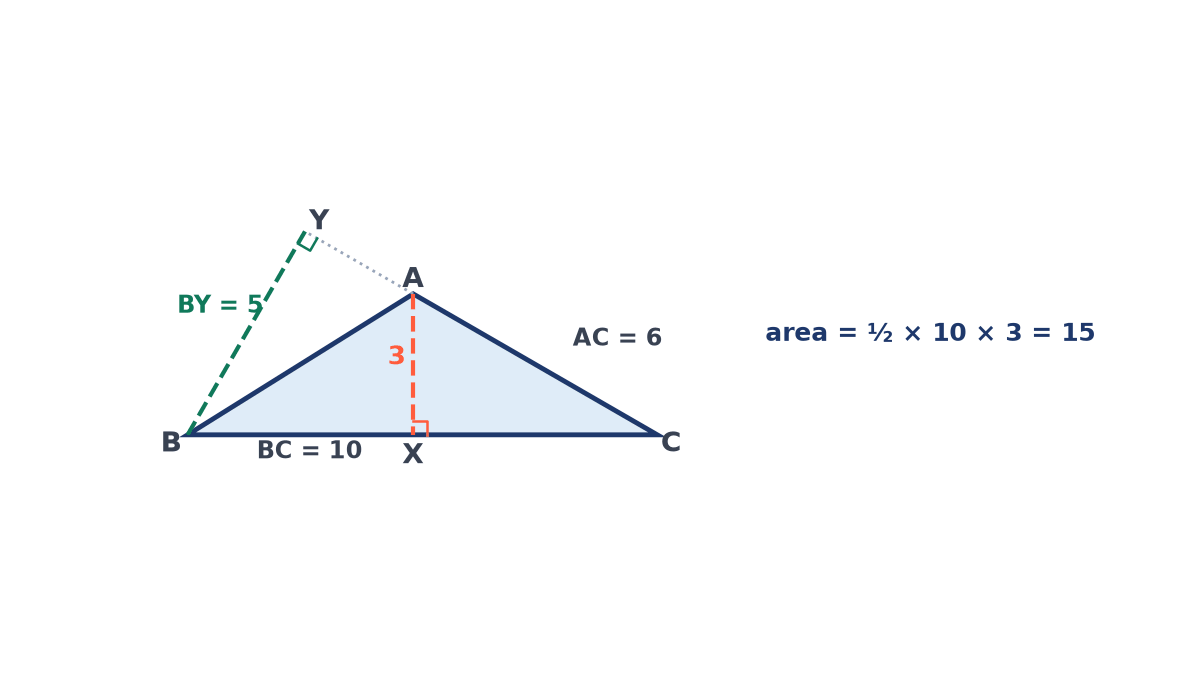
Finding an altitude. In triangle , with and , and with . The area is . It is also . Both describe the same triangle, so .
Diagonals of a rectangle. The two diagonals cut a rectangle into four triangles. They are not all congruent, and yet they all have the same area. Think of neighbours like and ; better still, take triangles and , which share the vertex and have bases and on the same diagonal. Their heights from the shared vertex are the same, and , so their areas match. Go round all four in this way and every area is equal.
A median halves a triangle. The line from a vertex to the midpoint of the opposite side makes two triangles with equal bases and the same height, so their areas are equal. This is exactly the fact behind the rectangle result.
Practice
- Find the missing sides: a rectangle with area m² and width m; and a rectangle with area in² and length in, placed beside a rectangle of area in² with the same height.
- Give two rectangles where the one with the bigger perimeter has the smaller area.
- A park measuring m has a m path all round the outside. Find the path's area in two ways: outer minus inner, and as four rectangles.
- A m plot has two paths, each m wide, crossing at its centre and parallel to the sides. What is the area of the paths? How much is left for planting?
- A square is cut into four congruent pieces by two perpendicular lines through its centre that are not parallel to its sides. Explain how the pieces can be rearranged into a bigger square with a square hole.
- Find the areas: (a) base cm, height cm; (b) a right triangle with legs and ; (c) an isosceles triangle with base and equal sides (find the height first).
- In triangle , with and , and with . Find .
- Triangle is isosceles with ; , and the area of is . What is the area of ?
- Describe how to turn a rectangle into a triangle of the same area, and a triangle into a rectangle of the same area (the Śulba-sūtras ask both).
- and are the midpoints of and . What fraction of triangle is triangle ? (Join and use the median fact twice.)
Answers
Show answers
- m. The height is in, so the second rectangle is in long.
- (perimeter , area ) and (perimeter , area ).
- m². As four rectangles: two of and two of , giving ✓.
- m². For planting: m².
- Each piece keeps one right-angled corner of the original square. Turn the pieces so that these four corners become the corners of a new, larger square, with the cut edges facing inwards. The straight cut edges of neighbouring pieces line up, and a square hole is left in the middle. The side of the hole is the difference between the two parts into which a cut divides a side of the original square, and the areas agree: new square original square hole.
- (a) . (b) . (c) The height is , so the area is .
- The area is , so and .
- is the altitude to the base of an isosceles triangle, so it bisects and cuts the triangle in half. The area is .
- Rectangle to triangle: keep the base and double the height (the apex can be above one corner, or anywhere on the line at twice the height). Triangle to rectangle: keep the base and take half the height. Or cut the triangle along the midline parallel to the base, and turn the top piece down beside the bottom to make a rectangle with the same base and half the height.
- Join . Then is half of (median ), and is half of (median ). So the answer is .