How to use this set
Fourteen questions from across the chapter. Sketch every figure and mark the base and its height. Remember, the height always meets the base at a right angle; it is never the slanting side. For shapes made of pieces, write down which pieces you will add and which you will subtract before you start calculating. Give exact answers unless a decimal is asked for.
Section A: Rectangles and paths
- One rectangle is and another is . Which has the bigger perimeter, and which the bigger area?
- A hall measuring m has a carpet that leaves a m border all round. What is the area of the carpet? And of the border?
- A plot of m has two m paths crossing at right angles through its centre, parallel to the sides. Find the area of the paths and the area left over.
- A rectangle's length is doubled and its width is halved. What happens to its area? And to its perimeter?
Section B: Triangles
- Find the areas: (a) base , height ; (b) a right triangle with legs and ; (c) an equilateral triangle with side .
- In triangle , the altitude from is and . The altitude from is . Find .
- is the midpoint of , and is the midpoint of . If triangle has area , find the areas of , and .
- Two identical rectangles share the base . is anywhere on of the first, and is anywhere on of the second. Compare the areas of triangles and , and explain.
Section C: Polygons and dissection
- A quadrilateral has a diagonal of , and the perpendiculars to it from the other two vertices are and . Find the area.
- A parallelogram has base and height . If its other side is , what is the height to that side? A rhombus has diagonals and ; find its area, side and height.
- A trapezium has parallel sides and and height . An isosceles trapezium has parallel sides and and legs . Find both areas.
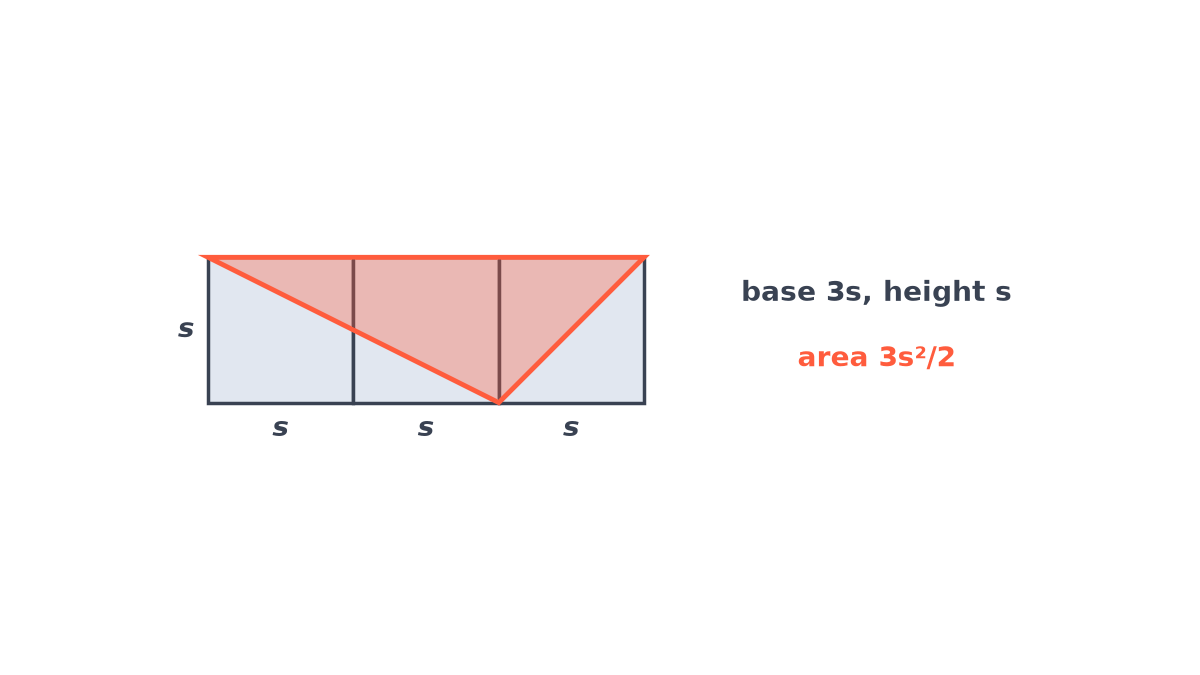
- Three identical squares of side stand in a row along a line. A triangle has its corners at the top-left corner of the first square, the top-right corner of the third, and the bottom-right corner of the second. Find its area. If the three squares together have area , what is the area of the triangle?
- Describe two dissections: a parallelogram into a rectangle, and a trapezium into a parallelogram of half the height.
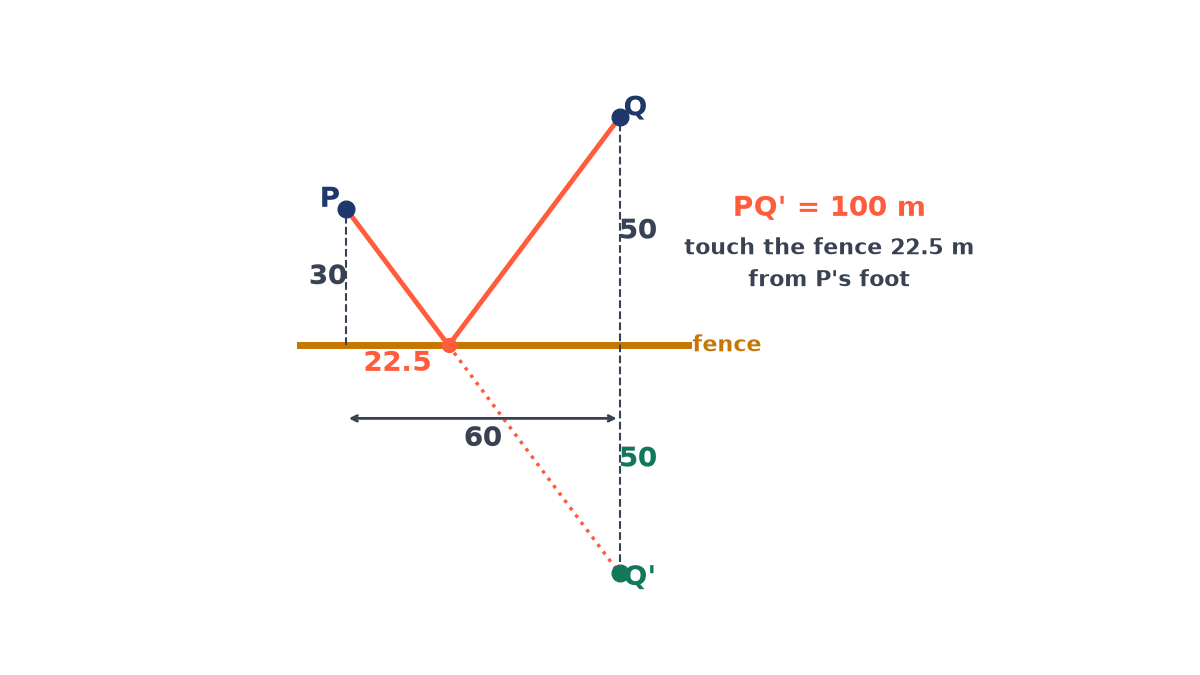
- A shepherd at has to touch a straight fence and then reach . is m and is m from the fence, and the points on the fence directly opposite them are m apart. How long is the shortest route, and where does it touch the fence?
Answers
Show answers
- Perimeters and ; areas and . So the first has the bigger perimeter, but the second has the bigger area.
- Carpet: m². Border: m².
- Paths: m². Left over: m².
- The area stays the same (). The perimeter goes from to , which is larger unless .
- (a) . (b) . (c) The height is , so the area is .
- The area is , so and .
- , and (because is a median of ). For , you might try to use as a median of , but it isn't one. Instead, since is the midpoint of , look at triangle as well, and split: .
- They are equal. Each is (the rectangle's height), which is half the rectangle, wherever the apex sits on the top side.
- .
- . Rhombus: area , side , height .
- . For the isosceles one, the overhang is and the height , so the area is .
- The two top corners are apart, and the third corner is below that line, so the area is . If the three squares have total area , then , and the triangle's area is .
- For the parallelogram: cut the right triangle off one end along a height and slide it to the other end. For the trapezium: cut along the midline parallel to the bases, and give the top half a half-turn so that it sits beside the bottom half.
- Reflect to , m on the other side of the fence. Then m. The route touches the fence m from the point opposite .