Cut, move, and the area stays
If you cut a shape into pieces and rearrange them, the area does not change. That single idea, called dissection, turns a parallelogram into a rectangle, a rhombus into a rectangle whose sides are half its diagonals, and a trapezium into a parallelogram twice its size. It also lets you break any polygon into triangles, so you can find the area of every polygon. At the end, we solve a shortest-path puzzle with the help of a mirror.
Any polygon
Draw one diagonal in a quadrilateral and you get two triangles. A pentagon gives three. In fact, any polygon can be cut into triangles by drawing lines from one vertex. Find the area of each triangle and add them up.
Example 1. Quadrilateral has diagonal cm, and the perpendiculars from and to are cm and cm. Its area is cm².
Example 2. A regular hexagon with side is made of six equilateral triangles of side , each with height . So its area is . Knowing just the side is enough.
Parallelogram by dissection
Take parallelogram with base , and draw ; this is a height. Now cut off triangle and slide it to the other end. It fits exactly onto triangle , where extended. Why exactly? The two right triangles have equal hypotenuses () and equal legs (), so they are congruent by RHS. What you get is rectangle , and because .
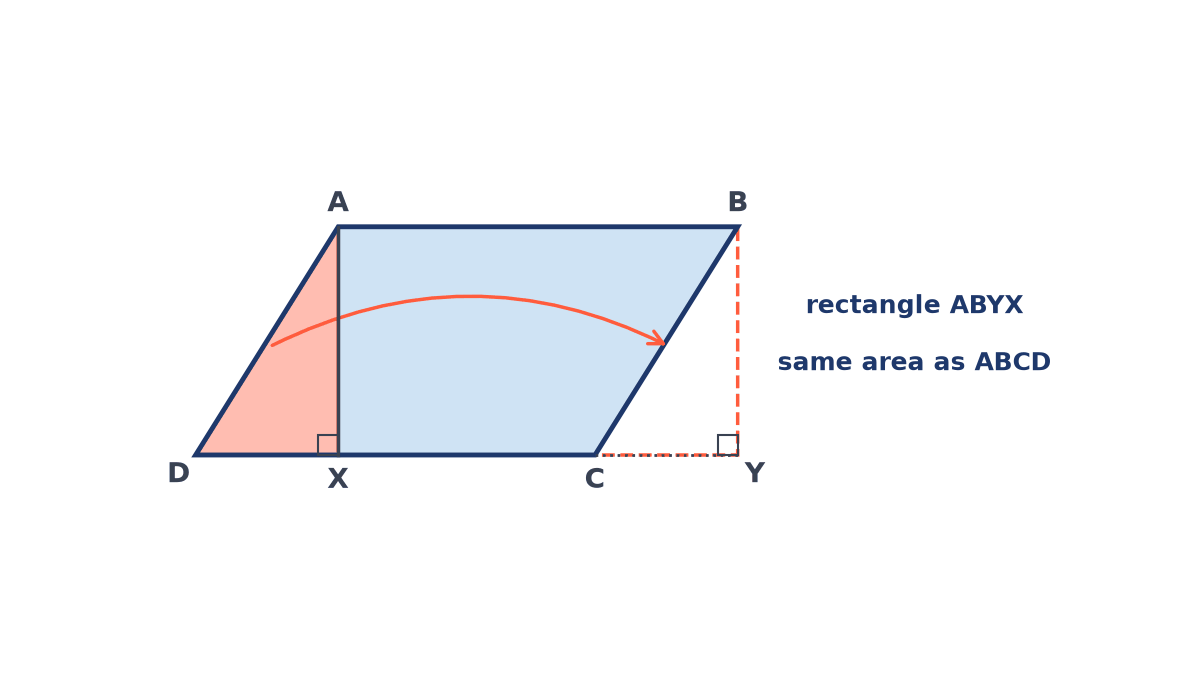
You can use any side as the base, as long as you use the height that goes with it. Rearranging pieces to make a new shape with the same area is called dissection.
Parallelograms standing on the same base between the same pair of parallel lines all have the same area. The most upright one, the rectangle, has the smallest perimeter.
Example 3. Base cm and height cm give cm². Now take sides and , where the height to the cm side is . The area is , so the height to the cm side is .
Rhombus
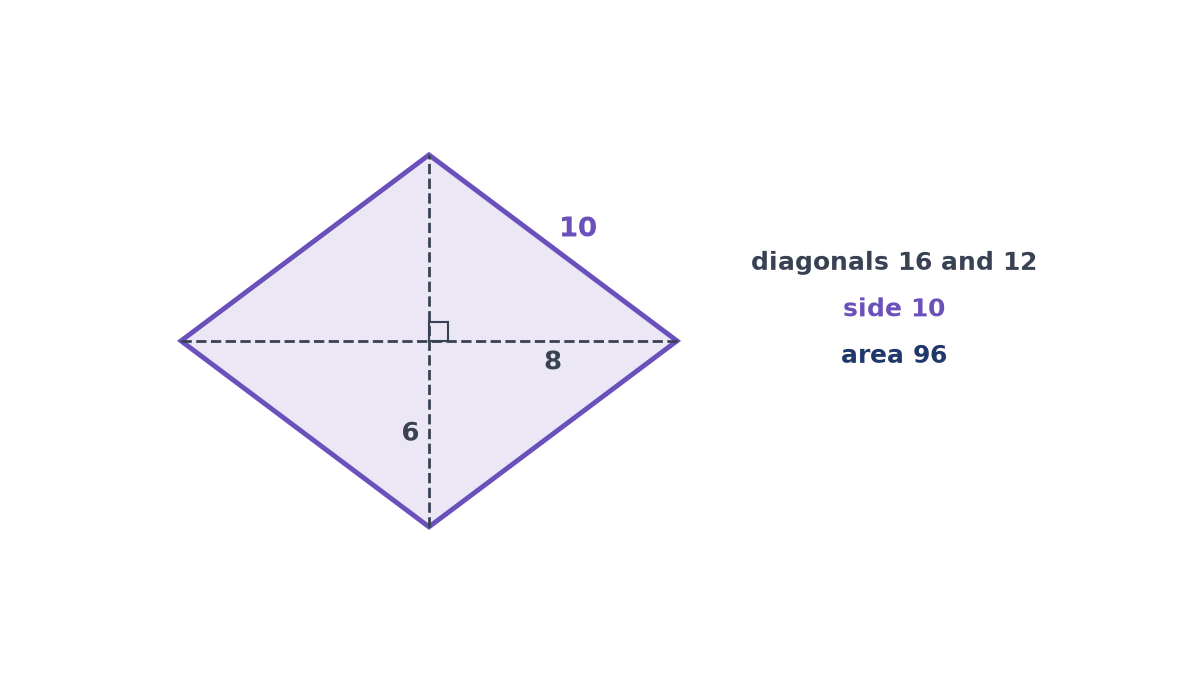
A rhombus is a parallelogram, so base height works fine. But its diagonals give another route. They are perpendicular and bisect each other, so they cut the rhombus into four congruent right triangles with legs and :
The same formula works for a kite, since its diagonals are perpendicular too.
Example 4. With diagonals and , the area is . The side is , and the height to a side is .
Trapezium
Take two copies of a trapezium with parallel sides , and height . Turn one upside down and fit them together, and you have a parallelogram with base and height . So
Another way: cut the trapezium along the midline parallel to the bases, and swing the top half round to make a parallelogram with base and height .
Example 5. Parallel sides and , height : area .
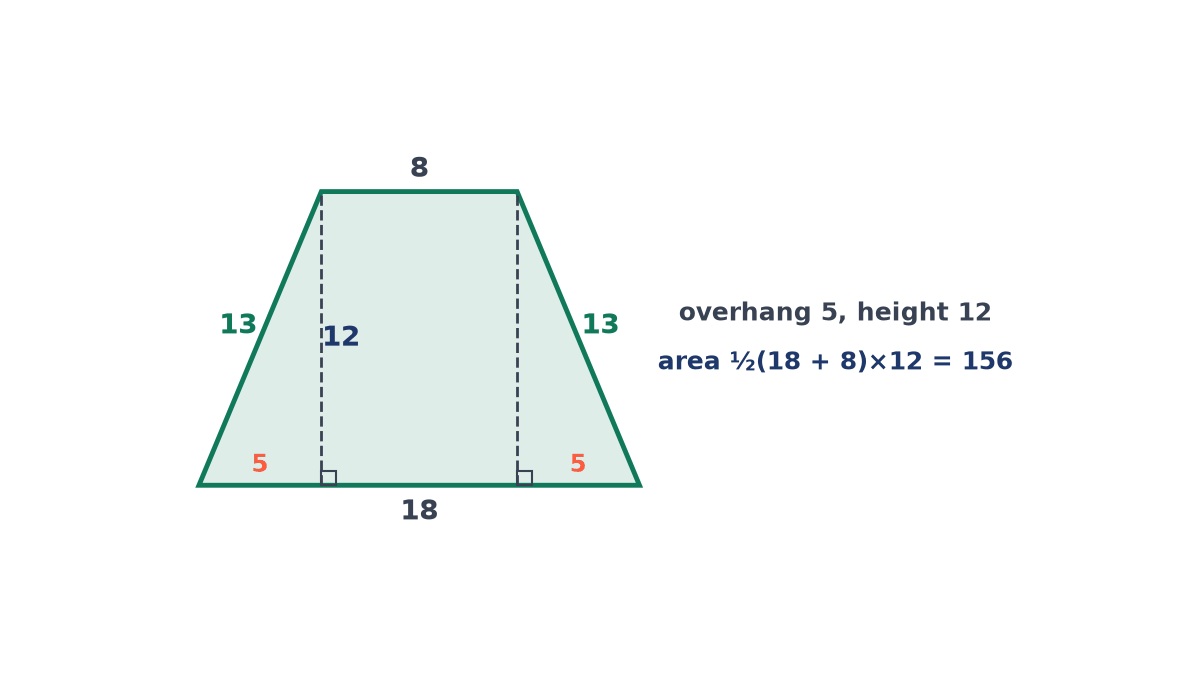
Example 6. An isosceles trapezium has parallel sides and and legs . The overhang on each side is , so and the area is .
Half a quadrilateral
Join the midpoints of the sides of any quadrilateral at all. The shape inside is a parallelogram with exactly half the area. (Each corner triangle you cut off is a quarter of the triangle on the matching diagonal.)
Shortest path via a mirror
A line runs parallel to segment . Every triangle with on has the same area, because the base and height are the same. But which one has the smallest perimeter? Here is the clever step: reflect in to get . For any on , , so , and this is smallest when lies on the straight segment . So is where crosses , and by symmetry it lies on the perpendicular bisector of . The winner is the isosceles triangle.
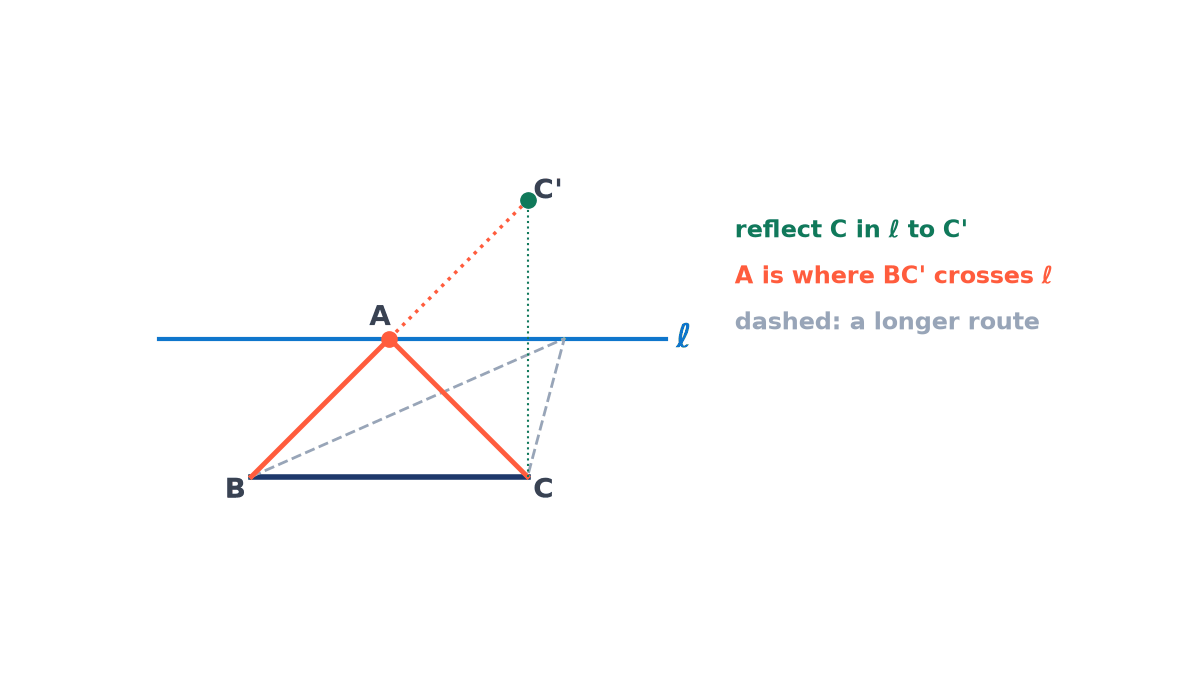
Gopal's walk. Gopal goes from his house to a river (a straight line) and then on to a tank. To find his shortest route, reflect the tank in the river, join the house to that reflection, and walk to the river where this line meets it.
Practice
- Quadrilateral has diagonal , and the perpendiculars to it from and are and . Find the area.
- A pentagon is split from one vertex into three triangles with areas , and . What is its area? How many triangles does a decagon split into?
- Find the areas of these parallelograms: (a) base , height ; (b) base , height ; (c) sides and with height to the cm side. In (c), also find the height to the cm side.
- Seven parallelograms stand on the same base between the same parallels. Compare their areas and their perimeters. Which has the smallest perimeter?
- A rhombus has diagonals and . Find its area, side and height. A kite has diagonals and ; what is its area?
- A trapezium has parallel sides and and height . What is its area? Another has area and parallel sides and ; what is its height?
- An isosceles trapezium has parallel sides and and legs . Find its area.
- Rectangle is . is on with , and is on with . Find the area of triangle by taking three right triangles away from the rectangle.
- Explain why joining the midpoints of a quadrilateral gives half its area.
- A house is m from a straight canal and a tank is m from it, and the two are m apart measured along the canal. Where should you touch the canal to make the walk house–canal–tank as short as possible, and how long is that walk?
Answers
Show answers
- .
- . Eight.
- (a) . (b) . (c) , and the other height is .
- All the areas are equal, but the perimeters are not. The rectangle has the smallest, and the perimeter grows as the parallelogram leans more.
- Area ; side ; height . The kite's area is .
- . For the second, , so .
- The overhang is , so the height is and the area is .
- The rectangle is . The triangles: : ; : ; : . So .
- Each corner triangle you cut off has sides half as long as the triangle made by two sides and a diagonal, so it has a quarter of that area. Taken in pairs, the four corners make up a quarter of each diagonal-triangle pair, which is half the quadrilateral. The parallelogram in the middle is the other half.
- Reflect the tank across the canal (so it sits m on the far side). The straight line from the house to that reflection meets the canal m from the point on the canal nearest the house. The walk is m long.