Two tangents, one length
Stand at a point outside a circle and you can draw exactly two tangents to it, and those two tangents always have the same length. That single fact, proved with a congruence, powers a whole family of results: the angle between the tangents, the four tangent lengths of a quadrilateral drawn around a circle, and the reason a parallelogram wrapped around a circle has to be a rhombus.
How many tangents?
- From a point inside the circle: none at all. Every line through it cuts the circle twice.
- From a point on the circle: exactly one.
- From a point outside: exactly two.
If is an external point whose tangents touch the circle at and , then and are called the lengths of the tangents from .
The theorem
Theorem. The lengths of the two tangents drawn from an external point to a circle are equal.
Proof. Join , and . Now compare triangles and :
- , since a tangent is perpendicular to the radius.
- , since both are radii.
- , since it's shared.
By the RHS congruence criterion, . So .
The congruence actually gives you more than equal lengths. The matching angles tell you two more things:
- , so bisects the angle between the tangents.
- , so bisects the angle at the centre.

The angle between the tangents
Look at quadrilateral . Two of its angles are , so the other two must add up to :
Example 1. Tangents from touch a circle at and , and . Find .
.
Example 2. is cm from and the radius is cm. Find the angle between the tangents from .
In right triangle , , so . The angle between the tangents is twice that, . And since has with a angle at the top, it is equilateral.
A quadrilateral around a circle
Example 3. A quadrilateral is drawn so that all four of its sides touch a circle. Prove .
Let the circle touch , , , at , , , . The two tangent lengths from each vertex are equal:
Add them up: , which is exactly .
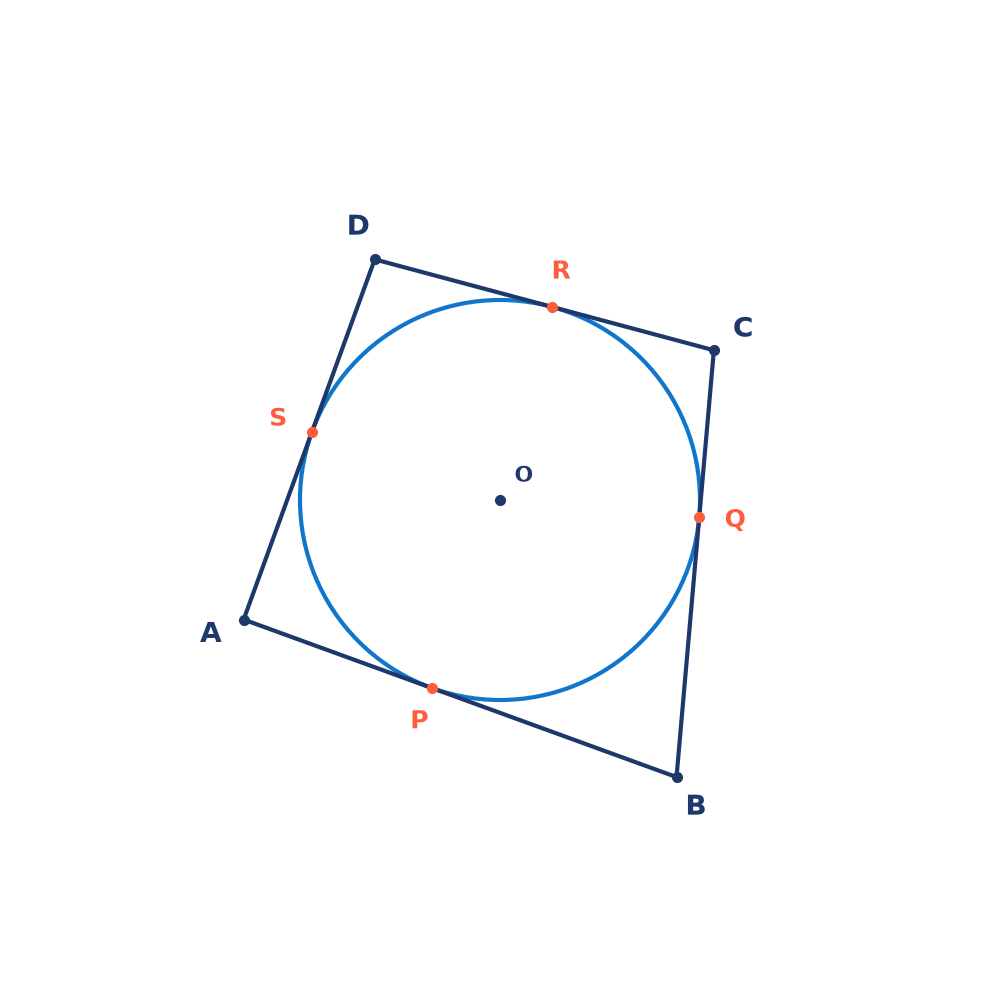
Example 4. Prove that a parallelogram drawn around a circle is a rhombus.
From Example 3, . In a parallelogram and , so this becomes , and . All four sides are equal, which makes it a rhombus.
A triangle's incircle
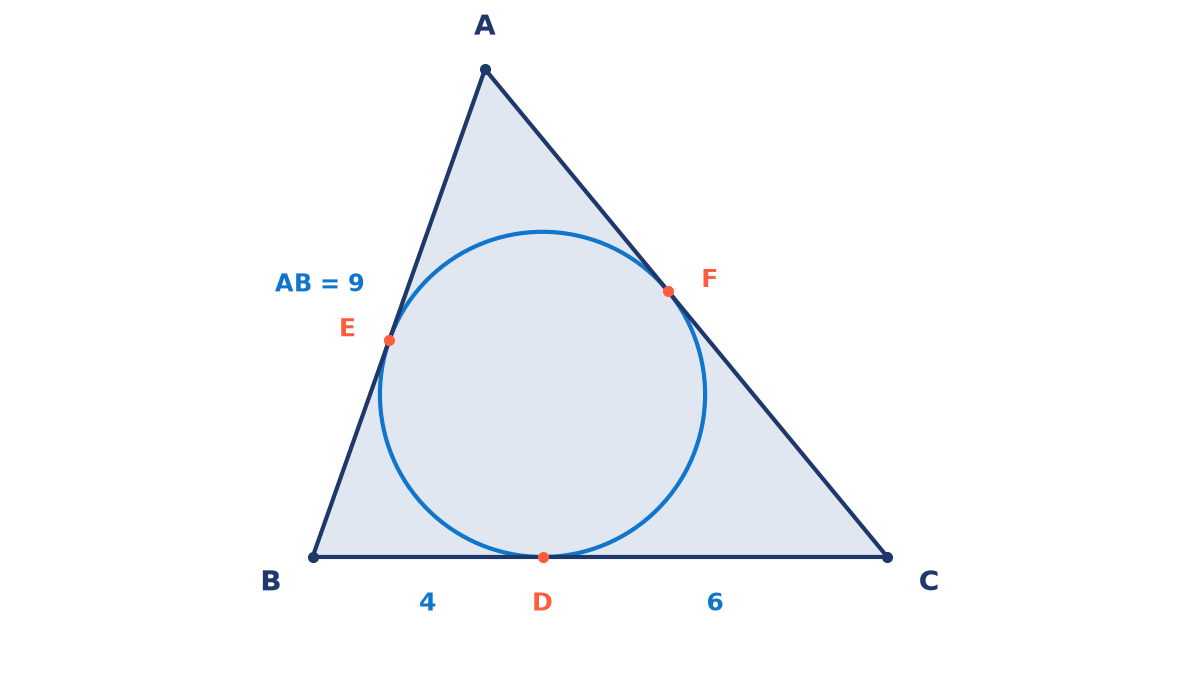
The circle that touches all three sides of a triangle is called its incircle. Again, the tangent lengths from each vertex are equal, and that lets you find sides you weren't given.
Example 5. The incircle of touches at , with cm and cm. If cm, find .
From , the tangents give , where is the contact point on . So . From , , where is the contact point on . From , . Putting it together, cm.
Practice
- Tangents and from touch a circle with centre at and . If , find and .
- cm and cm. Find the radius, and then .
- For a point , . Show that the tangents from make with each other.
- is a quadrilateral with a circle touching all four sides. , , . Find .
- The incircle of touches at , with , , and . Find .
- Prove that the angle between the two tangents from an external point is supplementary to the angle that the segment joining the points of contact subtends at the centre.
Answers
Show answers
- . Since bisects it, .
- cm, and cm.
- , so and .
- Use : , so .
- On , , so . On , , and . So .
- In quadrilateral , (radius meets tangent at a right angle). The angles of a quadrilateral add up to , so .