How to use this set
Ten questions on tangents, and only two facts are needed for all of them. A tangent is perpendicular to the radius at the point of contact, and the two tangents from an external point are equal. In every answer, say which of the two you're using and point out where the right angle is. In proofs, name the congruence criterion, or state the theorem you are relying on in words.
Section A: Lengths and angles
- A tangent from touches a circle of radius cm at , and cm. Find .
- Two tangents from touch a circle at and . cm and the radius is cm. Find and the perimeter of quadrilateral .
- Tangents from touch a circle at and , and . Find .
- A chord of a circle with centre has . The tangents at and meet at . Find and , and show that .
Section B: Circumscribed figures
- A circle touches the sides of quadrilateral at (on ). , , , . Find the perimeter of .
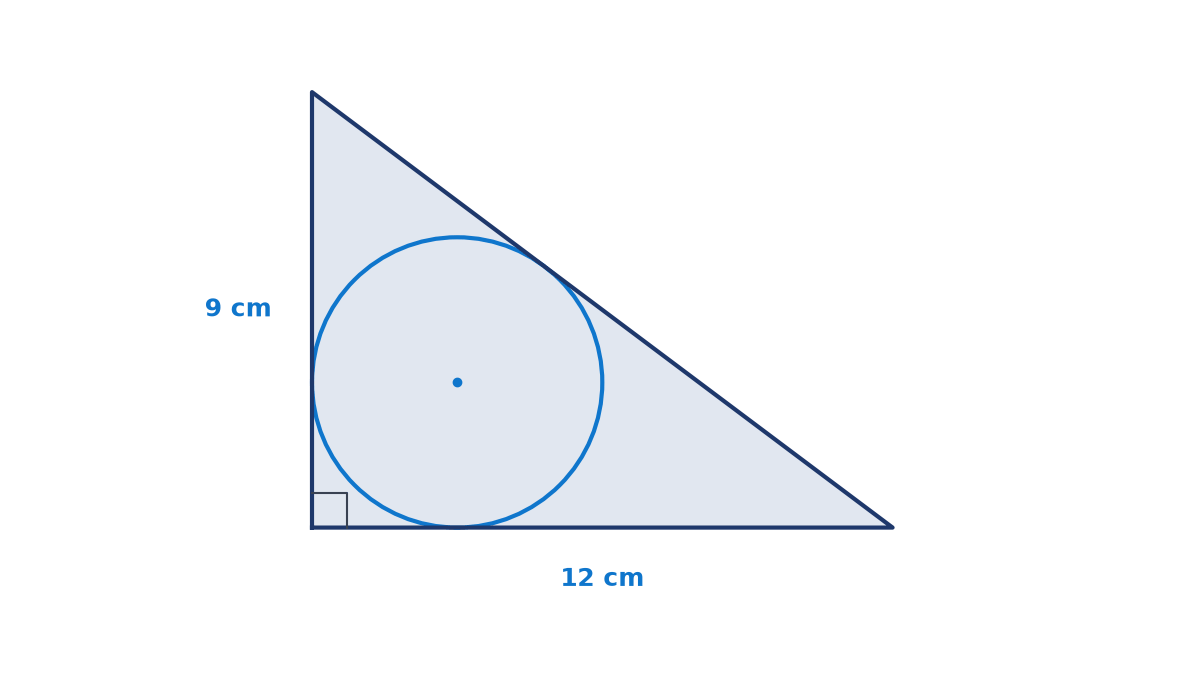
- A circle is drawn inside a right triangle with legs cm and cm, touching all three sides. Find its radius.
- The incircle of touches at , at and at . If , , , find , , .
Section C: Proofs
- Prove that the tangents drawn at the two ends of a chord make equal angles with the chord.
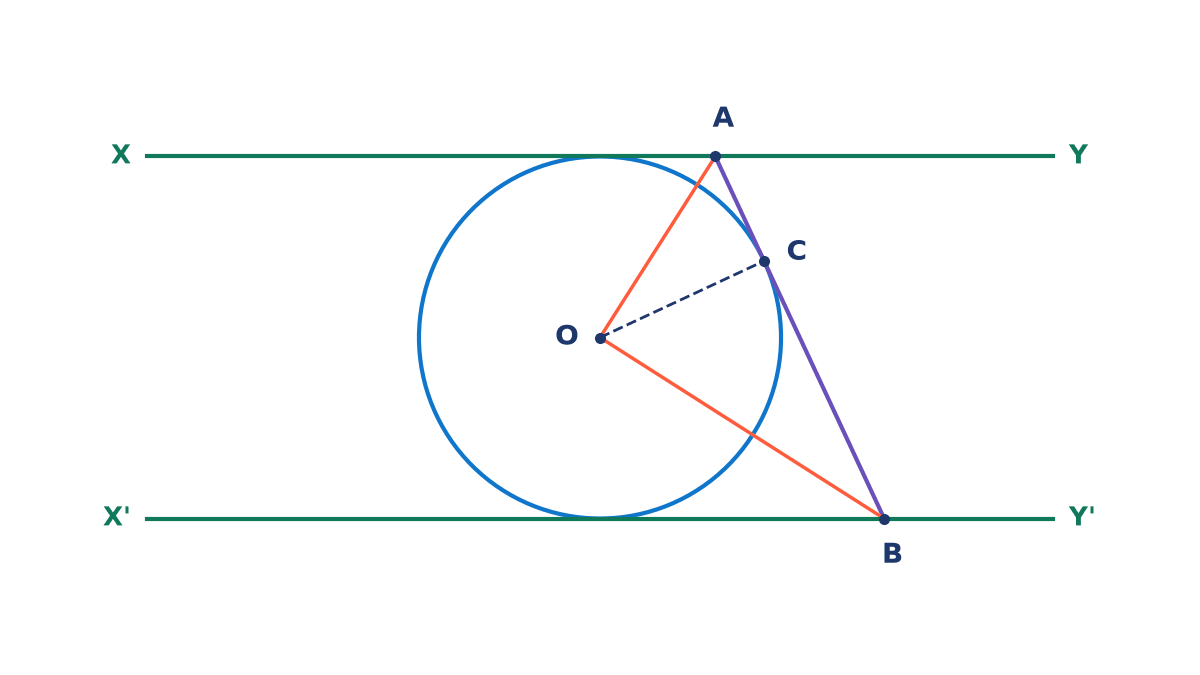
- and are two parallel tangents to a circle with centre . A third tangent , touching at , meets at and at . Prove that .
- Prove that a parallelogram drawn around a circle is a rhombus.
Answers
Show answers
- cm.
- cm. The perimeter is cm.
- Since , . And , so .
- . So is isosceles with a angle at the top, which makes and the triangle equilateral. Hence .
- The tangent lengths pair up: , , , . So the perimeter is .
- The hypotenuse is . Call the tangent lengths from the vertices (at the right angle), and . Then , , . Adding all three, , so and . Now here's the nice part: at the right-angle vertex, the two radii to the contact points and the two tangent pieces form a square. So cm.
- Let , , . Then , , . Adding and halving, . So , , , which gives , , .
- Let the tangents at and meet at . Since , triangle is isosceles, so .
- Join . bisects the angle between the tangents and (they're two tangents from ), and bisects the angle between and . Because , the interior angles and add up to . So their halves, and , add up to . That leaves in .
- For any quadrilateral around a circle, , because the tangent lengths from each vertex are equal. In a parallelogram and , so and . A parallelogram with two adjacent sides equal is a rhombus.