A line that just touches
Picture a bicycle wheel standing on a straight road. The road touches the wheel at exactly one point. A line and a circle can meet like that, or the line can miss the circle altogether, or cut right through it at two points. The touching kind is called a tangent, and it has one property that the whole chapter stands on: it is perpendicular to the radius at the point where it touches. In this lesson we define tangents, prove that property, and use it in the right-triangle calculations that come out of it.
Secants and tangents
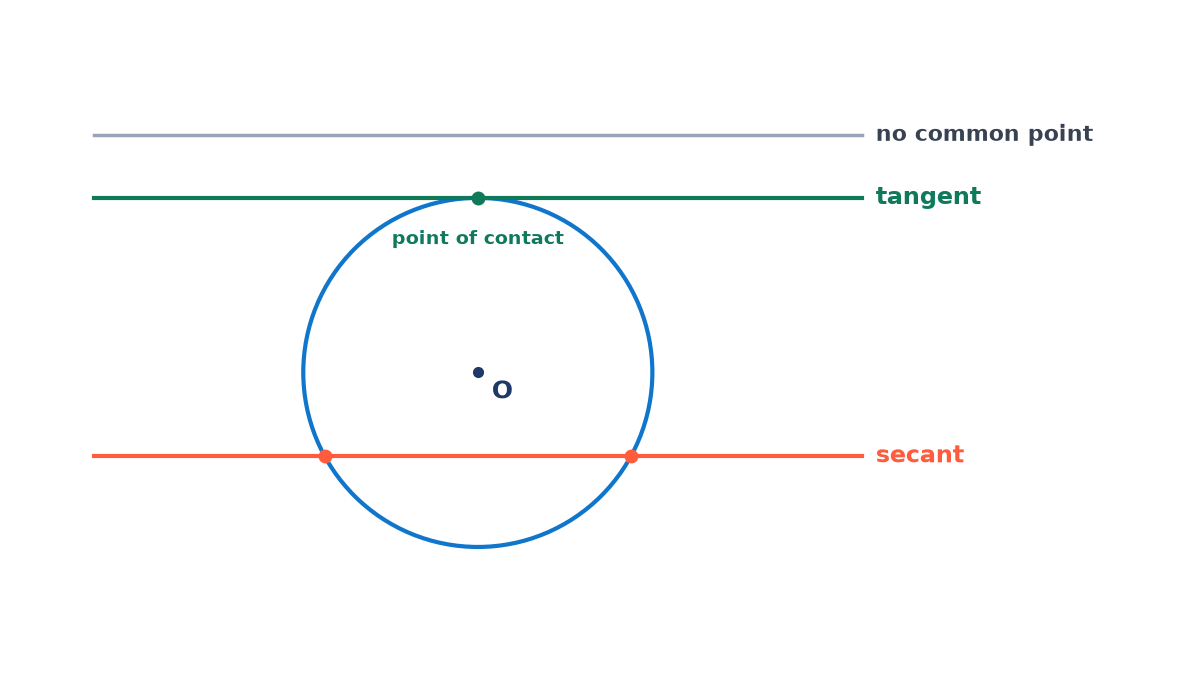
A line that meets a circle at two points is a secant. A line that meets it at exactly one point is a tangent, and that point is called the point of contact. A line that doesn't meet the circle at all is neither.
Imagine a secant whose two crossing points slide closer and closer together. At the moment they meet, the secant has turned into a tangent. So you can think of a tangent as the limit of a secant, where the "chord" has shrunk to a single point.
At each point of a circle there is exactly one tangent.
The theorem
Theorem. The tangent at any point of a circle is perpendicular to the radius through the point of contact.
Proof. Let the tangent touch the circle with centre at . Pick any other point on . Because meets the circle only at , the point must lie outside the circle, so is longer than the radius: .
That's true for every point on the line except . So is the shortest distance from to the line . And the shortest segment from a point to a line is always the perpendicular. Therefore .

Two consequences follow, and you'll quote both as reasons in later proofs:
- At any point of a circle, the perpendicular to the radius is the tangent. (This is the converse.)
- The perpendicular to a tangent at its point of contact passes through the centre.
The right triangle it creates
Wherever a radius meets a tangent at the point of contact, there's a right angle. Join the centre to any point on the tangent and a right triangle appears. The radius is one leg, the tangent segment is the other leg, and the line to the centre is the hypotenuse.
Example 1. A tangent from an external point touches a circle of radius cm at , and the centre is cm from . Find .
Since , , so cm.

Example 2. From a point that is cm from the centre, a tangent of length cm is drawn. Find the radius.
, so cm.
Example 3. is a tangent at and . Find .
In right triangle , .
A tangent and a chord through the point of contact
Example 4. A chord of a circle with centre is parallel to the tangent at a point . Prove that is the midpoint of the arc ; in other words, that bisects .
The tangent at is perpendicular to . Since is parallel to that tangent, as well. A line through the centre perpendicular to a chord bisects the chord, so bisects , and is equally far from and along the arc.
Practice
- A circle has radius cm. A tangent is drawn from a point cm from the centre. How long is it?
- The tangent from a point is cm long, and the radius is cm. How far is from the centre?
- is a tangent at to a circle with centre , and . Find .
- A line is cm from the centre of a circle of radius cm. What is the line to the circle? What if the distance were cm? Or cm?
- Two circles with the same centre have radii cm and cm. A chord of the larger circle touches the smaller one. How long is the chord?
- Prove that the tangents at the two ends of a diameter are parallel.
Answers
Show answers
- cm.
- cm.
- , so .
- At cm, equal to the radius, it's a tangent. At cm, less than the radius, it's a secant. At cm, more than the radius, it misses the circle.
- Let the chord touch the smaller circle at . Then with , and . So . Since bisects the chord, cm.
- Let be a diameter with centre . The tangent at is perpendicular to , and the tangent at is perpendicular to . But and lie along the same line , so both tangents are perpendicular to . Two lines perpendicular to the same line are parallel.