Where we are headed
Think of a list of numbers where you always get the next one by adding the same fixed amount. That is an arithmetic progression. In this lesson we settle the words you will use all chapter (first term, common difference, general form), learn how to test whether a list really is an AP, and practise writing one down from a description.
The definition
A sequence is an arithmetic progression (AP) when the gap between consecutive terms never changes:
That fixed gap is called the common difference, and we write the first term as . So every AP you will ever meet looks like this:
And is free to be positive, negative or even zero.
- has , , so it keeps going up.
- has , , so it keeps going down.
- has , , so it just stays put.
- has , .
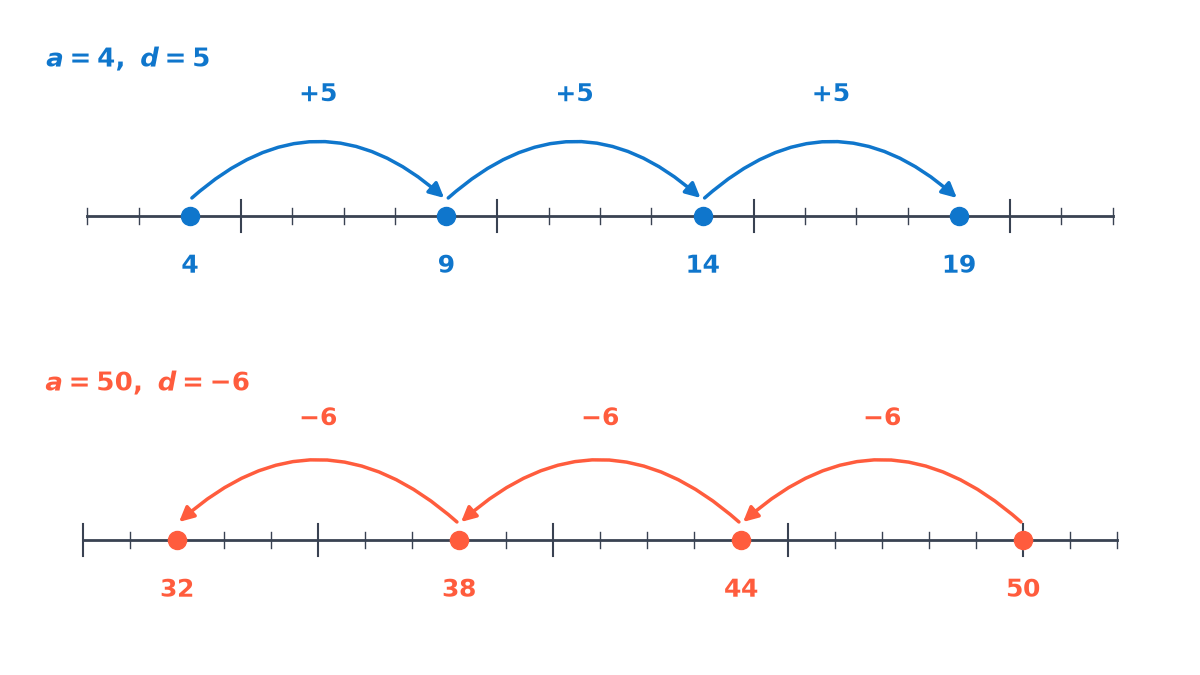
Testing whether a list is an AP
Work out every consecutive difference, and make sure they all match. Checking just one pair proves nothing, so don't be lazy here.
Example 1. Is an AP?
, , , . Yes, and .
Example 2. Is an AP?
, but . So no. (You may recognise these as square numbers, and their gaps keep growing.)
Example 3. Is an AP?
, while . No. Here each term is doubled rather than increased by a fixed amount. A fixed ratio gives a different kind of sequence altogether.
Example 4. Is an AP?
Every difference is . So yes, with and .
Example 5. Is an AP?
Compare with . These match only when (or ). So in general it is not an AP.
Writing an AP from and
Suppose and . Keep subtracting and you get .
With and , you get .
APs from situations
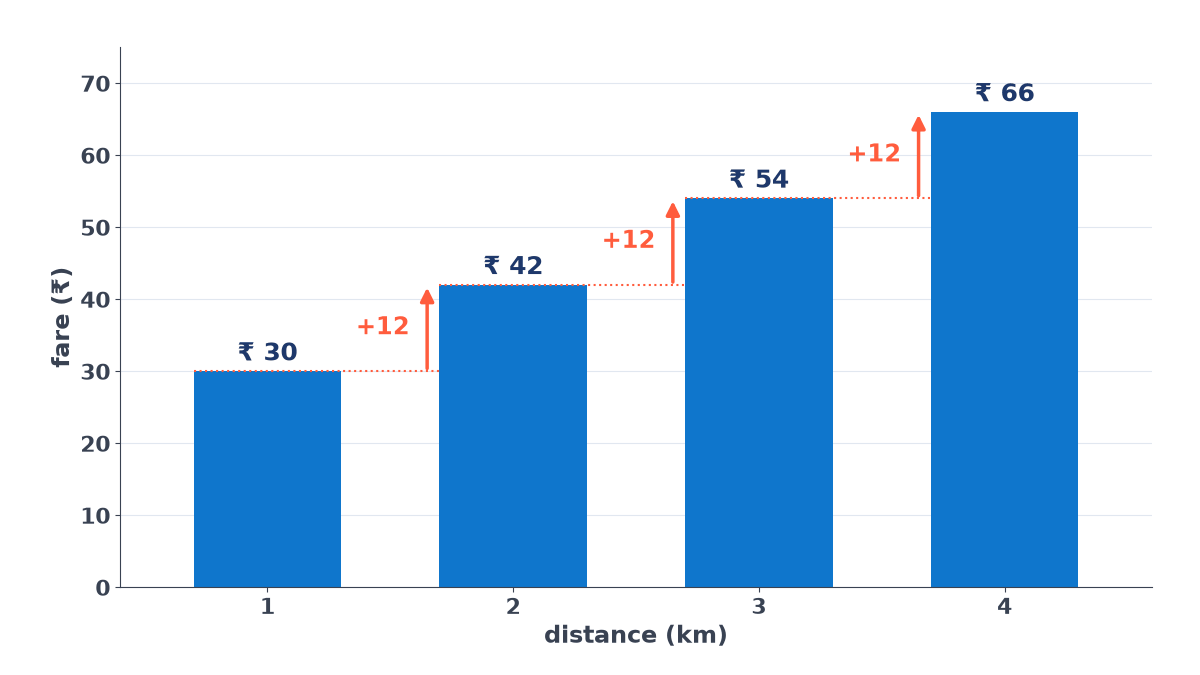
Example 6. A taxi charges ₹ for the first kilometre and ₹ for every kilometre after that. So the fares for km are . The gaps are all , which makes it an AP with , .
Example 7. You keep ₹ in a savings account at simple interest a year. After years the amounts are . That is an AP with , . (With compound interest the gaps would keep growing, so it would not be an AP.)
Example 8. Drop a ball from height , and each bounce takes it back up to of the height before. The heights are . The differences are and then , which don't match. Not an AP.
Finite and infinite APs
is a finite AP, because it stops at a last term. with nothing after the dots is infinite. Read the three dots as "and so on". If a number follows them, it means "up to and including this one".
Practice
- Decide whether each is an AP, and if it is, give and : (a) ; (b) ; (c) ; (d) .
- Write down the first four terms of the AP with , .
- Find for the AP .
- Digging a well costs ₹ for the first metre, and every further metre costs ₹ more than the one before. Write down the cost of each of the first four metres, and say whether these costs form an AP.
- Which of these give an AP? (a) The air left in a cylinder when a pump takes out a quarter of whatever remains at each stroke. (b) The seats in each row of a hall, where every row has more seats than the row in front.
Answers
Show answers
- (a) All the differences are , so it is an AP with , . (b) but , so not an AP. (c) All the differences are , so it is an AP with , . (d) All the differences are , so it is an AP with , .
- .
- , and checking the next pair, ✓. So .
- . The gaps are all , so yes, an AP.
- (a) No. Each stroke takes a quarter of an amount that keeps shrinking, so the gaps shrink too. (b) Yes. The rows go up by a fixed each time.