Where Sₙ = n/2 [2a + (n − 1)d] comes from, its second form n/2 (a + l), which to use, finding n from a given sum, reading a term off a formula for Sₙ, and sums that must be set up from a description.
Lesson 3 of 4
4 min read
7 practice questions
Why bother with a formula?
You could add the first hundred terms of an AP one at a time. You could also walk from Delhi to Agra. Neither is a good use of an afternoon. In this lesson we work out a formula for the sum of the first n terms, look at its two forms, and learn which one to pick up depending on what the question gives you.
The formula, and where it comes from
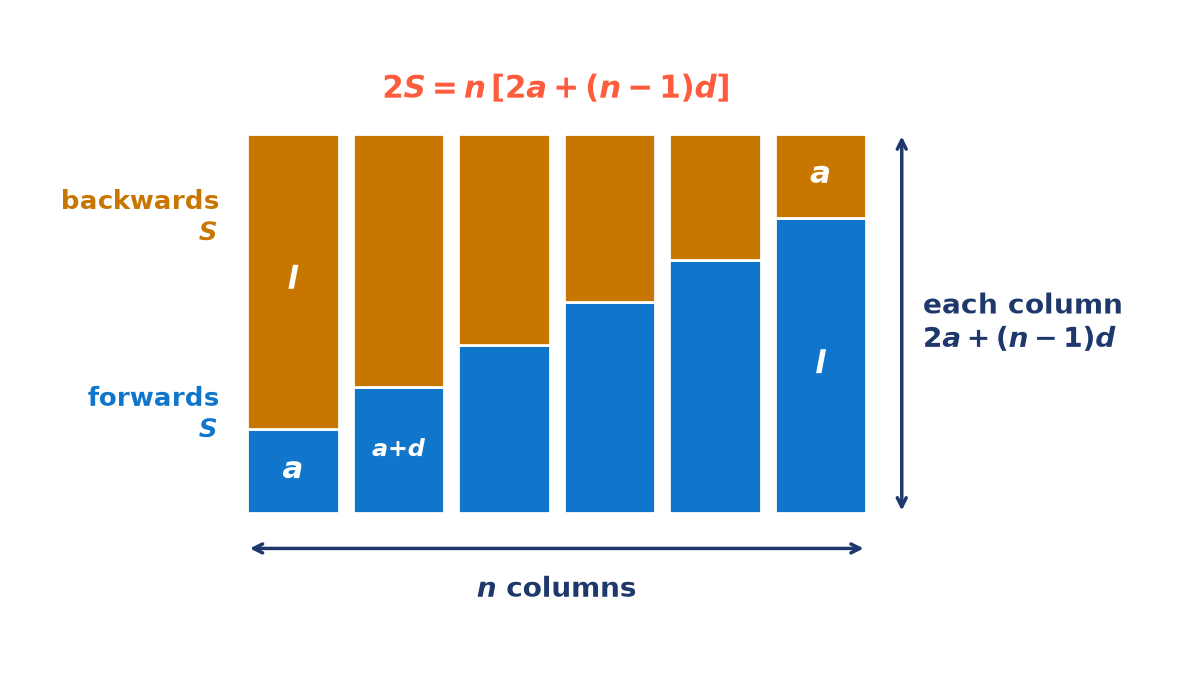
Here's a neat trick. Write the sum S of the first n terms once forwards and once backwards:
Now add the two lines term by term. Each pair adds up to exactly the same thing, 2a+(n−1)d, and there are n pairs:
2S=n[2a+(n−1)d]
Forwards plus backwards: n equal columns make 2S
Sn=2n[2a+(n−1)d]
The last term is l=a+(n−1)d, so we can also write this as
Sn=2n(a+l)
In words, half the number of terms times the sum of the first and last. Reach for this second form whenever you know the last term. If you only know a and d, use the first.
Using the formulas
Example 1. Find the sum of the first 30 terms of 5,9,13,….
Here a=5, d=4, n=30, so S30=230[10+29×4]=15×126=1890.
Example 2. Find 8+11+14+⋯+116.
We know a=8, d=3, l=116. First count the terms: 8+(n−1)⋅3=116 gives n=37. Then S=237(8+116)=237×124=37×62=2294.
Example 3. Find the sum of the first 20 terms of 15,12,9,….
With d=−3, S20=220[30+19×(−3)]=10×(30−57)=−270. Don't be alarmed by a negative sum. The seventh term is 0, and from the eighth term on the terms themselves are negative.
Finding n from a given sum
Set Sn equal to the given value and you get a quadratic in n. Keep the root that is a positive integer.
Example 4. How many terms of 3,7,11,… add up to 210?
2n[6+(n−1)⋅4]=210, so n(4n+2)=420, giving 4n2+2n−420=0, or 2n2+n−210=0. This factorises as (2n+21)(n−10)=0. We reject −221 and take n=10. So ten terms.
Sum from a formula for Sn; a term from two sums
Sometimes Sn is handed to you as a formula. Then the nth term is just the difference between two consecutive sums:
an=Sn−Sn−1
Example 5. The sum of the first n terms of an AP is Sn=3n2+5n. Find the 12th term.
a12=S12−S11=(432+60)−(363+55)=492−418=74.
Let's double-check using the AP itself: a1=S1=8 and a2=S2−S1=22−8=14, so d=6, and a12=8+11×6=74 ✓.
Sums that need setting up
Example 6. Find the sum of all two-digit numbers divisible by 6.
These are 12,18,24,…,96, so a=12, d=6, l=96. From 12+(n−1)⋅6=96 we get n=15. Then S=215(12+96)=215×108=810.
Example 7. A contractor gets ₹ 800 for the first day of a job and ₹ 30 more for each day after that. How much does he get in all for 25 days?
With a=800, d=30, n=25: S25=225[1600+24×30]=225×2320=25×1160=29000. That's ₹ 29000.
Practice
Find the sum of the first 16 terms of 7,10,13,….
Find 4+9+14+⋯+129.
Find the sum of the first 25 terms of 20,17,14,….
How many terms of 2,5,8,… add up to 155?
Given Sn=2n2+3n, find a1, d and a15.
Find the sum of all three-digit numbers divisible by 11.
An AP has first term 3, last term 51 and sum 459. Find n and d.
Answers
Show answers
S16=8[14+15×3]=8×59=472.
4+(n−1)⋅5=129 gives n=26. So S=13(4+129)=13×133=1729.
S25=225[40+24×(−3)]=225×(−32)=−400.
2n[4+3(n−1)]=155, so n(3n+1)=310, which gives 3n2+n−310=0, (3n+31)(n−10)=0, and n=10.
a1=S1=5 and a2=S2−S1=14−5=9, so d=4 and a15=5+14×4=61. (Check: S15−S14=495−434=61 ✓.)
The numbers are 110,121,…,990, so a=110, d=11, and 110+(n−1)⋅11=990 gives n=81. So S=281(110+990)=281×1100=44550.
2n(3+51)=459 gives 27n=459, so n=17. Then 3+16d=51, so d=3.
Test yourself
Sum of the First n Terms, Quiz
Five questions on the sum of the first n terms of an AP. Pick one answer for each.