aₙ = a + (n − 1)d, used in every direction: find a term, find which term a value is, decide whether a number belongs to the AP, recover a and d from two known terms, and count back from the end.
Lesson 2 of 4
4 min read
8 practice questions
Why we need a formula
If someone asks for the fiftieth term, you are not going to write out fifty terms. That isn't a method, it's punishment. So here we build a formula for the nth term of an AP and then turn it every way the exam likes to turn it: finding a term, finding which term a value is, recovering a and d from two known terms, and deciding whether a number shows up in an AP at all.
The formula
Look at the AP a,a+d,a+2d,…. The second term has one d added on, the third has two, and so the nth has n−1 of them:
an=a+(n−1)d
We call an the general term. If the AP has m terms, then am is its last term, often written l.
That n−1 is where students lose marks every year. The 10th term is a+9d, not a+10d.
Finding a term
Example 1. Find the 25th term of 6,10,14,….
Here a=6, d=4, n=25, so a25=6+24×4=102.
The terms climb by 4 each step: the 25th term is 102
Example 2. Find the 12th term of 40,33,26,….
Now a=40 and d=−7, so a12=40+11×(−7)=40−77=−37.
Which term is it?
Put an equal to the given value and solve for n. If n doesn't come out as a positive integer, the value simply isn't a term.
Example 3. Which term of 3,8,13,… is 148?
3+(n−1)⋅5=148, so (n−1)⋅5=145, n−1=29, and n=30. It's the 30th term.
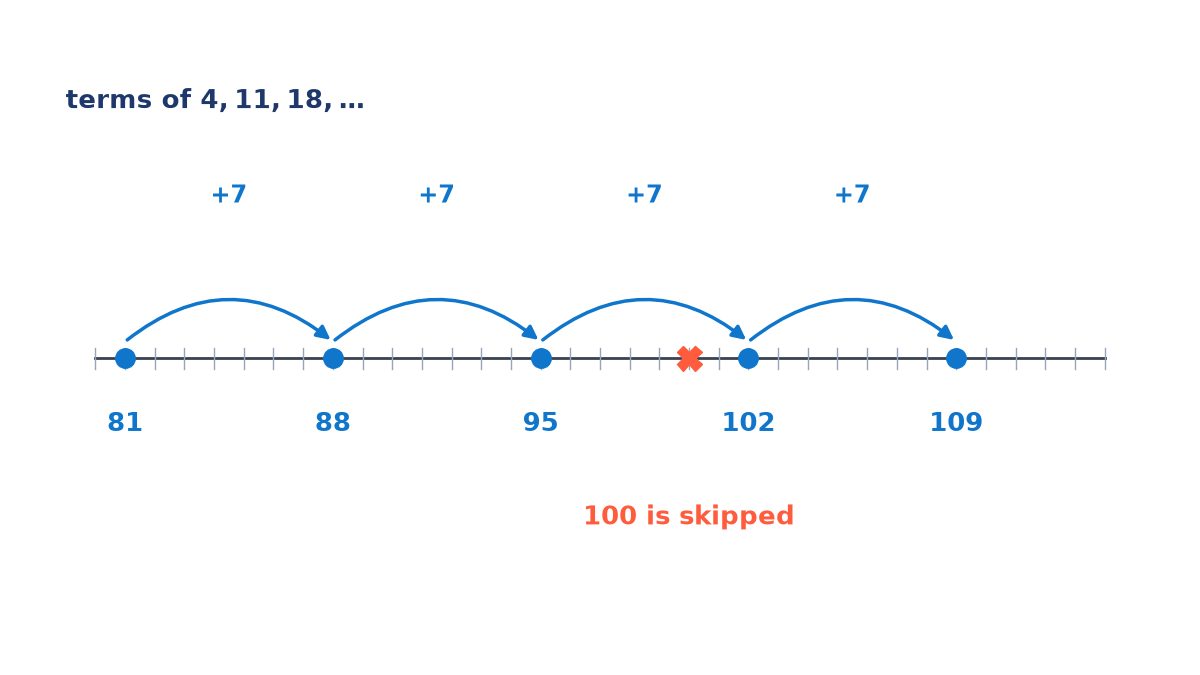
Example 4. Is 100 a term of 4,11,18,…?
4+(n−1)⋅7=100, so (n−1)⋅7=96 and n−1=796. That isn't a whole number, so the answer is no: 100 is not a term. (The AP jumps from 95 straight to 102.)
100 falls between the terms 95 and 102
Example 5. How many terms are there in 9,15,21,…,201?
9+(n−1)⋅6=201, so (n−1)⋅6=192, n−1=32, and n=33. There are thirty-three terms.
Two terms known: find a and d
Each term you know hands you one equation. Two terms give two equations, which is just enough for two unknowns.
Example 6. The 5th term of an AP is 22 and the 13th is 54. Find the AP.
We have a+4d=22 and a+12d=54. Subtracting, 8d=32, so d=4. Then a=22−16=6, and the AP is 6,10,14,….
Example 7. The 7th term is −1 and the 16th term is 17. Find the 30th term.
a+6d=−1 and a+15d=17. Subtracting, 9d=18, so d=2 and a=−13. Then a30=−13+29×2=45.
Terms from the end
In a finite AP with last term l, the nth term from the end is l−(n−1)d. You are just walking backwards, adding −d at each step.
Example 8. Find the 6th term from the end of 7,12,17,…,202.
Here l=202 and d=5, so the answer is 202−5×5=177.
A situation
Example 9. Someone repays a loan in monthly instalments: ₹ 1200 in the first month, then ₹ 50 more each month after that. In which month is the instalment ₹ 2150?
1200+(n−1)⋅50=2150, so (n−1)⋅50=950 and n=20. It happens in the 20th month.
Practice
Find a18 for 2,7,12,….
Find a15 for 100,93,86,….
Which term of 5,9,13,… is 113?
Is −84 a term of 12,8,4,…?
How many terms does −6,−2,2,…,90 have?
The 3rd term of an AP is 16 and the 9th term is 40. Find a, d and the 20th term.
Find the 4th term from the end of 11,18,25,…,235.
The 10th term of an AP is twice its 4th term, and its 6th term is 22. Find the AP.
Answers
Show answers
2+17×5=87.
100+14×(−7)=2.
5+(n−1)⋅4=113, so (n−1)⋅4=108 and n=28. It's the 28th term.
12+(n−1)(−4)=−84, so (n−1)(−4)=−96, n−1=24, n=25. Yes, it's the 25th term.
−6+(n−1)⋅4=90, so (n−1)⋅4=96 and n=25. Twenty-five terms.
a+2d=16 and a+8d=40, so 6d=24, d=4, a=8. Then a20=8+19×4=84.
Here d=7, so the answer is 235−3×7=214.
a+9d=2(a+3d) gives a=3d. Putting that into a+5d=22 gives 8d=22, so d=411 and a=433. The AP is 433,11,455,…. Check: a10=433+499=33 and a4=433+433=233, and sure enough 33=2×233 ✓.
Test yourself
The nth Term of an AP, Quiz
Five questions on the nth term of an AP. Pick one answer for each.