Expresswala Academy Mathematics Tuition

Probability

Class 10 Probability Problems: Coins, Dice and Playing Cards

Solve Class 10 probability problems with two and three coins, one and two dice, a pack of 52 cards, bags of balls, numbered discs and leap years, using trees, the 36-outcome grid and careful counting.

By 9 min read

Most board exam ques­tions on prob­a­bil­ity use a small set of famil­iar exper­i­ments: toss­ing coins, rolling dice, draw­ing cards, and pick­ing balls or num­bered discs. Once you know exactly how many out­comes each exper­i­ment has and how to list them, every ques­tion reduces to care­ful count­ing and the for­mula P(E)=favourable outcomestotal outcomes\displaystyle P(E) = \frac{\text{favourable outcomes}}{\text{total outcomes}}. This les­son sets out each exper­i­ment and works through the ques­tion types that appear most often.

Coins

How many out­comes?

One coin has 2 out­comes. Each extra coin dou­bles the count, because every ear­lier out­come can be fol­lowed by a head or a tail. So two coins give 2×2=42 \times 2 = 4 out­comes and three coins give 2×2×2=82 \times 2 \times 2 = 8 out­comes.

  • Two coins: HH, HT, TH, TT.
  • Three coins: HHH, HHT, HTH, HTT, THH, THT, TTH, TTT.

Toss­ing one coin three times gives the same 8 out­comes as toss­ing three coins together. HT and TH are dif­fer­ent out­comes: the first let­ter belongs to the first coin.

List­ing with a tree dia­gram

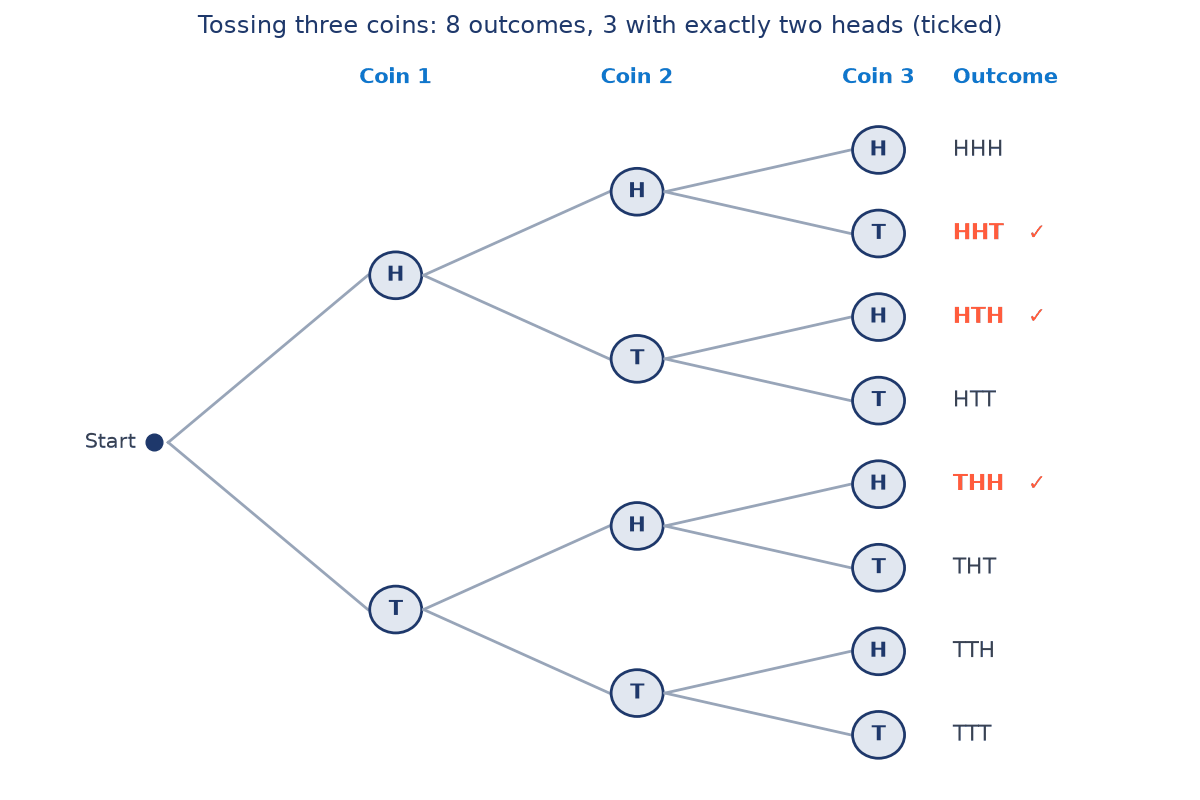
A tree dia­gram makes sure that noth­ing is missed. Each level of branches stands for one coin, and each path from the start to the end is one out­come.

Tree diagram for three coins with H and T branches at each level, giving 8 outcomes HHH to TTT; HHT, HTH and THH are ticked as exactly two heads
Three coins give 8 equally likely out­comes; exactly three of them con­tain two heads.

Words to read care­fully

  • Exactly two heads: two heads and no more.
  • At least two heads: two or more heads.
  • At most one head: one head or none.
  • No tail: every coin shows a head.

Dice

One die

One die has 6 out­comes: 1, 2, 3, 4, 5, 6. Among them, 2, 3 and 5 are prime; 4 is the only com­pos­ite num­ber; 1 is nei­ther prime nor com­pos­ite.

Two dice: the 36-out­come grid

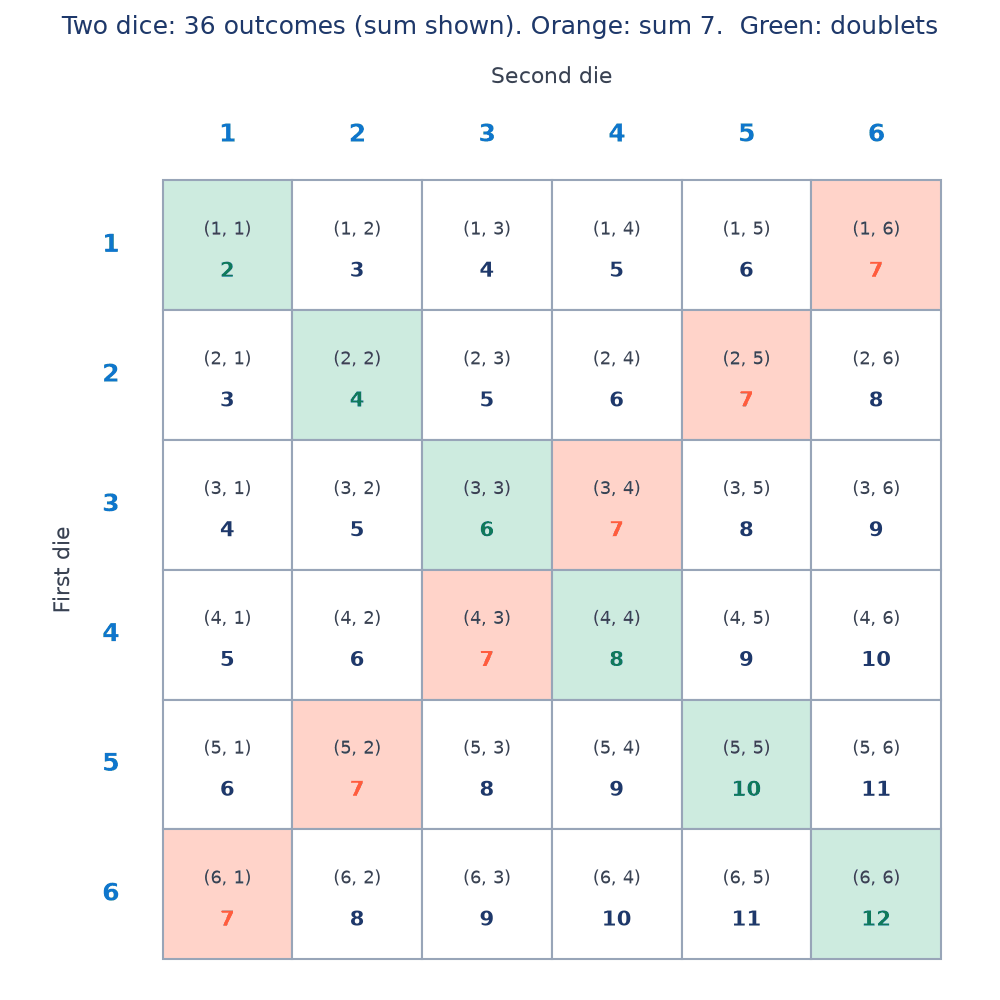
When two dice are rolled (or one die is rolled twice), each of the 6 results of the first die can pair with each of the 6 results of the sec­ond, so there are 6×6=366 \times 6 = 36 out­comes. Write each as an ordered pair (a,b)(a, b), where aa is on the first die and bb on the sec­ond. (2,5)(2, 5) and (5,2)(5, 2) are dif­fer­ent out­comes.

Six by six grid of two-dice outcomes with each sum written; the six cells with sum 7 are orange and the six doublets from (1, 1) to (6, 6) are green
The two-dice grid: sums of 7 run along one diag­o­nal and the dou­blets along the other.

Use­ful counts from the grid:

Sum23456789101112
Num­ber of out­comes12345654321

The counts add up to 36. A dou­blet is an out­come with the same num­ber on both dice; there are 6 of them.

A pack of cards

Struc­ture of the pack

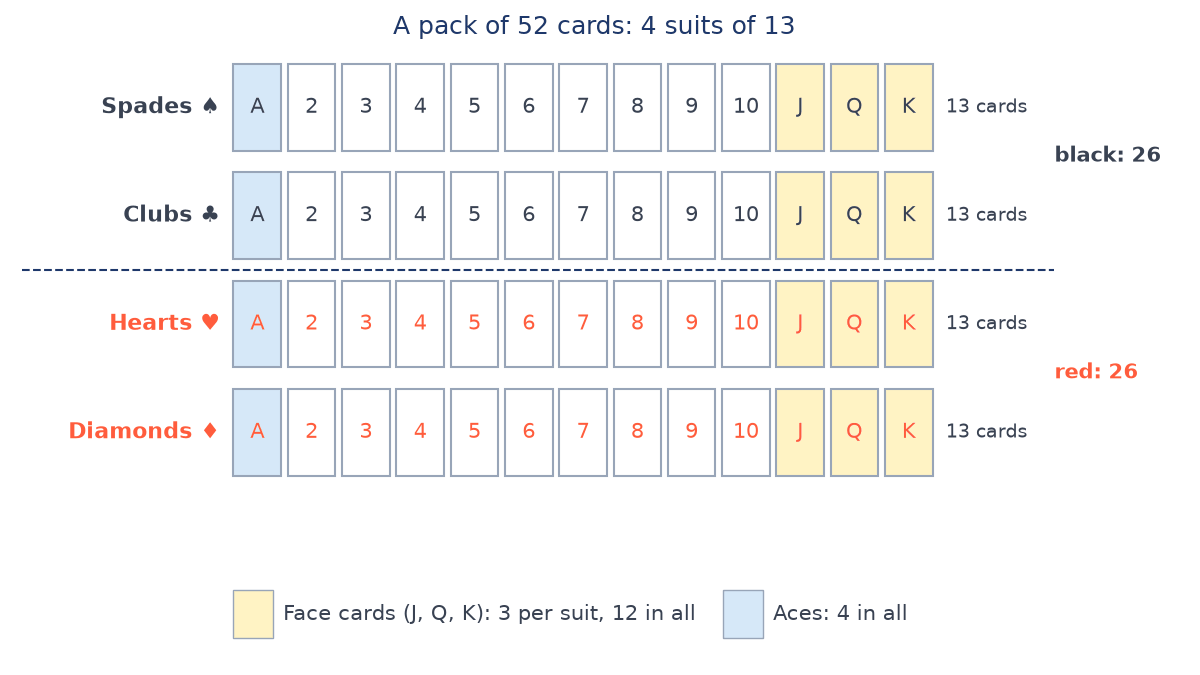
A stan­dard pack has 52 cards in 4 suits of 13 cards each. Spades and clubs are black; hearts and dia­monds are red. Each suit has an ace, the num­ber cards 2 to 10, and three face cards: the jack, the queen and the king.

  • Red cards: 26; black cards: 26.
  • Aces: 4; kings: 4; queens: 4; jacks: 4.
  • Face cards: 3×4=123 \times 4 = 12.
  • Cards of any one suit: 13.
Four rows of 13 cards for spades, clubs, hearts and diamonds, black above red; aces shaded blue and the 12 face cards J, Q, K shaded yellow
The 52 cards: 26 black and 26 red, 4 aces and 12 face cards.

Method for any count­ing prob­lem

  1. Iden­tify the exper­i­ment and write down nn: 4 or 8 for coins, 6 or 36 for dice, 52 (or fewer, if cards are removed) for a pack.
  2. Trans­late the event into a pre­cise list of out­comes; draw a tree or grid if needed.
  3. Count the favourable out­comes, avoid­ing dou­ble count­ing (for exam­ple, a card that is both a heart and a jack).
  4. Divide, sim­plify, and check that the answer lies between 0 and 1.

Worked exam­ples

Exam­ple 1: two coins

Two coins are tossed together. Find the prob­a­bil­ity of get­ting (a) at least one head, (b) exactly one head, (c) no head.

The out­comes are HH, HT, TH, TT, so n=4n = 4.

(a) At least one head: HH, HT, TH, so P=34\displaystyle P = \frac{3}{4}.

(b) Exactly one head: HT, TH, so P=24=12\displaystyle P = \frac{2}{4} = \frac{1}{2}.

(c) No head: TT, so P=14\displaystyle P = \frac{1}{4}. Notice that (a) and (c) are com­ple­men­tary: 34+14=1\displaystyle \frac{3}{4} + \frac{1}{4} = 1.

Answer: (a) 34\displaystyle \frac{3}{4} (b) 12\displaystyle \frac{1}{2} (c) 14\displaystyle \frac{1}{4}

Exam­ple 2: three coins

Three coins are tossed. Find the prob­a­bil­ity of get­ting (a) exactly two heads, (b) at least two heads, (c) no tail, (d) at least one tail.

Here n=8n = 8.

(a) HHT, HTH, THH, so P=38\displaystyle P = \frac{3}{8}.

(b) The three out­comes in (a) together with HHH, so P=48=12\displaystyle P = \frac{4}{8} = \frac{1}{2}.

(c) Only HHH, so P=18\displaystyle P = \frac{1}{8}.

(d) "At least one tail" is the com­ple­ment of "no tail", so P=1−18=78\displaystyle P = 1 - \frac{1}{8} = \frac{7}{8}.

Answer: (a) 38\displaystyle \frac{3}{8} (b) 12\displaystyle \frac{1}{2} (c) 18\displaystyle \frac{1}{8} (d) 78\displaystyle \frac{7}{8}

Exam­ple 3: sums and prod­ucts on two dice

Two dice are rolled. Find the prob­a­bil­ity that (a) the sum is 7, (b) a dou­blet appears, (c) the sum is at most 4, (d) the prod­uct is 12, (e) the sum is a prime num­ber.

Here n=36n = 36.

(a) (1,6),(2,5),(3,4),(4,3),(5,2),(6,1)(1,6), (2,5), (3,4), (4,3), (5,2), (6,1): P=636=16\displaystyle P = \frac{6}{36} = \frac{1}{6}.

(b) (1,1)(1,1) to (6,6)(6,6): P=636=16\displaystyle P = \frac{6}{36} = \frac{1}{6}.

(c) Sum 2, 3 or 4: 1+2+3=61 + 2 + 3 = 6 out­comes, so P=636=16\displaystyle P = \frac{6}{36} = \frac{1}{6}.

(d) (2,6),(6,2),(3,4),(4,3)(2,6), (6,2), (3,4), (4,3): P=436=19\displaystyle P = \frac{4}{36} = \frac{1}{9}.

(e) The pos­si­ble prime sums are 2, 3, 5, 7 and 11. From the table they occur in 1+2+4+6+2=151 + 2 + 4 + 6 + 2 = 15 ways, so

P(prime sum)=1536=512.\displaystyle P(\text{prime sum}) = \frac{15}{36} = \frac{5}{12}.

Answer: (a) 16\displaystyle \frac{1}{6} (b) 16\displaystyle \frac{1}{6} (c) 16\displaystyle \frac{1}{6} (d) 19\displaystyle \frac{1}{9} (e) 512\displaystyle \frac{5}{12}

Exam­ple 4: draw­ing one card

One card is drawn from a well-shuf­fled pack of 52. Find the prob­a­bil­ity that it is (a) a red king, (b) a face card, (c) nei­ther a heart nor a jack, (d) a black ace.

(a) King of hearts and king of dia­monds: P=252=126\displaystyle P = \frac{2}{52} = \frac{1}{26}.

(b) 12 face cards: P=1252=313\displaystyle P = \frac{12}{52} = \frac{3}{13}.

(c) First count "a heart or a jack": 13 hearts, plus the 3 jacks that are not hearts, giv­ing 16 (the jack of hearts is counted once only). So

P(neither)=52−1652=3652=913.\displaystyle P(\text{neither}) = \frac{52 - 16}{52} = \frac{36}{52} = \frac{9}{13}.

(d) Ace of spades and ace of clubs: P=252=126\displaystyle P = \frac{2}{52} = \frac{1}{26}.

Answer: (a) 126\displaystyle \frac{1}{26} (b) 313\displaystyle \frac{3}{13} (c) 913\displaystyle \frac{9}{13} (d) 126\displaystyle \frac{1}{26}

Exam­ple 5: after remov­ing cards

The king, queen and jack of spades are removed from a pack of 52 cards. The rest are shuf­fled and one card is drawn. Find the prob­a­bil­ity that it is (a) a spade, (b) a face card, (c) an ace, (d) a red card.

Cards left: n=52−3=49n = 52 - 3 = 49.

(a) Spades left: 13−3=1013 - 3 = 10, so P=1049\displaystyle P = \frac{10}{49}.

(b) Face cards left: 12−3=912 - 3 = 9, so P=949\displaystyle P = \frac{9}{49}.

(c) No ace was removed, so P=449\displaystyle P = \frac{4}{49}.

(d) All 26 red cards remain, so P=2649\displaystyle P = \frac{26}{49}.

Answer: (a) 1049\displaystyle \frac{10}{49} (b) 949\displaystyle \frac{9}{49} (c) 449\displaystyle \frac{4}{49} (d) 2649\displaystyle \frac{26}{49}

Exam­ple 6: find­ing an unknown num­ber of balls

A bag con­tains 8 red balls and some blue balls. The prob­a­bil­ity of draw­ing a blue ball at ran­dom is 35\displaystyle \frac{3}{5}. Find the num­ber of blue balls.

Let there be xx blue balls. The total is 8+x8 + x, so

x8+x=355x=24+3x2x=24x=12.\displaystyle \begin{aligned} \frac{x}{8 + x} &= \frac{3}{5} \\ 5x &= 24 + 3x \\ 2x &= 24 \\ x &= 12. \end{aligned}

Check: 1220=35\displaystyle \frac{12}{20} = \frac{3}{5}, and P(red)=820=25\displaystyle P(\text{red}) = \frac{8}{20} = \frac{2}{5}, which adds with 35\displaystyle \frac{3}{5} to 1.

Answer: 12 blue balls

Exam­ple 7: num­bered discs

A box has 90 discs num­bered 1 to 90. One disc is drawn at ran­dom. Find the prob­a­bil­ity that it bears (a) a two-digit num­ber, (b) a per­fect square, (c) a mul­ti­ple of 5.

(a) Two-digit num­bers: 10 to 90, which is 90−9=8190 - 9 = 81 num­bers. P=8190=910\displaystyle P = \frac{81}{90} = \frac{9}{10}.

(b) Per­fect squares up to 90: 1,4,9,16,25,36,49,64,811, 4, 9, 16, 25, 36, 49, 64, 81, which is 9 num­bers. P=990=110\displaystyle P = \frac{9}{90} = \frac{1}{10}.

(c) Mul­ti­ples of 5: 5,10,…,905, 10, \ldots, 90, which is 90÷5=1890 \div 5 = 18 num­bers. P=1890=15\displaystyle P = \frac{18}{90} = \frac{1}{5}.

Answer: (a) 910\displaystyle \frac{9}{10} (b) 110\displaystyle \frac{1}{10} (c) 15\displaystyle \frac{1}{5}

Exam­ple 8: 53 Sun­days in a leap year

Find the prob­a­bil­ity that a leap year cho­sen at ran­dom has 53 Sun­days.

A leap year has 366 days, and 366=52×7+2366 = 52 \times 7 + 2. So it has 52 com­plete weeks, which give 52 Sun­days, plus 2 extra con­sec­u­tive days. The two extra days can be any of these 7 equally likely pairs:

(Sun, Mon), (Mon, Tue), (Tue, Wed), (Wed, Thu), (Thu, Fri), (Fri, Sat), (Sat, Sun).

A 53rd Sun­day occurs when a Sun­day is among the two extra days, which hap­pens for 2 of the 7 pairs.

P(53 Sundays)=27.\displaystyle P(53 \text{ Sundays}) = \frac{2}{7}.

For an ordi­nary year, 365=52×7+1365 = 52 \times 7 + 1 leaves one extra day, so the prob­a­bil­ity of 53 Sun­days is 17\displaystyle \frac{1}{7}.

Answer: 27\displaystyle \frac{2}{7}

Com­mon mis­takes

  • Treat­ing (2,5)(2, 5) and (5,2)(5, 2) as the same out­come. With two dice there are 36 ordered out­comes, not 21.
  • Count­ing a card twice, such as the jack of hearts in "a heart or a jack".
  • For­get­ting to reduce the total after cards are removed from the pack.
  • Call­ing the ace a face card. Only the jack, queen and king are face cards.
  • Read­ing "at least one" as "exactly one". It is usu­ally eas­i­est as 1−P(none)1 - P(\text{none}).
  • In leap-year prob­lems, for­get­ting that the two extra days are con­sec­u­tive.

Try these

  1. Three coins are tossed. Find the prob­a­bil­ity of get­ting at most one head. Answer: 12\displaystyle \frac{1}{2}
  2. Two dice are rolled. Find the prob­a­bil­ity that the sum is 10. Answer: 112\displaystyle \frac{1}{12}
  3. Two dice are rolled. Find the prob­a­bil­ity that the sum is at least 10. Answer: 16\displaystyle \frac{1}{6}
  4. A card is drawn from a pack of 52. Find the prob­a­bil­ity that it is a red face card. Answer: 326\displaystyle \frac{3}{26}
  5. Find the prob­a­bil­ity that an ordi­nary (non-leap) year has 53 Mon­days. Answer: 17\displaystyle \frac{1}{7}
  6. Two dice are rolled. Find the prob­a­bil­ity that the prod­uct of the num­bers is odd. Answer: 14\displaystyle \frac{1}{4}

Key terms

Tree dia­gram
A branch­ing dia­gram in which every path from start to fin­ish is one out­come.
Ordered pair
An out­come such as (a,b)(a, b) in which the order mat­ters; aa belongs to the first die.
Dou­blet
An out­come of two dice with the same num­ber on both.
Suit
One of the four groups of 13 cards: spades, clubs, hearts, dia­monds.
Face card
A jack, queen or king; a pack has 12 of them.
At least
That many or more.
At most
That many or fewer.

Com­mon ques­tions

Is toss­ing one coin twice the same as toss­ing two coins once?

Yes. Both have the same 4 equally likely out­comes, HH, HT, TH and TT.

Why are there 36 out­comes with two dice and not 21?

The dice are dif­fer­ent objects, so a 2 on the first die with a 5 on the sec­ond is a dif­fer­ent out­come from a 5 on the first with a 2 on the sec­ond. Only the 36 ordered out­comes are equally likely.

Is the ace a face card?

No. The face cards are the jack, queen and king of each suit, 12 cards in all.

How do I han­dle "at least one" ques­tions quickly?

Find the prob­a­bil­ity of "none" and sub­tract it from 1. For three coins, P(at least one head)=1−18=78\displaystyle P(\text{at least one head}) = 1 - \frac{1}{8} = \frac{7}{8}.

What changes when some cards are removed?

Both the total and the favourable count may change. Recount each from the cards that are actu­ally left.

Ref­er­ences

  1. National Coun­cil of Edu­ca­tional Research and Train­ing. Math­e­mat­ics: Text­book for Class X. NCERT, New Delhi.
  2. Aggar­wal, R. S. Sec­ondary School Math­e­mat­ics for Class 10. Bharati Bhawan.
  3. Hall, H. S. and Knight, S. R. Higher Alge­bra. Macmil­lan.