Probability Class 10: Events, Outcomes and the Basic Formula
Learn the language of probability for Class 10: experiments, equally likely outcomes, events, the favourable-over-total formula, impossible and sure events, and complementary events, with six worked examples.
Probability is the mathematics of chance. It gives a number between 0 and 1 to say how likely something is to happen. Weather forecasts, quality checks in factories, insurance premiums and board games all rest on this idea. In Class 10 you study theoretical probability: the probability worked out by reasoning about the possible outcomes, before anything is actually tried. This lesson builds the vocabulary, the one formula you need, and the rules that follow from it.
A random experiment is an action whose result cannot be predicted with certainty, even though we know all the results that can occur. Tossing a coin, rolling a die and drawing a card from a well-shuffled pack are random experiments.
Each possible result is an outcome. Tossing a coin has two outcomes, head (H) and tail (T). Rolling a die has six outcomes: 1, 2, 3, 4, 5 and 6. The list of all outcomes is often called the sample space.
Outcomes are equally likely when none of them is expected to occur more often than any other. A fair coin, an unbiased die and a well-shuffled pack of cards all give equally likely outcomes. Words such as "fair", "unbiased", "at random" and "well-shuffled" in a question are telling you that the outcomes are equally likely. The formula below works only in this situation.
An event is a collection of outcomes that we are interested in. When a die is rolled, "getting an even number" is an event made up of the outcomes 2, 4 and 6. The outcomes that make an event happen are called the outcomes favourable to it.
An event with only one outcome, such as "getting a 5", is called an elementary event.
Since m counts some of the n outcomes, we always have 0≤m≤n. Dividing by the positive number n gives
0≤P(E)≤1.
So a probability can never be negative and can never be greater than 1. An answer such as 57 or −0.2 is a signal that something has gone wrong in the counting.
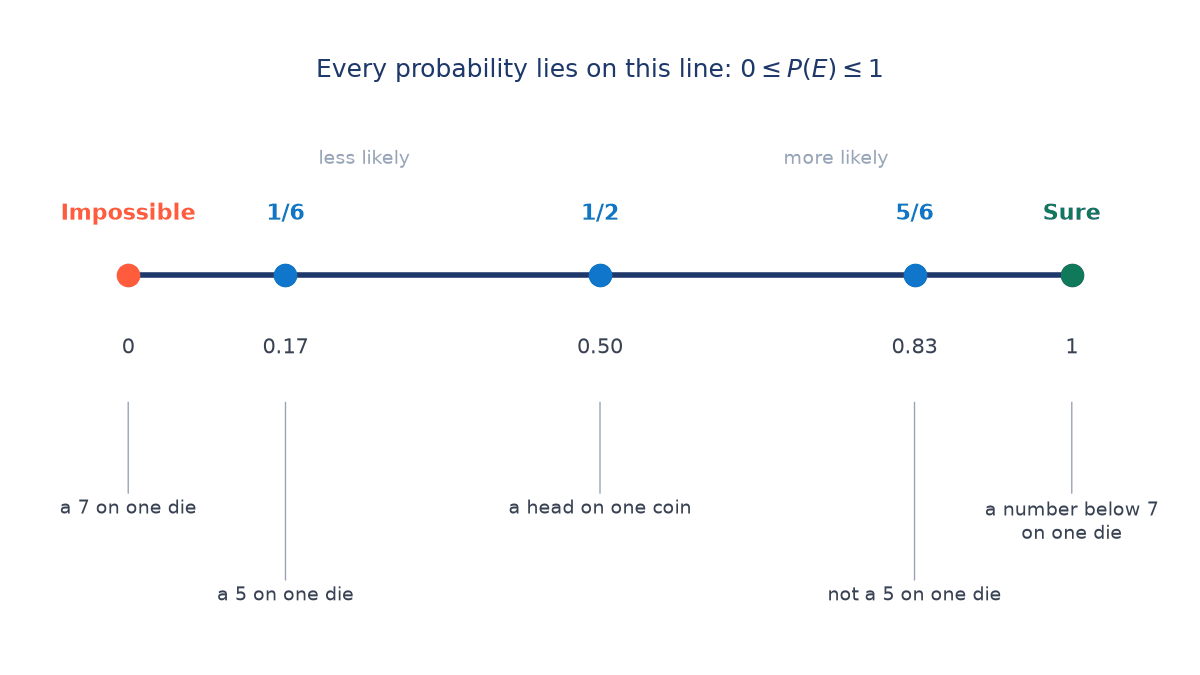
Every probability sits somewhere between the impossible (0) and the sure (1).
An event that has no favourable outcomes is an impossible event; here m=0, so its probability is 0. Getting a 7 on an ordinary die is impossible.
An event for which every outcome is favourable is a sure (certain) event; here m=n, so its probability is 1. Getting a number less than 7 on a die is sure.
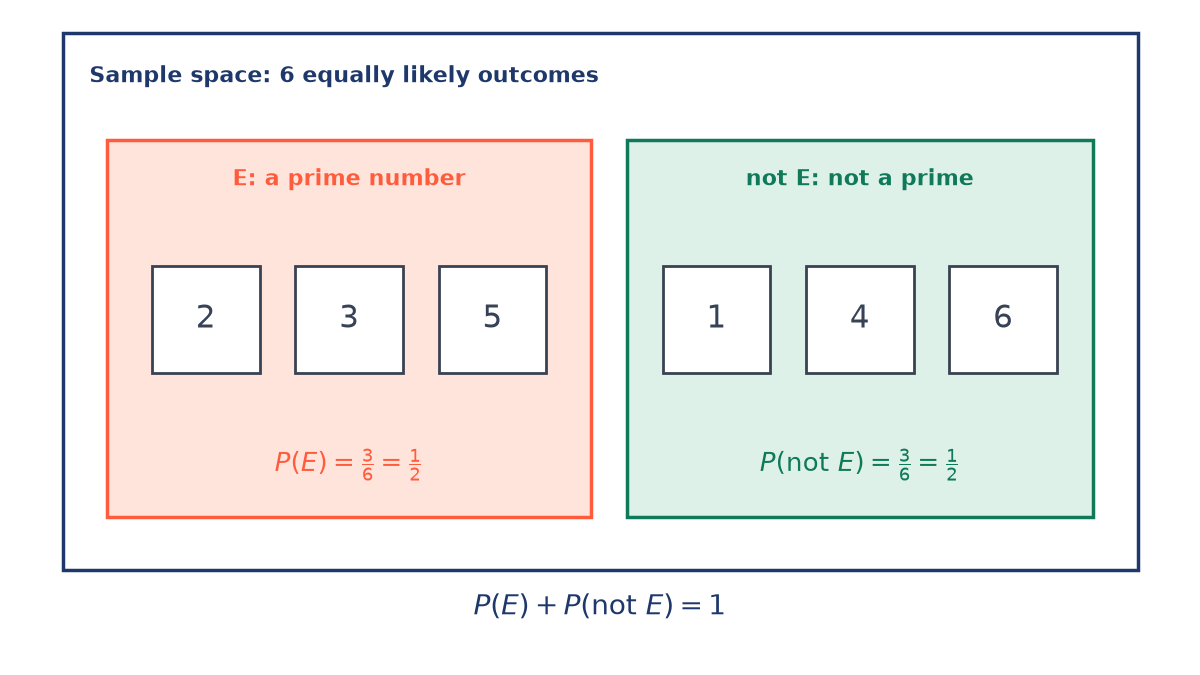
Suppose there are n equally likely outcomes and m of them are favourable to E. Every outcome is either favourable to E or not, and never both. So the remaining n−m outcomes are exactly the ones favourable to E. Hence
P(E)+P(E)=nm+nn−m=nn=1.
On one die, "a prime number" and "not a prime number" share out all six outcomes between them.
The same argument shows that the probabilities of all the elementary events of an experiment add up to 1. For a die, each of the six elementary events has probability 61, and
61+61+61+61+61+61=1.
This is a useful check: if the probabilities of all the separate outcomes do not add to 1, a mistake has been made.
A bag holds 5 red, 3 blue and 4 green balls of the same size. One ball is taken out at random. Find the probability that it is (a) red, (b) not green, (c) yellow.
Total number of balls: n=5+3+4=12.
(a) P(red)=125.
(b) The balls that are not green are the 5 red and 3 blue ones, so m=8 and P(not green)=128=32.
(c) There are no yellow balls, so this is an impossible event: P(yellow)=0.
Thirty cards are numbered 1 to 30 and shuffled well. One card is drawn. Find the probability that the number on it is (a) a multiple of 4, (b) a perfect square, (c) not a prime number.
Here n=30.
(a) Multiples of 4: 4, 8, 12, 16, 20, 24, 28. So m=7 and P=307.
(b) Perfect squares: 1, 4, 9, 16, 25. So m=5 and P=305=61.
(c) Primes up to 30: 2, 3, 5, 7, 11, 13, 17, 19, 23, 29, which is 10 numbers. So
P(prime)=3010=31,P(not prime)=1−31=32.
Note that 1 is neither prime nor composite, so it correctly falls in "not prime".
Answer: (a) 307 (b) 61 (c) 32
Example 4: using the complement with decimals#
The probability that a bulb picked at random from a batch is defective is 0.08. What is the probability that it is not defective? In a match, the probability that a team wins is 0.35 and a draw is not possible. What is the probability that the team loses?
"Defective" and "not defective" are complementary, so
P(not defective)=1−0.08=0.92.
With no draw, "lose" is the same as "not win", so P(lose)=1−0.35=0.65.
A carton holds 250 pens, of which 20 are defective. A shopkeeper takes one pen at random. Find the probability that it is (a) good, (b) defective.
Good pens: 250−20=230.
P(good)=250230=2523,P(defective)=25020=252.
Check: 2523+252=1.
Answer: (a) 2523 (b) 252
Example 6: outcomes that are not equally likely#
Two fair coins are tossed together. Ravi says: "There are three results, two heads, two tails, or one of each, so the probability of one head and one tail is 31." Is he right?
No. His three results are not equally likely. List the outcomes of the two coins separately: HH, HT, TH, TT. These four are equally likely, so n=4. The event "one head and one tail" is made up of HT and TH, so m=2 and
P(one head and one tail)=42=21,P(two heads)=41.
The result "one of each" can happen in two ways, which is why it is twice as likely as "two heads".
Using the formula when the outcomes are not equally likely, as in Example 6. Always break the experiment into outcomes that really are equally likely.
Giving an answer greater than 1 or less than 0. This always means a counting error.
Counting 1 as a prime number. The primes start at 2.
Forgetting to simplify: 128 should be written as 32.
Writing P(E)=P(E)−1 instead of 1−P(E).
Confusing "at least" and "at most", or "greater than" and "greater than or equal to". Write the favourable outcomes out in full before counting.
A fair die is rolled. Find the probability of getting an even number less than 5. Answer:31
A letter is chosen at random from the word PROBABILITY. Find the probability that it is (a) a vowel, (b) the letter B. Answer: (a) 114 (b) 112
If P(E)=0.27, find P(not E). Answer: 0.73
A box has 6 white and 9 black marbles. One is picked at random. Find the probability that it is black. Answer:53
A number is chosen at random from 1 to 50. Find the probability that it is a multiple of 7. Answer:507
A spinner has 8 equal sectors numbered 1 to 8. Find the probability that the pointer stops on a multiple of 3. Answer:41
No. The number of favourable outcomes is between 0 and the total number of outcomes, so every probability lies between 0 and 1, inclusive.
What is the difference between an elementary event and an event?#
An elementary event has exactly one outcome, such as "getting a 3". An event in general can have several outcomes, such as "getting an odd number".
Why does the question say "at random" or "well-shuffled"?#
Those words tell you the outcomes are equally likely. The formula favourable over total is valid only under that condition.
Use it when the "not" event is easier to count, or when the question gives P(E) as a decimal or fraction and asks for P(not E).
Is the probability the same as what will actually happen?#
No. A probability of 21 for a head does not mean exactly half of any ten tosses will be heads. It describes what to expect over a very large number of trials.