Expresswala Academy Mathematics Tuition

Probability

Probability Practice Questions with Solutions for Class 10

Eighteen original Class 10 probability questions with full step-by-step solutions: true or false facts, coins, dice, playing cards, balls, money-box coins, integers and complementary events.

By 8 min read

This set of 18 orig­i­nal ques­tions prac­tises the whole Class 10 prob­a­bil­ity chap­ter: true or false state­ments about prob­a­bil­ity, coins, dice, play­ing cards, balls, num­bers and com­ple­men­tary events. The ques­tions move from quick one-mark checks to longer three- and four-mark prob­lems. Try each one before read­ing the solu­tion.

Quick recap

IdeaWhat to remem­ber
Prob­a­bil­ity of an eventP(E)=favourable outcomestotal outcomes\displaystyle P(E) = \frac{\text{favourable outcomes}}{\text{total outcomes}}, for equally likely out­comes
Range0≤P(E)≤10 \leq P(E) \leq 1; impos­si­ble event 0, sure event 1
Com­ple­mentP(E‾)=1−P(E)P(\overline{E}) = 1 - P(E)
Ele­men­tary eventsTheir prob­a­bil­i­ties add up to 1
Coins2 coins: 4 out­comes; 3 coins: 8 out­comes
Dice1 die: 6 out­comes; 2 dice: 36 ordered pairs
Cards52 cards, 4 suits of 13, 26 red, 26 black, 12 face cards (J, Q, K), 4 aces

Method: list the out­comes, check they are equally likely, count the favourable ones, divide and sim­plify.

True or false

Ques­tion 1

State true or false, with a rea­son: the prob­a­bil­ity of an event can be 65\displaystyle \frac{6}{5}.

The num­ber of favourable out­comes can never exceed the total num­ber of out­comes, so every prob­a­bil­ity is at most 1. Since 65>1\displaystyle \frac{6}{5} \gt 1, it can­not be a prob­a­bil­ity.

Answer: False.

Ques­tion 2

State true or false, with a rea­son: when three coins are tossed, the prob­a­bil­ity of exactly two heads is 14\displaystyle \frac{1}{4}, because the num­ber of heads can only be 0, 1, 2 or 3.

Those four results are not equally likely. The 8 equally likely out­comes are HHH, HHT, HTH, HTT, THH, THT, TTH, TTT, and exactly two heads occur in HHT, HTH and THH, so the prob­a­bil­ity is 38\displaystyle \frac{3}{8}.

Answer: False; the prob­a­bil­ity is 38\displaystyle \frac{3}{8}.

Ques­tion 3

State true or false: if the prob­a­bil­ity that it rains tomor­row is 0.36, the prob­a­bil­ity that it does not rain tomor­row is 0.64.

"Rain" and "no rain" are com­ple­men­tary, so P(no rain)=1−0.36=0.64P(\text{no rain}) = 1 - 0.36 = 0.64.

Answer: True.

Ques­tion 4

State true or false: when two dice are rolled, get­ting a sum of 13 is an impos­si­ble event.

The largest pos­si­ble sum is 6+6=126 + 6 = 12, so no out­come gives 13. The event has prob­a­bil­ity 0.

Answer: True.

Coins

Ques­tion 5

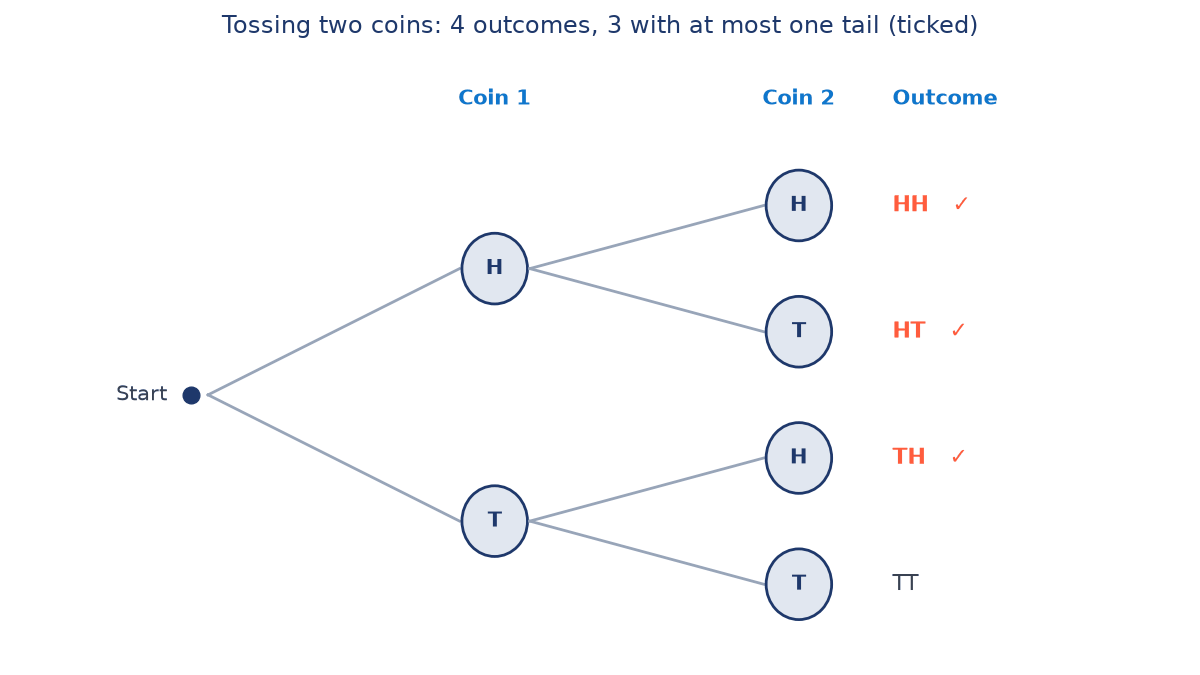
Two coins are tossed together. Find the prob­a­bil­ity of get­ting at most one tail.

The out­comes are HH, HT, TH, TT, so n=4n = 4. "At most one tail" means no tail or one tail: HH, HT, TH, so m=3m = 3.

P(at most one tail)=34.\displaystyle P(\text{at most one tail}) = \frac{3}{4}.

Tree diagram for two coins with H and T branches giving outcomes HH, HT, TH and TT; HH, HT and TH are ticked as having at most one tail
Ques­tion 5: three of the four out­comes have at most one tail.

Why this works: only TT has more than one tail, so the answer is also 1−14\displaystyle 1 - \frac{1}{4}.

Answer: 34\displaystyle \frac{3}{4}

Ques­tion 6

Three coins are tossed. Find the prob­a­bil­ity of get­ting (a) at least one tail, (b) exactly one head, (c) all three coins show­ing the same face.

The 8 out­comes are HHH, HHT, HTH, HTT, THH, THT, TTH, TTT.

(a) Only HHH has no tail, so P=1−18=78\displaystyle P = 1 - \frac{1}{8} = \frac{7}{8}.

(b) Exactly one head: HTT, THT, TTH, so P=38\displaystyle P = \frac{3}{8}.

(c) Same face: HHH and TTT, so P=28=14\displaystyle P = \frac{2}{8} = \frac{1}{4}.

Answer: (a) 78\displaystyle \frac{7}{8} (b) 38\displaystyle \frac{3}{8} (c) 14\displaystyle \frac{1}{4}

Dice

Ques­tion 7

A die is rolled once. Find the prob­a­bil­ity of get­ting (a) a fac­tor of 6, (b) a num­ber greater than 6.

(a) The fac­tors of 6 on a die are 1, 2, 3 and 6, so P=46=23\displaystyle P = \frac{4}{6} = \frac{2}{3}.

(b) No face is greater than 6, so this is an impos­si­ble event: P=0P = 0.

Answer: (a) 23\displaystyle \frac{2}{3} (b) 00

Ques­tion 8

Two dice are rolled together. Find the prob­a­bil­ity of get­ting (a) a sum of 8, (b) a dou­blet of even num­bers.

There are 36 out­comes.

(a) Sum 8: (2,6),(3,5),(4,4),(5,3),(6,2)(2,6), (3,5), (4,4), (5,3), (6,2), so P=536\displaystyle P = \frac{5}{36}.

(b) Even dou­blets: (2,2),(4,4),(6,6)(2,2), (4,4), (6,6), so P=336=112\displaystyle P = \frac{3}{36} = \frac{1}{12}.

Answer: (a) 536\displaystyle \frac{5}{36} (b) 112\displaystyle \frac{1}{12}

Ques­tion 9

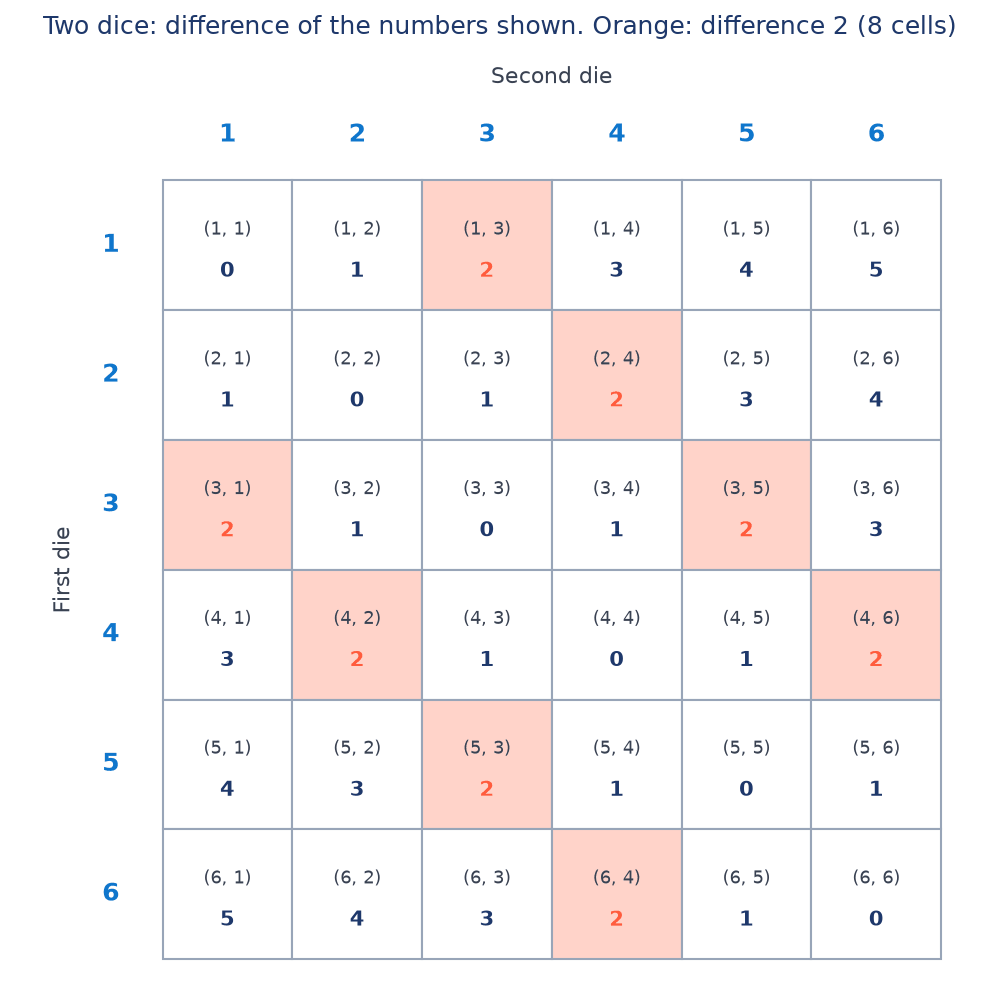
Two dice are rolled. Find the prob­a­bil­ity that the dif­fer­ence between the two num­bers is 2.

List the ordered pairs whose num­bers dif­fer by 2:

(1,3), (3,1), (2,4), (4,2), (3,5), (5,3), (4,6), (6,4).(1,3),\ (3,1),\ (2,4),\ (4,2),\ (3,5),\ (5,3),\ (4,6),\ (6,4).

That is 8 out­comes out of 36.

Six by six grid of two-dice outcomes showing the difference of the two numbers in each cell; the eight cells with difference 2 are shaded orange
Ques­tion 9: the eight out­comes with dif­fer­ence 2 lie on two lines par­al­lel to the diag­o­nal.

P(difference 2)=836=29.\displaystyle P(\text{difference } 2) = \frac{8}{36} = \frac{2}{9}.

Answer: 29\displaystyle \frac{2}{9}

Ques­tion 10

In a game, Meena rolls two dice. She wins if the prod­uct of the two num­bers is a per­fect square. Find the prob­a­bil­ity that she (a) wins, (b) does not win.

The pos­si­ble per­fect-square prod­ucts are 1, 4, 9, 16, 25 and 36.

  • Prod­uct 1: (1,1)(1,1).
  • Prod­uct 4: (1,4),(4,1),(2,2)(1,4), (4,1), (2,2).
  • Prod­uct 9: (3,3)(3,3).
  • Prod­uct 16: (4,4)(4,4).
  • Prod­uct 25: (5,5)(5,5).
  • Prod­uct 36: (6,6)(6,6).

That is 8 favourable out­comes.

P(win)=836=29,P(not win)=1−29=79.\displaystyle P(\text{win}) = \frac{8}{36} = \frac{2}{9}, \qquad P(\text{not win}) = 1 - \frac{2}{9} = \frac{7}{9}.

Why this works: every dou­blet gives a square prod­uct, and (1,4)(1,4), (4,1)(4,1) are the only non-dou­blets that do.

Answer: (a) 29\displaystyle \frac{2}{9} (b) 79\displaystyle \frac{7}{9}

Ques­tion 11

Two dice are rolled. Find the prob­a­bil­ity that (a) the sum is not 7, (b) the sum is greater than 9.

(a) Sum 7 occurs in 6 of the 36 out­comes, so P(sum 7)=16\displaystyle P(\text{sum } 7) = \frac{1}{6} and

P(sum not 7)=1−16=56.\displaystyle P(\text{sum not } 7) = 1 - \frac{1}{6} = \frac{5}{6}.

(b) Sum 10: 3 ways; sum 11: 2 ways; sum 12: 1 way. Total 6, so P=636=16\displaystyle P = \frac{6}{36} = \frac{1}{6}.

Answer: (a) 56\displaystyle \frac{5}{6} (b) 16\displaystyle \frac{1}{6}

Cards

Ques­tion 12

A card is drawn at ran­dom from a well-shuf­fled pack of 52 cards. Find the prob­a­bil­ity that it is (a) the queen of dia­monds, (b) not a face card, (c) a black card that is not a king.

(a) There is exactly one queen of dia­monds: P=152\displaystyle P = \frac{1}{52}.

(b) Cards that are not face cards: 52−12=4052 - 12 = 40, so P=4052=1013\displaystyle P = \frac{40}{52} = \frac{10}{13}.

(c) There are 26 black cards, of which 2 are kings, leav­ing 24. So P=2452=613\displaystyle P = \frac{24}{52} = \frac{6}{13}.

Answer: (a) 152\displaystyle \frac{1}{52} (b) 1013\displaystyle \frac{10}{13} (c) 613\displaystyle \frac{6}{13}

Ques­tion 13

All the clubs are removed from a pack of 52 cards. The remain­ing cards are shuf­fled and one is drawn. Find the prob­a­bil­ity that it is (a) red, (b) a king, (c) a club, (d) a face card.

Cards left: 52−13=3952 - 13 = 39 (spades, hearts, dia­monds).

(a) All 26 red cards remain: P=2639=23\displaystyle P = \frac{26}{39} = \frac{2}{3}.

(b) Kings left: 3, so P=339=113\displaystyle P = \frac{3}{39} = \frac{1}{13}.

(c) No clubs remain, so P=0P = 0.

(d) Face cards left: 3×3=93 \times 3 = 9, so P=939=313\displaystyle P = \frac{9}{39} = \frac{3}{13}.

Answer: (a) 23\displaystyle \frac{2}{3} (b) 113\displaystyle \frac{1}{13} (c) 00 (d) 313\displaystyle \frac{3}{13}

Balls, coins and num­bers

Ques­tion 14

A bag con­tains 4 red balls and some white balls. The prob­a­bil­ity of draw­ing a white ball is twice the prob­a­bil­ity of draw­ing a red ball. Find the num­ber of white balls.

Let there be xx white balls, so the total is 4+x4 + x.

P(white)=2×P(red)x4+x=2×44+xx=8.\displaystyle \begin{aligned} P(\text{white}) &= 2 \times P(\text{red}) \\ \frac{x}{4 + x} &= 2 \times \frac{4}{4 + x} \\ x &= 8. \end{aligned}

Mul­ti­ply­ing both sides of the sec­ond line by 4+x4 + x (which is pos­i­tive) gives x=8x = 8.

Check: with 12 balls, P(white)=812=23\displaystyle P(\text{white}) = \frac{8}{12} = \frac{2}{3} and P(red)=412=13\displaystyle P(\text{red}) = \frac{4}{12} = \frac{1}{3}; the first is twice the sec­ond and they add to 1.

Answer: 8 white balls

Ques­tion 15

A money box con­tains sixty ₹1 coins, thirty ₹2 coins, twenty-five ₹5 coins and five ₹10 coins. One coin falls out at ran­dom when the box is turned upside down. Find the prob­a­bil­ity that the coin (a) is a ₹5 coin, (b) is not a ₹10 coin, (c) is worth less than ₹5.

Total coins: 60+30+25+5=12060 + 30 + 25 + 5 = 120.

(a) There are 25 ₹5 coins, so P=25120=524\displaystyle P = \frac{25}{120} = \frac{5}{24}.

(b) Coins that are not ₹10: 120−5=115120 - 5 = 115, so P=115120=2324\displaystyle P = \frac{115}{120} = \frac{23}{24}.

(c) Coins worth less than ₹5 are the ₹1 and ₹2 coins: 60+30=9060 + 30 = 90, so P=90120=34\displaystyle P = \frac{90}{120} = \frac{3}{4}.

Answer: (a) 524\displaystyle \frac{5}{24} (b) 2324\displaystyle \frac{23}{24} (c) 34\displaystyle \frac{3}{4}

Ques­tion 16

An inte­ger xx is cho­sen at ran­dom from −4,−3,−2,−1,0,1,2,3,4-4, -3, -2, -1, 0, 1, 2, 3, 4. Find the prob­a­bil­ity that (a) x2≤4x^2 \leq 4, (b) x2>16x^2 \gt 16.

There are 9 equally likely val­ues.

(a) x2≤4x^2 \leq 4 holds for x=−2,−1,0,1,2x = -2, -1, 0, 1, 2, so P=59\displaystyle P = \frac{5}{9}.

(b) The largest value of x2x^2 is 16, so x2>16x^2 \gt 16 never holds: P=0P = 0.

Answer: (a) 59\displaystyle \frac{5}{9} (b) 00

Ques­tion 17

A lot of 150 LED bulbs con­tains 120 good bulbs, 21 slightly dim bulbs and 9 faulty bulbs. Shop­keeper A buys a bulb only if it is good, while shop­keeper B buys a bulb unless it is faulty. One bulb is taken out at ran­dom. Find the prob­a­bil­ity that (a) A will buy it, (b) B will buy it, (c) it is faulty.

(a) A buys only the 120 good bulbs:

P(A buys)=120150=45.\displaystyle P(\text{A buys}) = \frac{120}{150} = \frac{4}{5}.

(b) B buys good or dim bulbs, 120+21=141120 + 21 = 141 of them:

P(B buys)=141150=4750.\displaystyle P(\text{B buys}) = \frac{141}{150} = \frac{47}{50}.

(c) P(faulty)=9150=350\displaystyle P(\text{faulty}) = \frac{9}{150} = \frac{3}{50}. As a check, "B buys" and "faulty" are com­ple­men­tary: 4750+350=1\displaystyle \frac{47}{50} + \frac{3}{50} = 1.

Answer: (a) 45\displaystyle \frac{4}{5} (b) 4750\displaystyle \frac{47}{50} (c) 350\displaystyle \frac{3}{50}

Ques­tion 18

Cards num­bered 1 to 40 are placed in a box and one is drawn at ran­dom. Find the prob­a­bil­ity that the num­ber is (a) a prime num­ber, (b) not a mul­ti­ple of 3.

(a) Primes up to 40: 2, 3, 5, 7, 11, 13, 17, 19, 23, 29, 31, 37, which is 12 num­bers.

P(prime)=1240=310.\displaystyle P(\text{prime}) = \frac{12}{40} = \frac{3}{10}.

(b) Mul­ti­ples of 3 up to 40: 3,6,…,393, 6, \ldots, 39, which is 13 num­bers. So

P(not a multiple of 3)=1−1340=2740.\displaystyle P(\text{not a multiple of } 3) = 1 - \frac{13}{40} = \frac{27}{40}.

Answer: (a) 310\displaystyle \frac{3}{10} (b) 2740\displaystyle \frac{27}{40}

Key terms

Equally likely
Out­comes that each have the same chance of occur­ring.
Favourable out­come
An out­come that makes the event in ques­tion hap­pen.
Impos­si­ble event
An event with prob­a­bil­ity 0, such as a sum of 13 on two dice.
Sure event
An event with prob­a­bil­ity 1.
Com­ple­men­tary events
An event and its "not" event, whose prob­a­bil­i­ties add to 1.
Dou­blet
An out­come of two dice with the same num­ber on both.
Face card
A jack, queen or king of any suit.

Com­mon ques­tions

How much work­ing should I show for a one-mark ques­tion?

Write the total num­ber of out­comes, the favourable out­comes, and the frac­tion. That short line is enough to earn the mark and to let you check your count.

Should I leave the answer as a frac­tion or a dec­i­mal?

Give a frac­tion in low­est terms unless the ques­tion uses dec­i­mals. Both are cor­rect if they are equal.

How do I avoid miss­ing out­comes with two dice?

Draw or imag­ine the 6 by 6 grid and go row by row. Remem­ber that (a,b)(a, b) and (b,a)(b, a) are sep­a­rate out­comes when a≠ba \neq b.

When is the com­ple­ment quicker?

When­ever the ques­tion says "not", "at least one" or "does not win". Count the oppo­site event, which is usu­ally smaller, and sub­tract its prob­a­bil­ity from 1.

Ref­er­ences

  1. National Coun­cil of Edu­ca­tional Research and Train­ing. Math­e­mat­ics: Text­book for Class X. NCERT, New Delhi.
  2. Sharma, R. D. Math­e­mat­ics for Class 10. Dhan­pat Rai Pub­li­ca­tions.
  3. Aggar­wal, R. S. Sec­ondary School Math­e­mat­ics for Class 10. Bharati Bhawan.