Not all tuition centres are alike, and in mathematics the difference shows quickly. In areas like Poranki, Vijayawada, where students have several coaching options, the real question is not “Which tuition is available?” but “Which one actually helps students understand maths?”
This guide is for parents and students who keep hearing that a particular tutorial is “popular” and want to know what that should mean. It explains what genuine popularity in education rests on, how maths teaching has been changing, why Expresswala Academy describes itself as among the popular choices, and, most usefully, how to test any tutorial yourself during a demo class.
Popular does not mean crowded; it means effective
Many people assume that a popular tuition centre is simply one with more students. In practice, lasting popularity in education is built on:
- Consistent student results
- Concept clarity, not rote learning
- Improvement in student confidence
- Parent satisfaction
Institutes that deliver these outcomes tend to gain trust and recognition over time. A crowded room, on the other hand, can be a warning sign if it means doubts go unanswered.
The shift in how students learn maths
Traditional tuition often centred on memorising formulas and repeating similar problems. Coaching centres in Vijayawada are changing, and the stronger maths tutorials now emphasise:
- Concept-first teaching
- Real-life application of maths
- Logical thinking and reasoning
- Step-by-step problem solving
This shift is one reason some institutes stand out more than others.
Why Expresswala Academy is among the popular choices
Among the tutorials in Poranki, Expresswala Academy states that it has gained strong recognition for its teaching style and consistent academic results. It describes six reasons.
1. Concept clarity over memorisation
Students are taught why a formula works, not just how to apply it, which the academy says improves long-term understanding and reduces exam anxiety.
2. Structured learning from Class 2 to 12
The academy offers a complete academic path from basic arithmetic to advanced mathematics, so that students do not feel lost at higher levels.
3. Small batches
Unlike overcrowded coaching centres, smaller batches allow individual attention, faster doubt resolution and a personalised learning pace. The academy names this as a key reason for improved performance.
4. An activity-based learning approach
Maths is about logic as well as numbers. The academy uses interactive activities, visual explanations and guided problem-solving to keep learning engaging.
5. A strong focus on competitive exams
Students are prepared for IIT-JEE, EAMCET and Olympiads, giving a dual focus on school and competitive exams.
6. Track record and student trust
With 1,200+ students taught and strong reviews, the academy states that it has built a solid reputation in Poranki.
Five checks for any maths tutorial
Before choosing a tuition centre, students and parents should evaluate these five points. They apply to every centre, including the one described above.
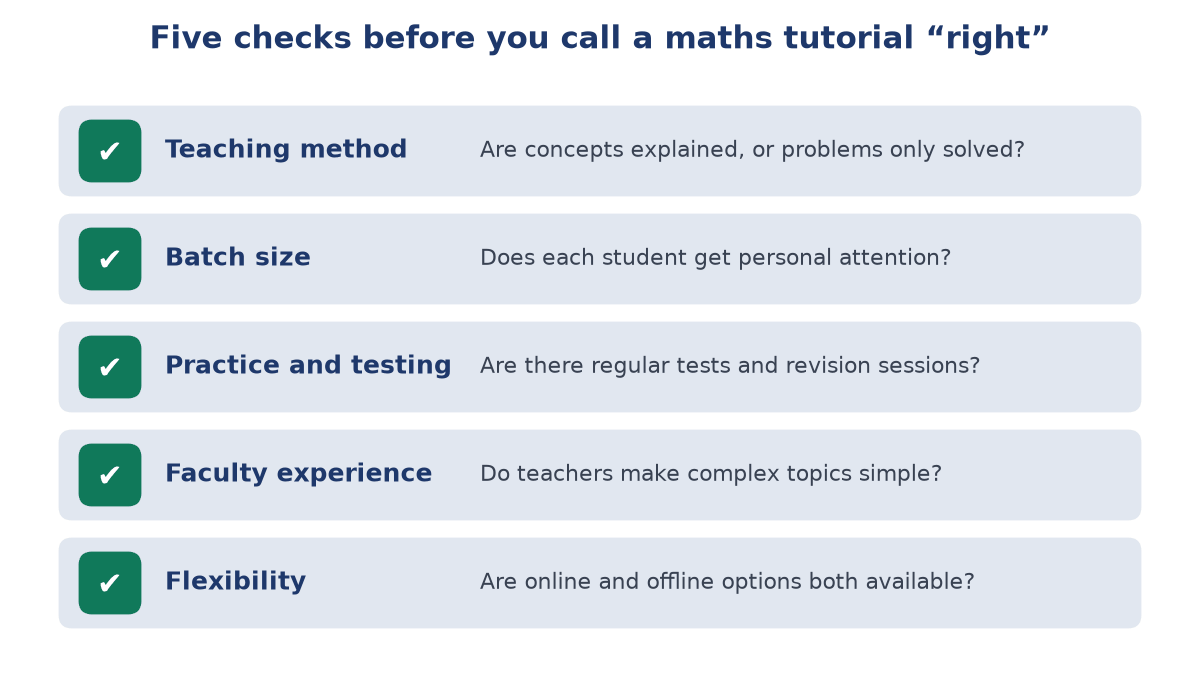
- Teaching method. Does the tutor explain concepts, or just solve problems on the board?
- Batch size. Are students getting personal attention?
- Practice and testing. Are there regular tests and revision sessions?
- Faculty experience. Do teachers make complex topics simple?
- Flexibility. Are online and offline options available?
Institutes that satisfy all five tend to become popular for the right reasons.
How to use a demo class as a test
The academy suggests that the best way to choose is to experience the teaching. A demo class is most useful when you go in with a plan.
- Before: ask your child to bring one topic they currently find confusing.
- During: notice whether the teacher asks students questions, or only talks. Notice whether your child is given a chance to try a problem alone.
- Watch the doubts: see how a wrong answer is handled. A calm correction that explains the error is a good sign.
- After: ask your child to explain one idea from the class. If they can, some real teaching happened.
- Compare fairly: if you try more than one centre, use the same five checks for each.
Popular tutorials versus the right tutorial
An important point: the most popular tuition is not always the best one for a particular child. The right one is the one that fits your child’s learning style. A good maths tutorial should:
- Remove the fear of mathematics
- Build confidence step by step
- Encourage curiosity and questioning
Expresswala Academy states that it aligns closely with these principles, which it gives as the reason for its growing popularity among students in Vijayawada.
Common mistakes
- Choosing a centre only because many classmates go there.
- Treating a large batch as proof of quality.
- Believing claims without attending a demo class.
- Asking only about results and never about teaching method.
- Ignoring your child’s own opinion after the trial class.
- Comparing centres on different criteria, which makes the comparison unfair.
Final thoughts
When you search for popular maths tutorials in Poranki, Vijayawada, look beyond names and numbers. Focus on the quality of teaching, student outcomes and the learning experience. Expresswala Academy describes itself as one of the most trusted and preferred maths coaching centres in the region, citing its concept-driven approach, experienced faculty and student-first method. The fairest way to decide is to attend a demo class and see the teaching for yourself.
Key terms
- Tutorial
- A local term for a private coaching centre that supports school or college study.
- Concept-first teaching
- Teaching why a method works before drilling how to use it.
- Batch
- A group of students taught together at a fixed time.
- Revision session
- A class that returns to earlier topics to fix them in memory before an exam.
- IIT-JEE
- The Joint Entrance Examination used for admission to engineering programmes, including the Indian Institutes of Technology.
- EAMCET
- The state-level entrance test for engineering, agriculture and pharmacy courses, now known in Andhra Pradesh as EAPCET.
- Olympiad
- A competition that tests reasoning and problem-solving beyond the usual syllabus.
Common questions
Does “popular” mean the best?
Not necessarily. Popularity built on results, clarity, confidence and parent satisfaction is meaningful, but the right tutorial is the one that suits your child’s learning style.
What should I check first?
Start with the teaching method: whether concepts are explained or problems are simply solved. Then check batch size, practice and testing, faculty and flexibility.
Which classes does Expresswala Academy teach?
The academy states that it offers structured learning from Class 2 to 12.
Which competitive exams does it prepare students for?
IIT-JEE, EAMCET and Olympiads, alongside school exams.
How can I judge a centre before paying?
Attend a demo class with a clear plan, watch how doubts are handled, and ask your child to explain what they learned afterwards.
References
- National Council of Educational Research and Training. Mathematics textbooks for Classes IX–XII. NCERT, New Delhi.
- National Testing Agency. Joint Entrance Examination (Main) information bulletin. NTA, New Delhi.
- Board of Intermediate Education, Andhra Pradesh. Intermediate courses and examinations. BIEAP, Vijayawada.