Mathematics is often seen as the most feared subject among students. Usually that is not because the subject is inherently difficult, but because it has been taught without clarity. In areas like Poranki, Vijayawada, many students struggle with maths not for lack of effort but because of gaps in understanding.
This guide takes a problem-first view. Before comparing tuition points, it helps to work out why your child is struggling, because the right remedy depends on the cause. We look at the common root causes, what good tuition does about each, how Expresswala Academy describes its own approach, and how you can check at home whether tuition is working.
The real problem: why students struggle with maths
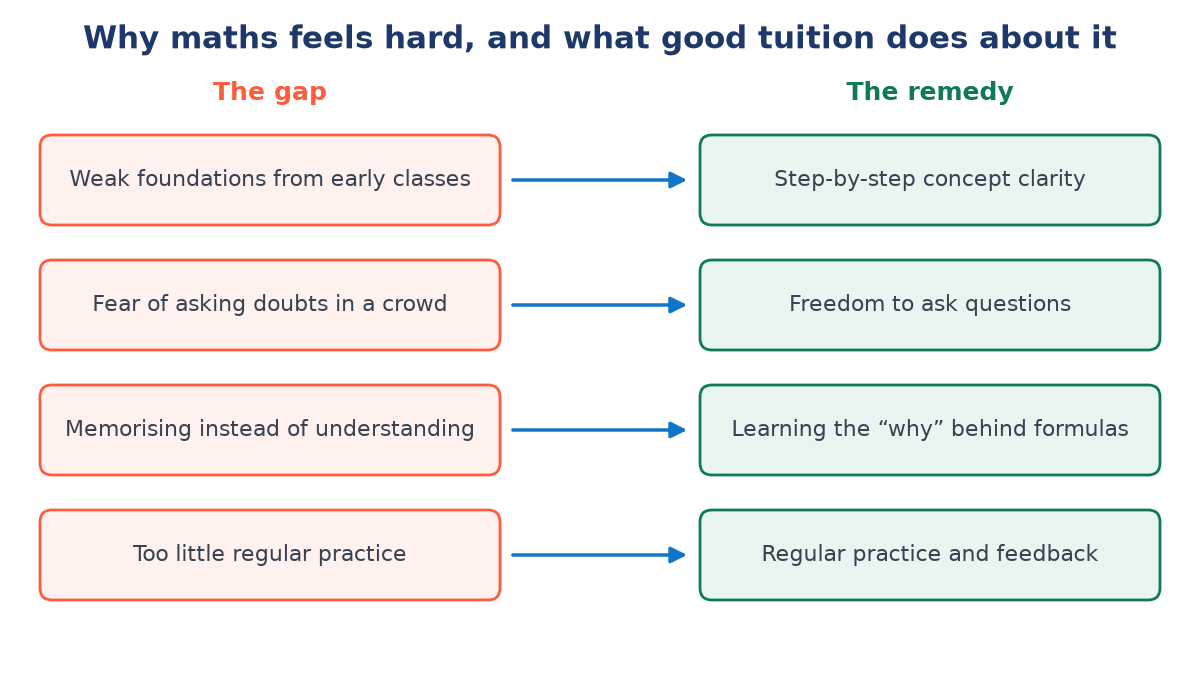
Before choosing a tuition centre, it is worth understanding the usual root causes:
- Weak foundational concepts from early classes
- Fear of asking doubts in crowded classrooms
- Memorisation instead of understanding
- Lack of consistent practice
Once these gaps form, maths starts to feel overwhelming, even for capable students. Each new topic rests on an older one, so a small gap can quietly grow year after year.
How to diagnose the gap at home
You do not need to be a maths teacher to spot the pattern. Try these simple checks over a week.
- Ask for an explanation, not an answer. Pick a solved homework problem and ask your child to explain each step aloud. If they can do the steps but not say why, the gap is understanding rather than effort.
- Go back one year. Give a short question from an earlier class on the same topic. If that also causes trouble, the gap is in the foundation.
- Watch what happens with a doubt. Ask whether they raised their hand in class recently. Reluctance to ask is a common and fixable cause.
- Look at the notebook. Long gaps between practice dates, or only copied class examples, point to a practice problem.
- Change the question slightly. If a small change in numbers or wording stops them, they may be memorising patterns.
Write down what you find. It will help you explain your child’s needs clearly when you visit any tuition point.
The right tuition can change the picture
A good tuition centre does not just teach formulas; it rebuilds the student’s approach to learning maths. At a high-quality tuition point, students should experience:
- Step-by-step concept clarity
- Freedom to ask questions
- Regular practice and feedback
- Confidence-building teaching methods
This is where, according to this site, institutes like Expresswala Academy have made a noticeable difference in Poranki.
What Expresswala Academy says it does differently
The academy describes its aim as changing how students think about maths, rather than only adding extra classes.
1. From basics to brilliance
Students from Classes 2 to 12 are guided in a structured way, so that no concept is skipped or rushed. The intention is a strong mathematical foundation from an early stage.
2. Learning beyond textbooks
Instead of only repetitive problem-solving, students engage in activity-based learning, guided problem-solving techniques and logical reasoning exercises, which the academy says make maths more intuitive and less stressful.
3. A concept-first teaching method
Every topic is explained from the ground up, so that students understand the “why” behind formulas. This is described as improving retention and problem-solving ability.
4. Personal attention in small batches
Smaller batches allow teachers to identify weak areas quickly, give personalised guidance and track progress, which the academy links to consistent improvement.
5. Preparation for school and competitive exams
Students are trained for school exams and also for IIT-JEE foundation, EAMCET and Olympiads.
6. Flexible learning options
Both offline classes in Poranki and live online sessions are offered, so students can learn in the way that suits their schedule and comfort.
An environment that builds confidence
A good tuition point also creates the right atmosphere. At Expresswala Academy, as described on this site, students are encouraged to ask questions, mistakes are treated as learning opportunities, and learning happens without pressure. This atmosphere plays a key role in removing the fear of maths.
Who should join a maths tuition point in Poranki?
Structured coaching of this kind suits:
- Students struggling with basics
- Students aiming for high scores
- Competitive exam aspirants
- Students lacking confidence in maths
Whether a student is weak or already doing well, the right guidance can take them to the next level.
How to tell whether tuition is working
Marks move slowly, so look for earlier signs as well. With the right support, the academy lists these outcomes: strong conceptual clarity, faster problem-solving, better academic performance, confidence in exams and long-term success in maths. At home you can watch for smaller signals:
- Your child starts homework without being pushed.
- They can explain a method in their own words.
- They attempt an unfamiliar question instead of leaving it blank.
- They mention asking a doubt in class.
- Mistakes are repeated less often.
Over time, maths can shift from being a “difficult subject” to a scoring strength.
Questions to ask before you enrol
- How will you find out where my child’s gaps begin?
- What happens when a student is too shy to ask a doubt?
- How much practice is set between classes, and who checks it?
- How will I hear about progress, and how often?
- Can we attend a demo class first?
Common mistakes
- Assuming a low mark means low effort, without looking for the underlying gap.
- Adding more hours of the same kind of teaching that already did not work.
- Pushing ahead to new chapters while earlier concepts are still unclear.
- Scolding mistakes, which makes a child less likely to ask questions.
- Stopping tuition as soon as marks improve, before the habit of practice is settled.
Final thoughts
Choosing a maths tuition point in Poranki, Vijayawada, is not just about extra classes; it is about giving a student the right direction. With its concept-based teaching, activity-driven learning and student-focused approach, Expresswala Academy describes itself as a trusted choice for many families in Poranki. If your goal is understanding and confidence as well as marks, find the gap first, then choose the tuition that addresses it. The academy invites students to enrol for a demo class and experience its way of teaching.
Key terms
- Foundational concept
- An idea from an earlier class, such as place value or fractions, that later topics depend on.
- Rote learning
- Memorising steps or answers without understanding why they work.
- Concept-first teaching
- Explaining why a method works before practising how to use it.
- Diagnostic test
- A short test used to find where a student’s understanding breaks down, rather than to award marks.
- NCERT
- The National Council of Educational Research and Training, which publishes the national model textbooks used in many schools.
- JEE foundation
- Early preparation, usually during school, that builds the skills later needed for the Joint Entrance Examination.
Common questions
Why does my child find maths hard even after working hard?
Common causes include weak foundations from earlier classes, fear of asking doubts, memorising instead of understanding, and a lack of consistent practice. Effort alone does not close these gaps.
Which classes does Expresswala Academy guide?
According to this article, students from Classes 2 to 12.
Does the academy prepare students for entrance exams?
Yes. It lists IIT-JEE foundation, EAMCET and Olympiads alongside school exams.
Can my child learn online?
The academy offers both offline classes in Poranki and live online sessions.
Is tuition only for weak students?
No. Structured coaching is described as suitable both for students struggling with basics and for those aiming for high scores or competitive exams.
References
- National Council of Educational Research and Training. Mathematics textbooks for Classes IX–XII. NCERT, New Delhi.
- Central Board of Secondary Education. Curriculum for Secondary and Senior Secondary Classes. CBSE, New Delhi.
- National Testing Agency. Joint Entrance Examination (Main) information bulletin. NTA, New Delhi.