Finding the right maths tutor is not only a matter of convenience. It is about choosing someone who can change the way a student understands and approaches mathematics, and that choice can shape a child's attitude to the subject for years.
If you are asking, "Where can I find the best maths tutor in Poranki?", you have already taken the first step towards better results. This guide is written for parents and students in Poranki and nearby Vijayawada who are starting that search and want a practical way to go about it.
It covers what "best" should actually mean for a maths tutor, one well-known local option, a step-by-step way to search, the questions worth asking, and the mistakes that make families switch tutors halfway through the year.
What does "best maths tutor" actually mean?
Before choosing a tutor, it helps to be clear about what makes one the best. It is not only about qualifications; it is about impact on the student. A tutor with impressive credentials who cannot explain an idea at the student's level will not help much.
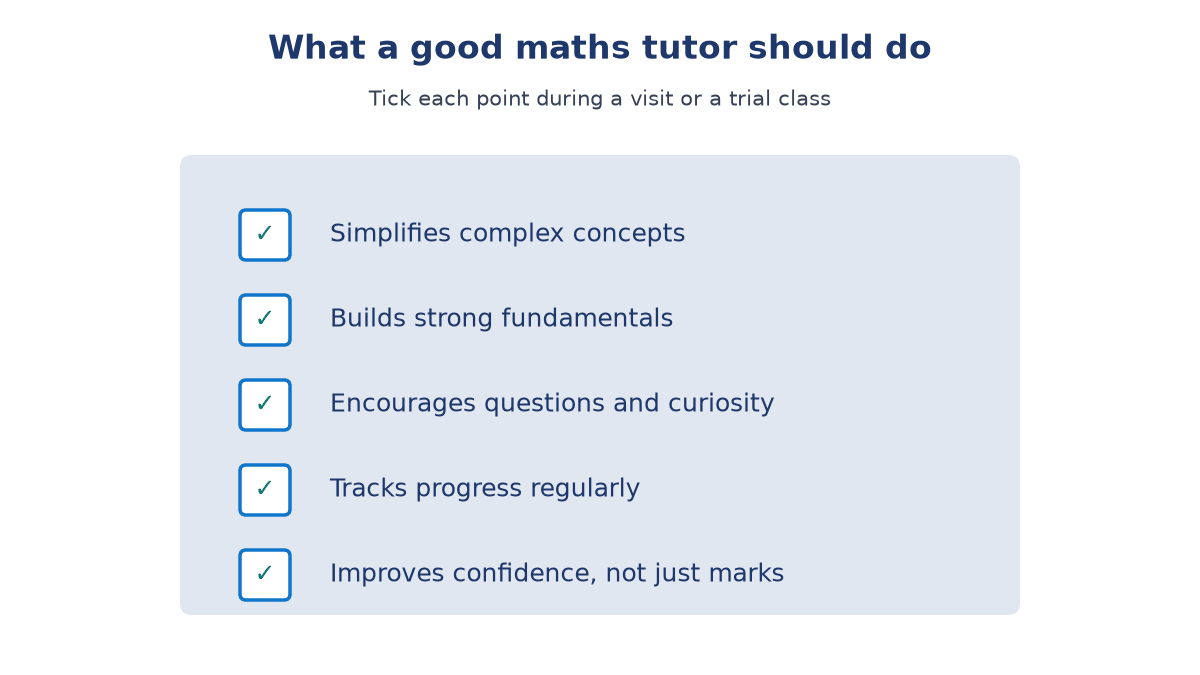
A great maths tutor should:
- Simplify complex concepts
- Build strong fundamentals
- Encourage questions and curiosity
- Track progress regularly
- Improve confidence, not just marks
In places like Poranki and Vijayawada, where several tuition options exist, this distinction becomes important. Two tutors can cover the same syllabus in very different ways, and only one of them may suit your child.
Maths tutors and tuition centres in Poranki
Here is a well-known option that students and parents consider.
Expresswala Academy
Expresswala Academy is one of the most trusted names in Poranki for mathematics coaching. It is known for:
- A concept-based teaching approach
- Classes from 2nd to 12th standard
- IIT-JEE, EAMCET and Olympiad preparation
- Small batches with personal attention
The academy focuses on building strong foundations and logical thinking rather than rote learning, which helps students perform consistently well.
Where to look: a step-by-step search
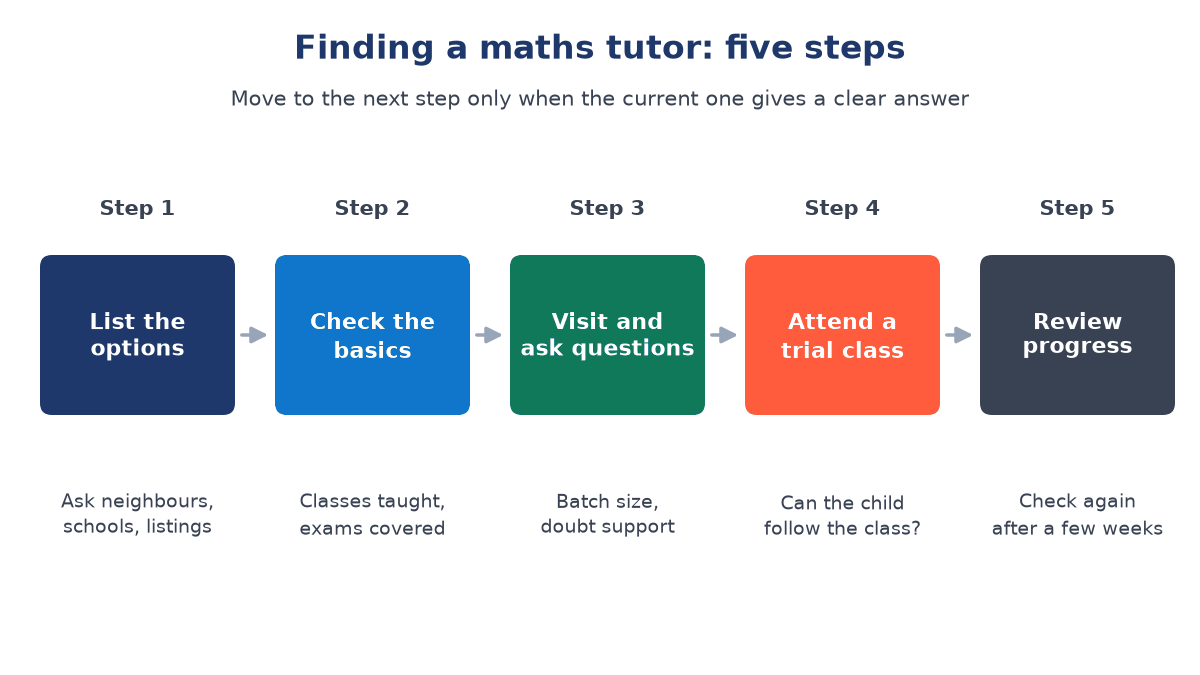
A calm, ordered search usually gives a better result than choosing the first name someone mentions. The steps below work for any tutor or tuition centre.
- List the options. Ask neighbours, other parents in your child's class, and teachers. Local business listings and the tutor's own website help you build a first list.
- Check the basics. Confirm which classes the tutor teaches, which syllabus they follow, and whether they prepare students for the exams your child will face, such as school board exams or entrance tests.
- Visit and ask questions. See the place where classes happen. Ask about batch size, how doubts are handled and how progress is reported to parents.
- Attend a trial class. If a trial or demonstration class is offered, let your child attend. What matters most is whether the child can follow the explanation.
- Review progress. After a few weeks, look at class notes, corrected work and test papers, and talk to your child about how the classes feel.
Matching the tutor to the student
The best tutor for one child may not be the best for another. Think about where your child is today:
- A primary school child usually needs patience, number sense and a friendly setting more than speed.
- A middle or high school student needs clear explanations of algebra and geometry and regular written practice.
- A senior student preparing for board exams or entrance tests needs a tutor who can handle harder problems and manage time well in tests.
- An Olympiad aspirant needs problems that go beyond the textbook and a tutor who enjoys puzzles and reasoning.
When you speak to a tutor, describe your child honestly: strong areas, weak areas, and how they react when stuck. A good tutor will tell you plainly whether they can help.
Questions to ask before you enrol
- Which classes and syllabuses do you teach, and which exams do you prepare students for?
- How many students are in a batch, and how do you give individual attention?
- How do you explain a topic a student has already failed to understand at school?
- How and when are doubts cleared?
- How do you track progress, and how will parents hear about it?
- Is there a trial class before we commit?
- What should the student do at home between classes?
Common mistakes
- Choosing only by distance or by what a friend's child joined, without checking whether the teaching suits your child.
- Judging a tutor only by marks claims instead of by how clearly they explain.
- Skipping the trial class, or not asking the child what they thought of it.
- Expecting results in a few weeks when the real problem is a weak foundation from earlier classes.
- Never checking notebooks or test papers after enrolment.
- Switching tutors often, which breaks continuity and leaves new gaps.
Key terms
- Concept-based teaching
- Teaching that explains why a method works, so a student can apply it to unfamiliar questions instead of memorising steps.
- Rote learning
- Memorising procedures or answers without understanding them; it tends to fail when a question is framed differently.
- Batch
- The group of students taught together in one class. Smaller batches usually allow more individual attention.
- IIT-JEE
- The Joint Entrance Examination used for admission to engineering programmes, including the Indian Institutes of Technology.
- EAMCET
- The state-level entrance test used for admission to engineering and related courses in Andhra Pradesh and Telangana.
- Olympiad
- A competition that tests mathematical reasoning and problem solving beyond the regular school syllabus.
- Trial class
- A sample class a student attends before enrolling, to see whether the teaching style suits them.
Common questions
Which classes does Expresswala Academy teach?
The academy offers classes from 2nd to 12th standard, along with IIT-JEE, EAMCET and Olympiad preparation.
How is the teaching at Expresswala Academy described?
It is described as concept-based, with small batches and personal attention, and a focus on strong foundations and logical thinking rather than rote learning.
Should I choose a tutor near home?
Distance matters because regular attendance matters, but it should not be the only reason. Check the teaching first, then weigh travel time.
How soon should I expect improvement?
It depends on how large the gaps are. Look first for signs such as fewer repeated mistakes and more willingness to attempt problems; marks often follow later.
Is a small batch better than one-to-one tuition?
Both can work. A small batch adds peer learning and some healthy pressure, while one-to-one suits a student who needs a very different pace. Ask how the tutor handles individual needs either way.
References
- National Council of Educational Research and Training. Mathematics textbooks for Classes IX–XII. NCERT, New Delhi.
- Board of Secondary Education, Andhra Pradesh. SSC examinations. BSEAP, Vijayawada.
- Board of Intermediate Education, Andhra Pradesh. Intermediate courses and examinations. BIEAP, Vijayawada.
- National Testing Agency. Joint Entrance Examination (Main) information bulletin. NTA, New Delhi.