If someone tells you an auto-rickshaw went a certain distance, you still do not know where it ended up. You need the direction too. Quantities like displacement, velocity and force carry both a size and a direction, and we call them vectors. In this chapter you will meet the different kinds of vectors, add them with the triangle law, multiply them by scalars, write them in components as ai^+bj^+ck^, and use the section formula in vector form.
A vector is a directed line segment AB with magnitude ∣AB∣ and a direction. You will come across these types: zero (magnitude 0), unit (magnitude 1), equal (same magnitude and direction), collinear (parallel), negative of a (same size, opposite direction).
Direction cosines. Suppose r makes angles α,β,γ with the axes. Then l=cosα, m=cosβ, n=cosγ are its direction cosines, and l2+m2+n2=1.
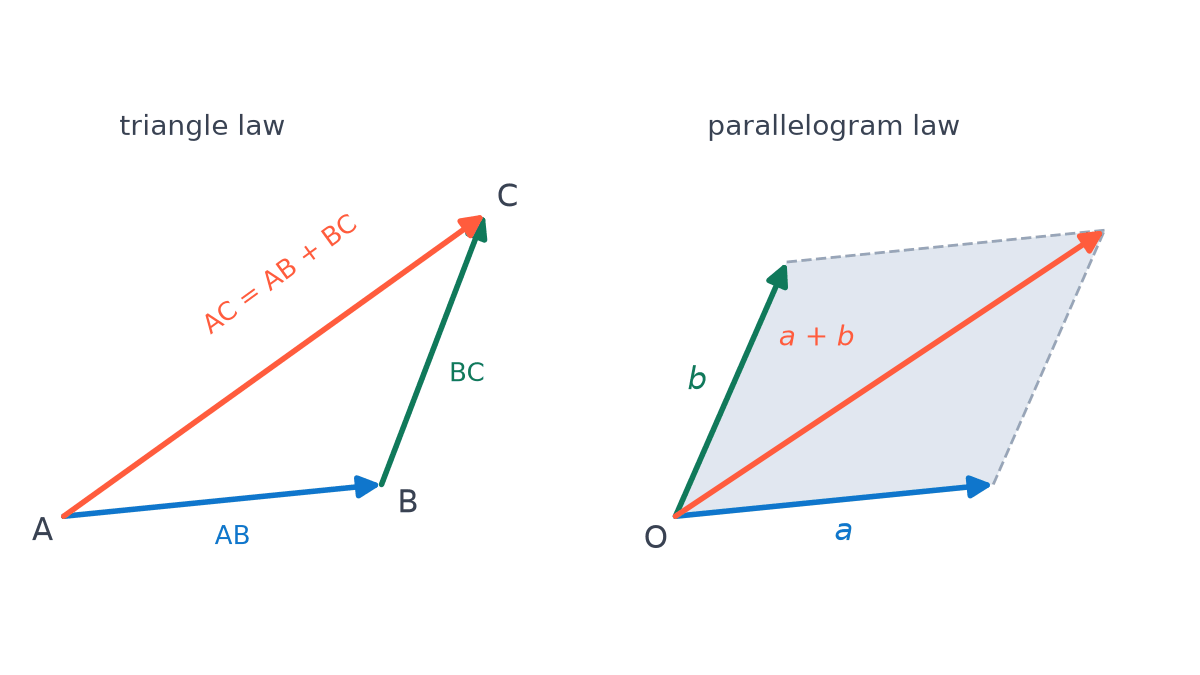
Triangle law:AB+BC=AC. Parallelogram law: if two vectors start from the same point, their sum is the diagonal of the parallelogram they make. Vector addition is both commutative and associative. For any scalar, ∣ka∣=∣k∣∣a∣; and the direction flips when k<0. To get the unit vector along a, just divide by its length: a^=∣a∣a.
Triangle law and parallelogram law: two views of the same sum.
Let i^,j^,k^ be unit vectors along the axes. Then the position vector of P(x,y,z) is r=xi^+yj^+zk^, ∣r∣=x2+y2+z2, and its direction cosines are rx,ry,rz.
PQ = position vector of Q − position vector of P. In other words, the end point minus the starting point. Adding and scaling vectors is done one component at a time.
Example 1. For a=2i^−j^+2k^, we get ∣a∣=3, a^=31(2i^−j^+2k^), and direction cosines 32,−31,32.
Example 2. With P(1,3,−2) and Q(4,−1,10), PQ=3i^−4j^+12k^, which has length 13.
Example 3. If a=i^+2j^−k^ and b=3i^−j^+2k^, then 2a−b=−i^+5j^−4k^.
Example 4. To get a vector of magnitude 10 along 3i^+4k^, take the unit vector and stretch it: 10⋅53i^+4k^=6i^+8k^.
Collinearity.a and b are collinear when b=λa for some number. Three points A,B,C lie on one line when AB and BC are collinear.
Example 5. Take A(1,2,3), B(3,5,4), C(7,11,6). Then AB=2i^+3j^+k^, BC=4i^+6j^+2k^=2AB, so the points are collinear.
This is the same section formula you know from coordinate geometry, now in vector language. The point dividing AB (position vectors a, b) internally in m:n has position vector m+nmb+na; and externally, it is m−nmb−na. The midpoint is simply 2a+b.
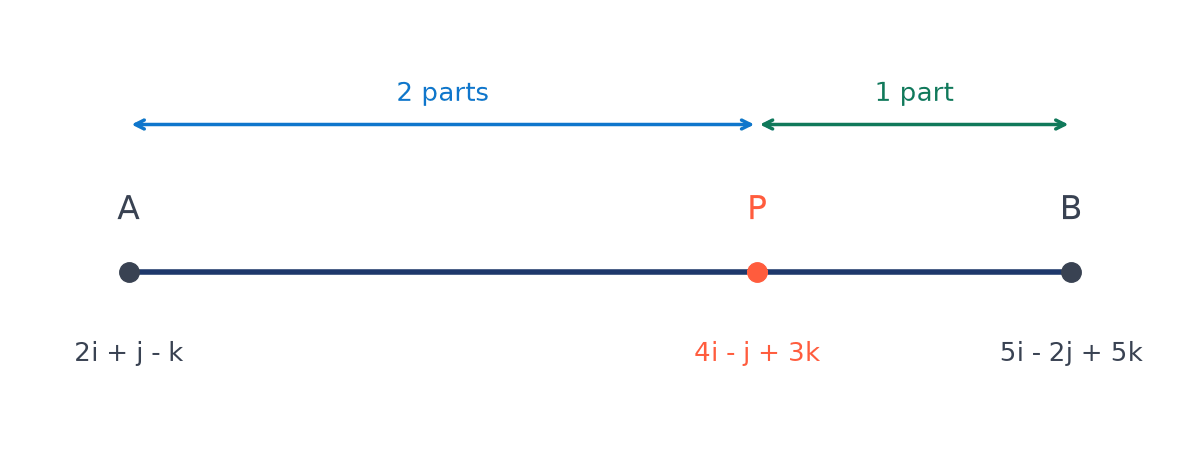
Example 6.a=2i^+j^−k^, b=5i^−2j^+5k^, divided internally in the ratio 2:1, gives 32b+a=4i^−j^+3k^.
Example 6: P divides AB internally in the ratio 2 : 1.