You can multiply two vectors in two different ways, and each one answers a different question. The scalar (dot) product gives you a plain number, and it tells you about the angle between the vectors. The vector (cross) product gives you a new vector standing perpendicular to both, and its length turns out to be an area. We will define both, use them to find angles, projections, perpendicular directions and areas, and finish with mixed practice.
It is commutative and distributive, so it behaves much like ordinary multiplication.
The projection of a on b is ∣b∣a⋅b.
Example 1.a=i^+2j^+2k^, b=2i^−j^+2k^. Then a⋅b=2−2+4=4, so cosθ=3⋅34=94, and the projection of a on b is 34.
Example 2. For what λ are 2i^+λj^+k^ and i^−2j^+3k^ perpendicular? Set the dot product to zero: 2−2λ+3=0, which gives λ=25.
Example 3. A very useful identity is ∣a+b∣2=∣a∣2+2a⋅b+∣b∣2. If ∣a∣=3, ∣b∣=4 and ∣a+b∣=5, then a⋅b=0, so the vectors are perpendicular. Does that remind you of Pythagoras?
a×b=∣a∣∣b∣sinθn^, where n^ is the unit vector perpendicular to both, chosen by the right-hand rule. Curl the fingers of your right hand from the first vector to the second, and your thumb points along it. In components,
a×b=i^a1b1j^a2b2k^a3b3.
b×a=−a×b; a×a=0; i^×j^=k^, j^×k^=i^, k^×i^=j^.
a×b=0⟺ the vectors are parallel, or one of them is zero.
∣a×b∣ gives the area of the parallelogram on a and b, and half of it gives the area of the triangle.
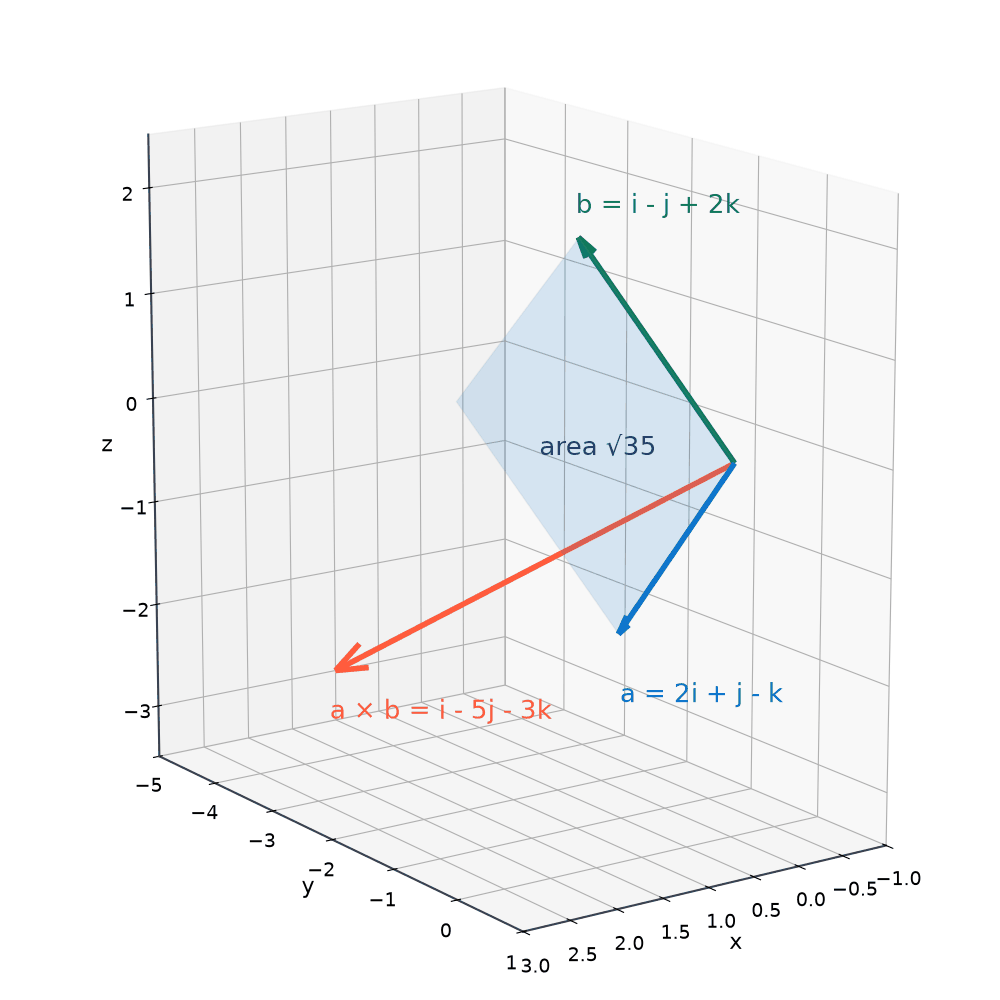
Example 4.a=2i^+j^−k^, b=i^−j^+2k^. Then a×b=(2−1)i^−(4+1)j^+(−2−1)k^=i^−5j^−3k^, and the parallelogram has area 35.
a x b is perpendicular to both vectors; its length is the parallelogram area.
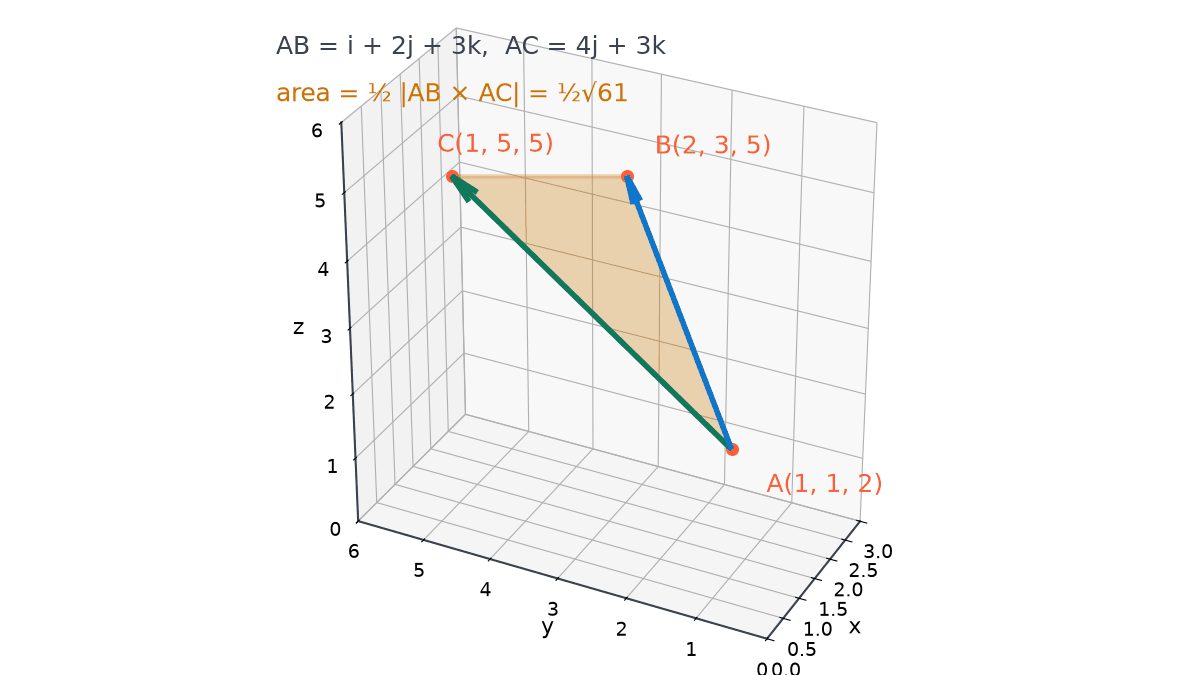
Example 5. Let us find the area of the triangle A(1,1,2), B(2,3,5), C(1,5,5). Here AB=i^+2j^+3k^, AC=4j^+3k^. Their cross product is −6i^−3j^+4k^, so the area is 2161.
The triangle area is half the length of AB x AC.
Example 6. For a unit vector perpendicular to both vectors of Example 4, just divide their cross product by its length: 351(i^−5j^−3k^).