Doing the best with what you have
A factory has only so many workers and so much material, and wants the biggest profit it can get. A diet has to supply enough nutrients while costing as little as possible. When the goal and all the limits are linear, something remarkable happens: the best choice always sits at a corner of the region the limits allow. We will learn to set up such linear programming problems, solve them by checking the corners, and practise on the kinds of problems you will meet in exams.
Setting up the problem
Every linear programming problem has three parts:
- decision variables ;
- a linear objective function to maximise or minimise;
- linear constraints (inequalities).
The points that satisfy every constraint form the feasible region. Each of those points is a feasible solution, and the best of them is the optimal solution.
Corner-point theorem. If an optimal value exists at all, it occurs at a corner (vertex) of the feasible region. And if the region is bounded, you are guaranteed both a maximum and a minimum.
The corner-point method, step by step
- Graph the constraints and shade the feasible region.
- Find its corner points.
- Evaluate at each corner.
- For a bounded region, the largest value is the maximum and the smallest the minimum. An unbounded region needs one extra check: a candidate value is truly the maximum only if the half-plane does not meet the feasible region (and similarly for a minimum with ).
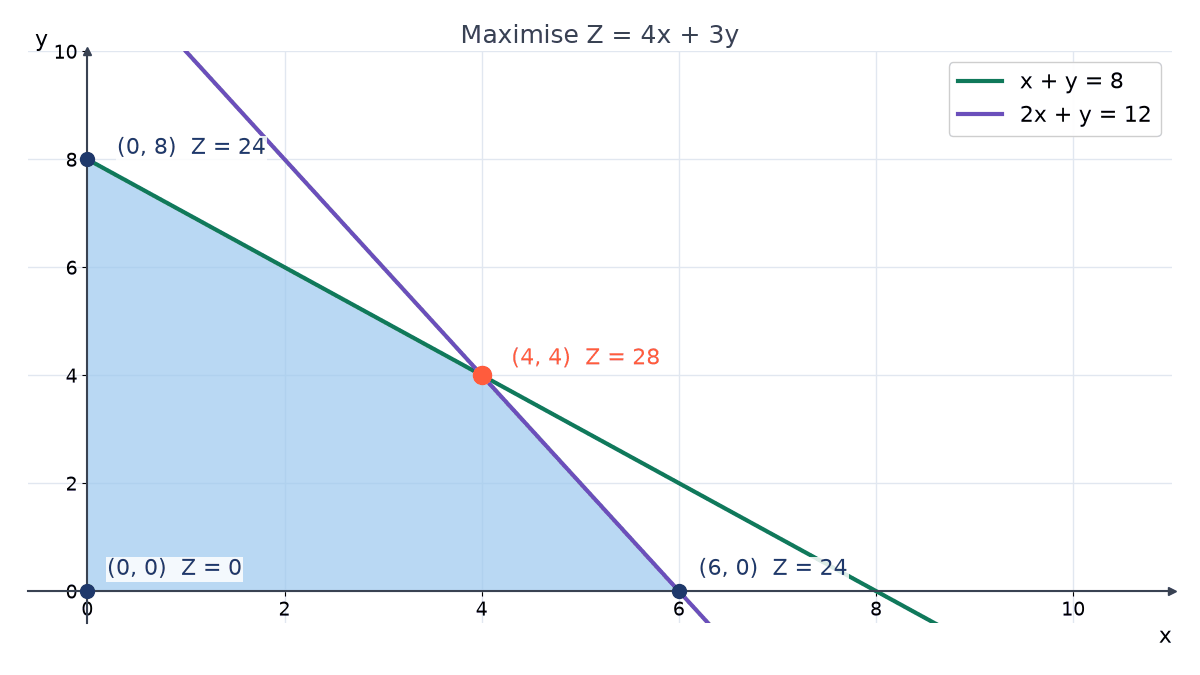
Example 1. Maximise subject to , , . The corners are , , , , giving . So the maximum is at .
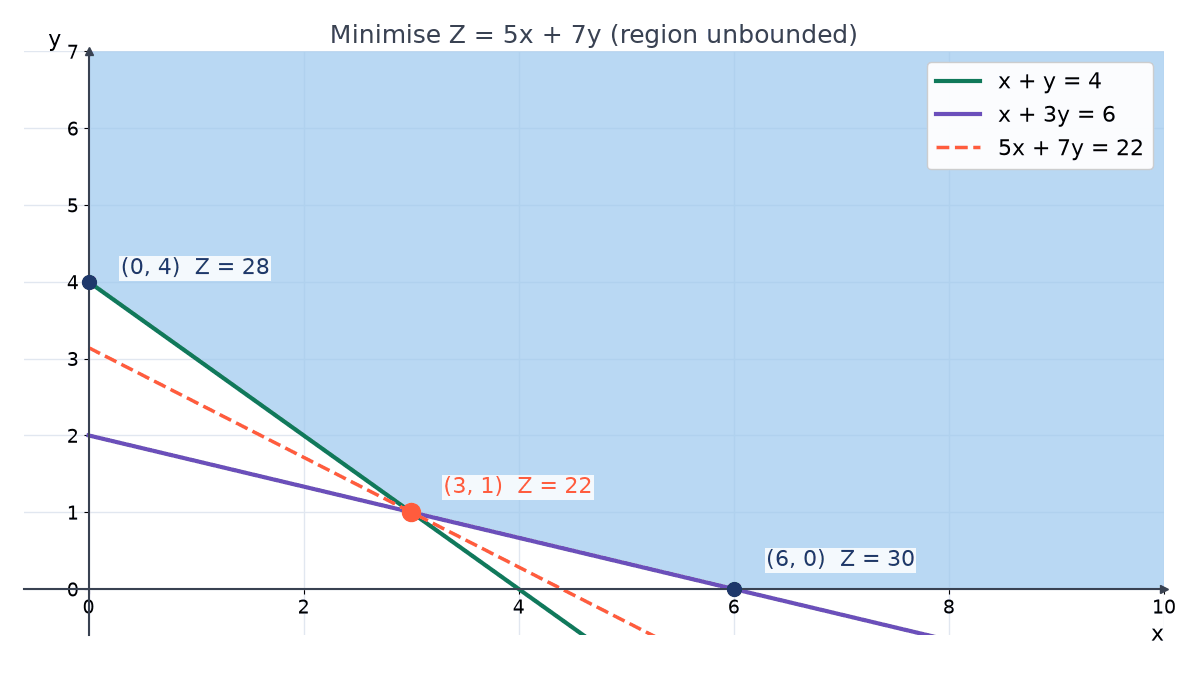
Example 2. Minimise subject to , , . This time the region is unbounded, with corners , , : . The candidate is , but we must check: the half-plane does not meet the region, so the minimum is at .
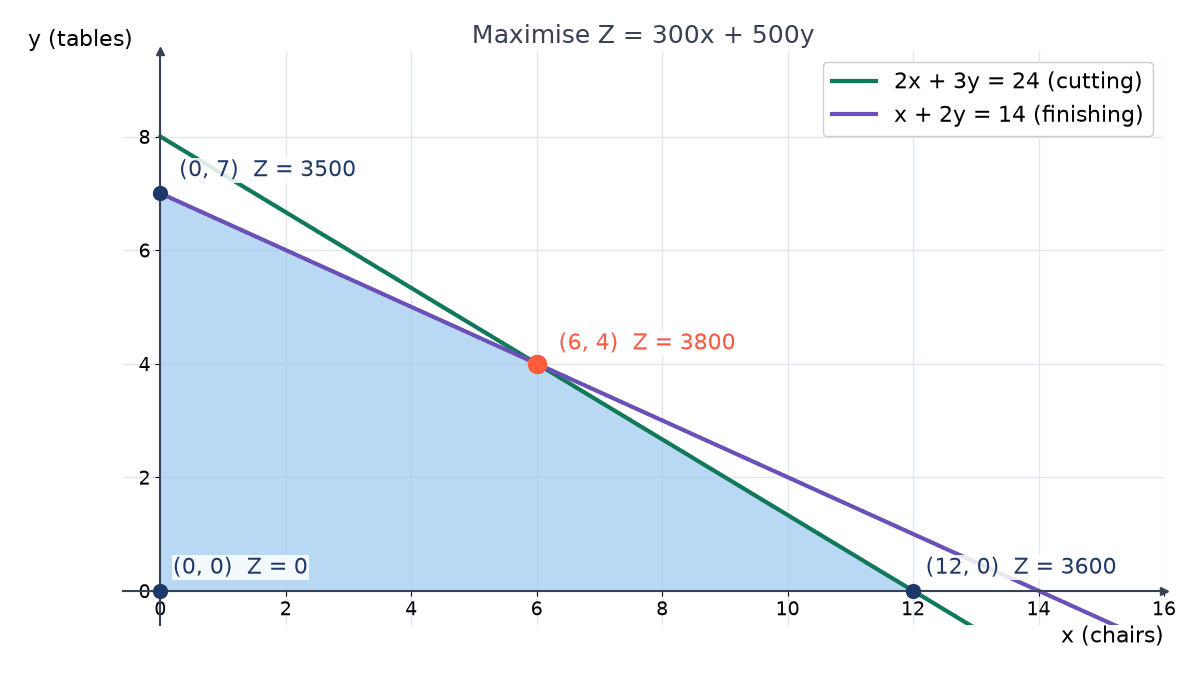
Example 3 (manufacturing). A workshop makes chairs (profit ₹) and tables (profit ₹). A chair needs h of cutting and h of finishing; a table h and h. There are h of cutting and h of finishing a day. Letting the two variables count chairs and tables, we must maximise subject to , , . The corners are , , , , with . So the workshop should make chairs and tables for ₹.
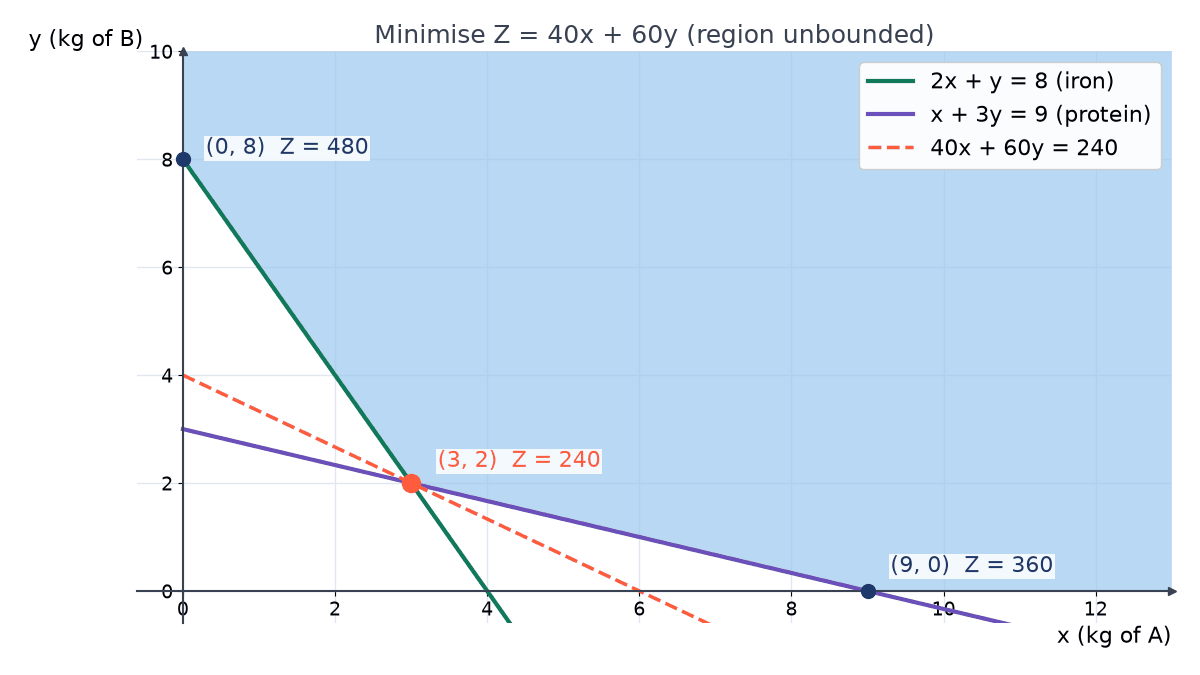
Example 4 (diet). Food A has units of iron and of protein per kg (₹/kg); food B has and (₹/kg). At least units of iron and of protein are needed. We minimise with , . The corners are , , : . Checking the half-plane finds no feasible points, so the minimum is ₹ with kg of A and kg of B.
Try these yourself
- Maximise subject to , , .
- Minimise subject to , , , .
- Maximise subject to , , , .
- Show that has no maximum subject to , , .
- A dealer has ₹ and room for items. Fans cost ₹ (profit ₹) and lamps ₹ (profit ₹). How many of each should she buy to maximise profit?
- A farmer has hectares for wheat and gram. Wheat earns ₹ and gram ₹ per hectare; wheat needs workers per hectare and gram , and workers are available. Find the best allocation.
- A mixture must contain at least units of vitamin A and of vitamin B. Food P has and units per packet (₹), food Q has and (₹). Find the cheapest mixture.
- Why must the optimum of a linear objective over a bounded polygon occur at a corner?
Answers to check against
Show answers
- Corners : : max at .
- Corners : : min at .
- Corners : : max at .
- The region is unbounded upward and grows without limit along for large .
- , : corners , , , ; profits , , , : buy fans and lamps.
- , : corners , , : , , : ha wheat, ha gram.
- , : corners , , : costs , , : packets of P and of Q, ₹.
- is constant along lines . Slide such a line across the region, and the last point it touches is always a corner.